 English
 Español
 العربية
Case Study: Transitioning a Beverage Line from Virgin PET to 50% rPET Without Output Loss
An Advanced Technical Analysis of Thermal Absorption Modification, Closed-Loop Servo Control, and Production Speed Retention in Sustainable Bottling Lines
1. Executive Summary & Production Challenge
A multinational beverage bottling enterprise aimed to convert its high-speed 500ml water bottling operations from 100% virgin PET to a 50% recycled PET (rPET) blend to comply with strict regional sustainability directives. However, early trials on legacy blow molding equipment resulted in a 18% loss in hourly production speed, unstable wall thickness distribution, elevated scrap rates, and frequent preform thermal degradation. Bangemachine was engaged as the primary engineering partner to upgrade the line architecture and optimize process parameters, ensuring a seamless transition without sacrificing nominal bottle-per-hour (BPH) output or structural performance.
2. Technical Hurdles in High-Speed rPET Processing
1. Enhanced Infrared Radiation Absorption
Due to subtle discoloration and micro-particle inclusion inherent to recycled resin, 50% rPET preforms exhibit a significantly higher infrared absorption coefficient than virgin PET. Under standard heating configurations, the outer preform skin overheated rapidly, causing surface crystallization (haze) and preform neck deformation while leaving the inner core under-conditioned.
2. Intrinsic Viscosity (IV) Instability and Material Distribution
Fluctuations in intrinsic viscosity (IV) across recycled preform lots compromised the material's natural stretch-hardening response during high-speed blowing. This led to localized wall thinning along bottle bases and shoulders, causing top-load structural failure during automated palletization.
3. Bangemachine Engineering Solutions
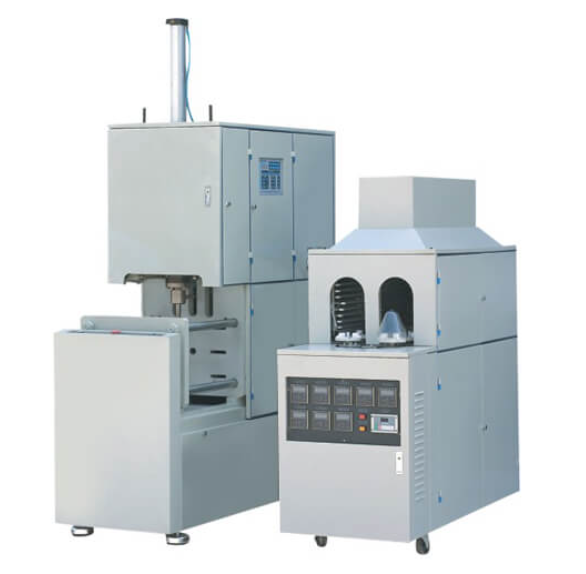
To preserve maximum rated production output while incorporating 50% rPET resin, Bangemachine integrated specialized hardware and control modifications into the stretch blow molding platform:
- Adaptive Multi-Zone Infrared Oven with Enhanced Convection: Reconfigured short-wave quartz lamps combined with high-velocity internal cooling air manifolds to prevent outer surface skin overheating, allowing radiant heat to soak deeply into the preform core.
- Dynamic Servo-Driven Stretch Kinematics: Implemented digital closed-loop servo controls for stretch rod descent and pre-blow timing, enabling microsecond adjustments that compensated for batch-to-batch IV variances automatically.
- Integrated Pyrometer Temperature Feedback: Deployed non-contact infrared sensors at the oven outlet to evaluate preform thermal profiles in real time, auto-modulating lamp power to maintain pinpoint thermal consistency.
4. Key Production Performance Metrics
| Performance Parameter | Legacy Line (50% rPET Trial) | Bangemachine Upgraded System |
|---|---|---|
| Line Production Output | Speed dropped by 18% (Sub-rated speed) | 100% Nominal Speed Retained (Zero Output Loss) |
| Container Scrap / Reject Rate | 6.8% (Thermal haze & thin walls) | < 0.4% Continuous Running Stability |
| Top-Load Structural Integrity | Inconsistent (Failures at high stacking) | Full Structural Compliance Matched to Virgin Baseline |
| Heating Oven Power Consumption | Baseline High Power | 14% Reduction (Utilized rPET higher heat absorption) |
5. Partner with Bangemachine for Sustainable Bottling Solutions
As a premier Chinese enterprise specializing in the research, development, and manufacturing of high-performance PET blow molding machines, Bangemachine provides industry-leading technical expertise, machinery retrofits, and turnkey factory integration. Whether converting existing packaging lines to high-percentage rPET or building high-speed greenfield plants, our expert engineering team ensures peak efficiency, minimum carbon footprint, and absolute operational reliability. Contact Bangemachine today to consult with our stretch blow molding specialists.