 English
 Español
 العربية
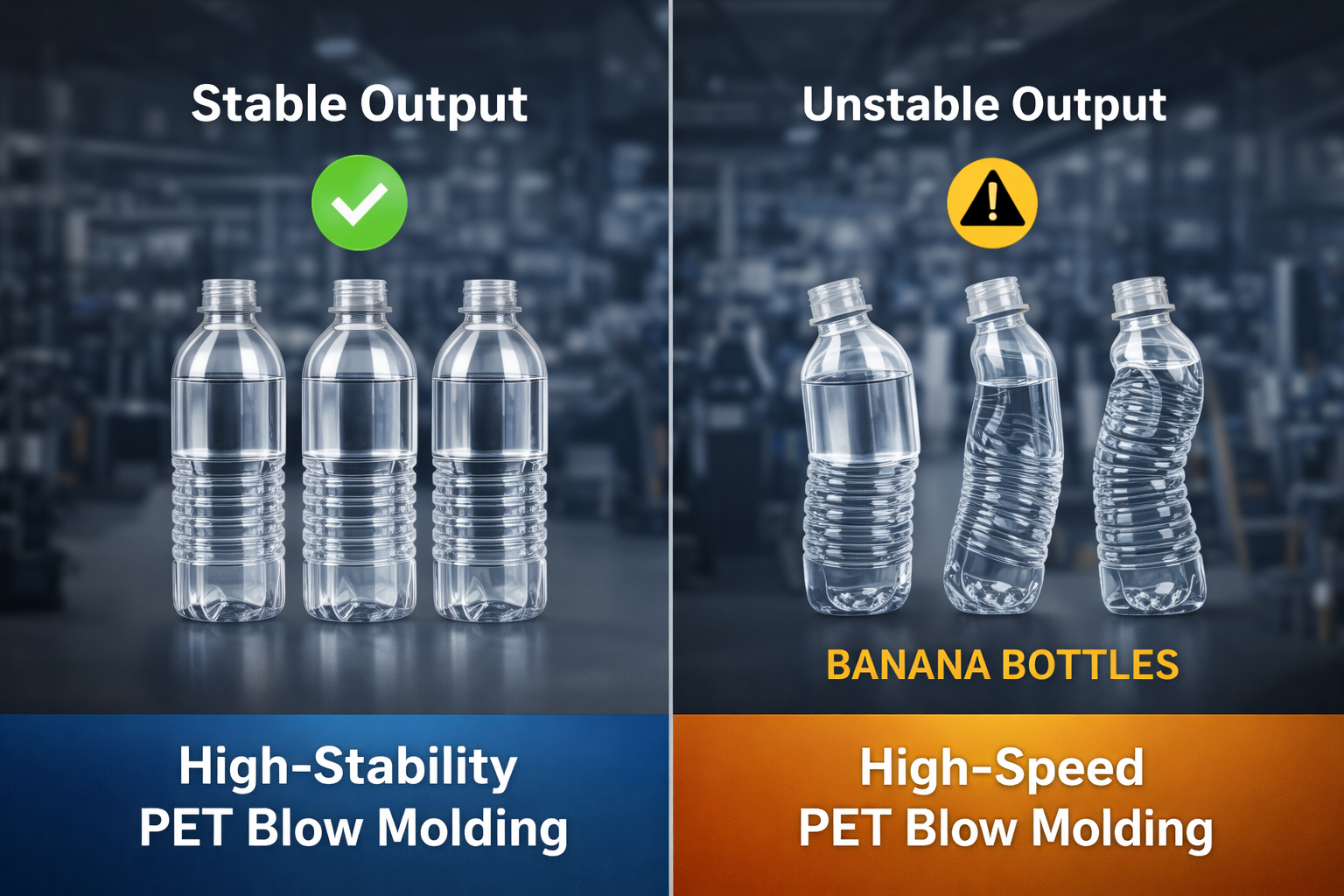
In the PET bottle manufacturing industry, many factories still focus heavily on one number when purchasing a blow molding machine:
Maximum BPH (Bottles Per Hour)
At first glance, higher speed sounds more profitable.
But after visiting many bottled water factories, edible oil packaging plants, and beverage production lines, we found that the real challenge in PET production is usually not speed itself.
The real challenge is:
long-term production stability.
Because in real factory environments, unstable production creates much bigger losses than slightly lower machine speed.
The Hidden Problems Behind “High-Speed Production”
Many PET factories experience problems such as:
- bottle deformation
- unstable bottle standing
- increasing reject rates
- random “banana bottles”
- air consumption fluctuations
- production stoppages
- unstable bottle transfer
- inconsistent bottle wall thickness
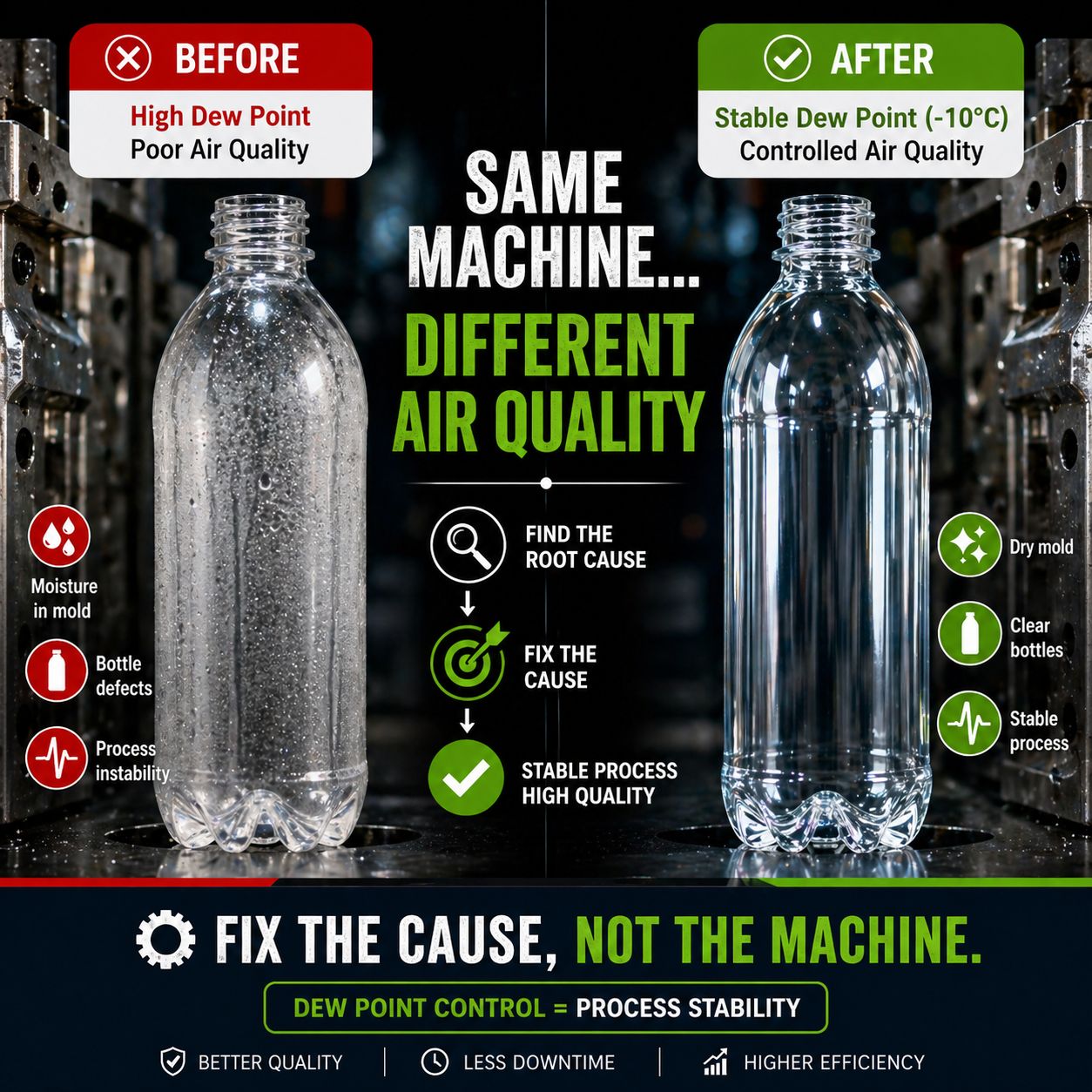
In many cases, factories initially believe the blow molding machine itself is the problem.
However, after deeper inspection, the real causes are often connected to the entire PET production system.
For example:
1. Preform Consistency Problems
Even small variations in:
- preform weight
- neck finish precision
- wall thickness distribution
can create instability during high-speed blowing.
At higher production speeds, these deviations become amplified.
2. Mold Cooling Imbalance
Uneven mold cooling can cause:
- inconsistent bottle shaping
- unstable crystallization
- bottle deformation after filling
Many factories underestimate how important cooling balance is for stable PET bottle production.
Especially in lightweight bottle projects.
3. Air Recovery System Instability
Compressed air is one of the highest operating costs in PET bottle manufacturing.
An unstable air recovery system can lead to:
- fluctuating blowing pressure
- unstable bottle quality
- increased energy consumption
This is why modern PET factories increasingly focus on energy-saving air recovery optimization.
4. Bottle Transfer Timing Deviation
At high production speeds, even small transfer timing deviations can create:
- bottle jams
- unstable conveying
- efficiency loss
- unexpected downtime
Over time, these “small” problems create major production losses.
PET Bottle Production Is A Complete System
One of the biggest misunderstandings in the industry is thinking that PET bottle production depends only on the blow molding machine.
In reality, stable production depends on coordination between:
- blow molding machine
- preform mold
- bottle design
- cooling system
- airflow stability
- transfer system
- operator settings
When these systems are not properly matched, even expensive equipment can become unstable.
This is why more factories are now focusing on:
integrated PET production solutions
instead of purchasing equipment from multiple unrelated suppliers.
Why Stability Creates Higher Long-Term Profitability
In real production environments, stable production creates:
✔ lower reject rates
✔ lower compressed air consumption
✔ fewer shutdowns
✔ more stable bottle quality
✔ easier lightweight bottle production
✔ more reliable delivery schedules
✔ lower maintenance costs
Because true profitability comes from:
continuous stable production
—not simply from theoretical machine speed.
The Future Of PET Bottle Manufacturing
As the PET packaging industry becomes more competitive, factories are increasingly focusing on:
- energy saving
- lightweight bottle optimization
- mold-machine compatibility
- long-term production reliability
- system coordination
- production efficiency optimization
In the future, factories that achieve stable, energy-efficient, and highly coordinated production systems will have a major competitive advantage.
Because in PET manufacturing: