 English
 Español
 العربية

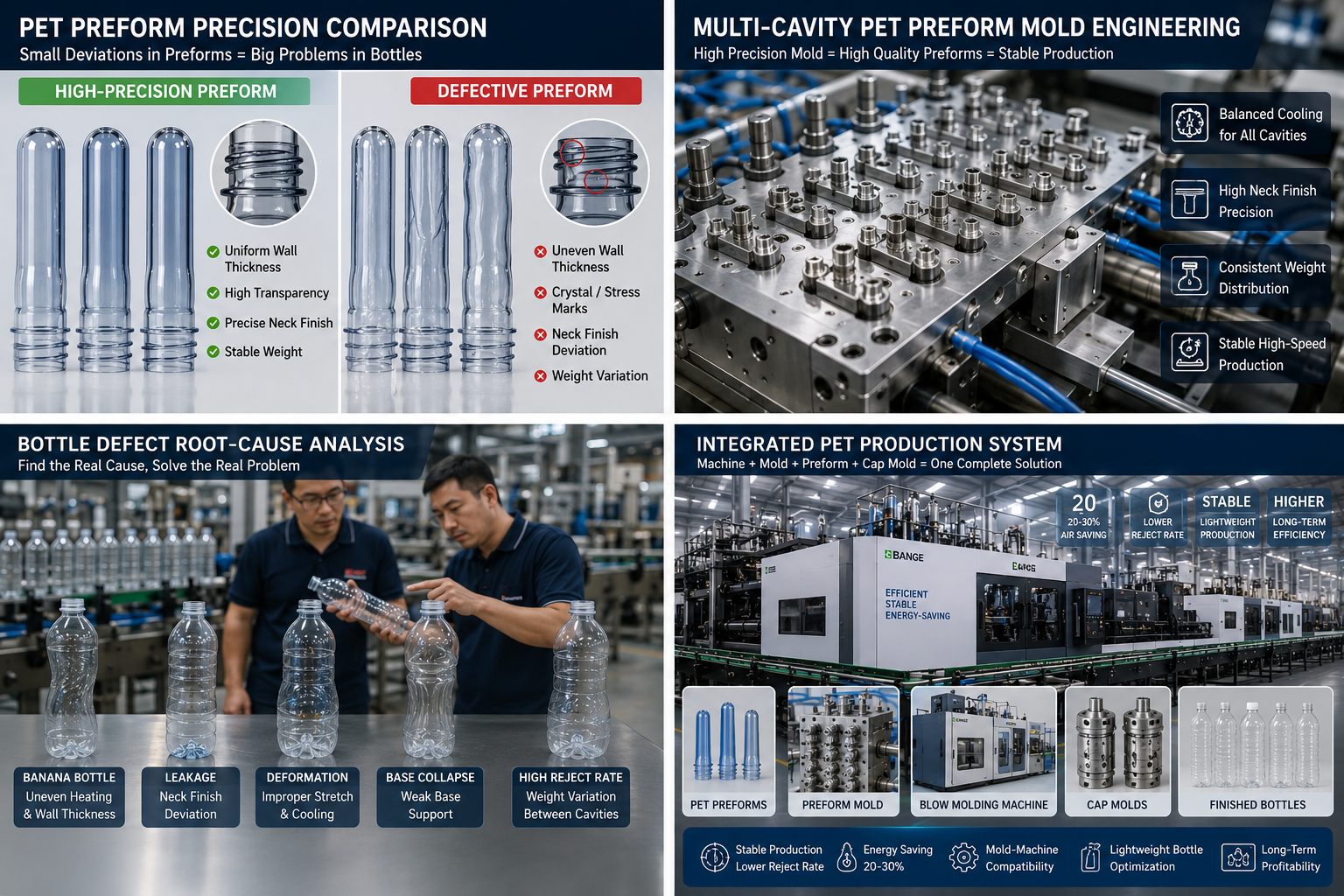
When PET bottle defects appear during production, many factories immediately adjust the blow molding machine parameters.
But after visiting many PET bottle factories, we found that:
many bottle problems actually begin before the blowing process even starts.
In one bottled water factory, the customer faced:
- unstable bottle wall thickness
- bottle deformation after filling
- random leakage problems
- inconsistent bottle transparency
- increasing reject rates at high speed
At first, operators repeatedly adjusted:
- heating temperature
- blowing pressure
- stretch timing
However, the production line remained unstable.
After deeper inspection, the real problem came from:
inconsistent PET preform quality.
This is one of the most overlooked issues in PET bottle manufacturing.
Because even the best blow molding machine cannot fully compensate for unstable preforms.
The Hidden Problems Inside PET Preforms
Many factories focus heavily on:
- machine speed
- automation
- output capacity
But underestimate the importance of:
preform consistency.
In high-speed PET production, even small preform deviations can create major instability.
1️⃣ Uneven Wall Thickness Distribution
If the preform wall thickness is uneven:
- bottle stretching becomes unstable
- bottle shoulder areas become weak
- bottle bases deform more easily
- transparency becomes inconsistent
This problem becomes much worse in lightweight bottle projects.
2️⃣ Neck Finish Precision Deviation
Poor neck finish precision can create:
- cap sealing problems
- leakage after filling
- unstable bottle transfer
- capping inconsistency
Many “cap problems” actually begin at the preform stage.
3️⃣ Poor Cooling During Preform Injection
Improper cooling can cause:
- internal stress
- crystallization imbalance
- unstable reheating performance
Later during blowing:
- bottle shape becomes inconsistent
- deformation risk increases
4️⃣ Weight Variation Between Cavities
In multi-cavity preform molds, unstable cavity balance creates:
- inconsistent bottle quality
- blowing pressure instability
- reject rate fluctuation
At high speed, these small differences create large long-term production losses.
PET Production Is A Precision Coordination Industry
Many factories still think:
“The blow molding machine determines bottle quality.”
But in reality:
stable PET bottle production depends on coordination between:
- preform mold
- injection quality
- bottle design
- blow molding machine
- mold cooling
- airflow stability
- transfer timing
This is why integrated PET solutions are becoming increasingly important for modern factories.
Why Integrated PET Solutions Improve Stability
When:
- machine supplier
- preform mold supplier
- cap mold supplier
all work independently,
production instability often increases.
Because:
- dimensions may not fully match
- thermal behavior differs
- cooling systems are not coordinated
- lightweight bottle optimization becomes difficult
Integrated system engineering helps factories achieve:
✔ lower reject rates
✔ stable bottle quality
✔ better cap sealing performance
✔ lower air consumption
✔ more stable lightweight bottle production
✔ higher long-term efficiency
In PET Manufacturing, Small Preform Deviations Create Big Production Losses
Factories often focus on visible machine problems.
But experienced PET engineers know:
stable bottle production usually begins with stable preforms.
Technical Insights & Root-Cause Analysis
Common Root Causes Of PET Bottle Instability
| Problem | Hidden Root Cause |
|---|---|
| Banana bottles | Uneven preform heating & wall thickness |
| Leakage | Neck finish precision deviation |
| Bottle collapse | Poor stretch ratio & preform consistency |
| High reject rate | Multi-cavity weight variation |
| Unstable transparency | Crystallization imbalance |
| Bottle transfer problems | Neck dimension inconsistency |
Practical Factory-Oriented Solutions
Recommended Optimization Priorities
1. Improve Preform Mold Precision
Focus on:
- cavity consistency
- cooling balance
- neck finish precision
2. Stabilize Injection Molding Conditions
Monitor:
- injection pressure
- cooling cycle
- resin temperature
- cavity filling balance
3. Optimize Lightweight Bottle Structure
Avoid excessive lightweighting without:
- cooling optimization
- airflow adjustment
- structural support analysis
4. Coordinate Mold + Machine Engineering
Treat:
- preform mold
- blow mold
- blowing system
as one complete engineering system.