 English
 Español
 العربية
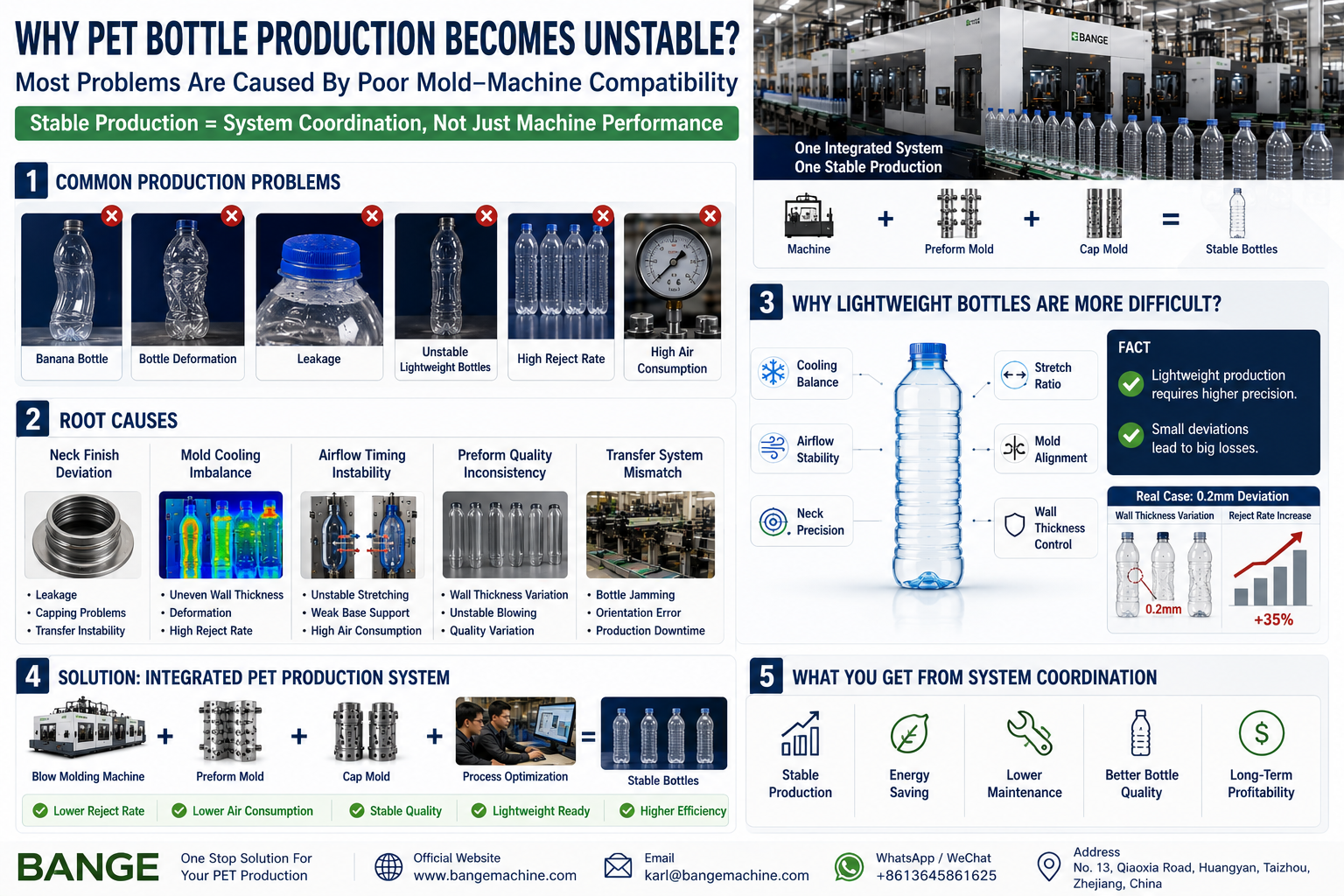
Many factories believe that buying a faster or more expensive blow molding machine will automatically improve production efficiency.
But in real PET bottle manufacturing, production stability depends on much more than machine speed.
Many common factory problems such as:
- banana bottles
- bottle deformation
- leakage
- unstable lightweight bottles
- high reject rates
- excessive air consumption
- unstable transfer systems
are often caused by poor coordination between the entire PET production system.
PET Bottle Manufacturing Is A System Engineering Process
Stable production requires coordination between:
- PET blow molding machine
- PET preform mold
- cap mold
- bottle design
- cooling system
- airflow stability
- transfer timing
When one part becomes unstable, the entire production line efficiency can decrease.
This is especially important during:
- high-speed production
- lightweight bottle manufacturing
- long-term continuous operation
Why Lightweight Bottle Production Is More Difficult
Many factories want to reduce bottle weight to save resin costs.
However, lightweight bottles require much higher production precision.
Even small deviations in:
- preform wall thickness
- mold cooling balance
- neck finish precision
- blowing pressure
- stretch timing
can create:
- bottle collapse
- unstable standing performance
- deformation after filling
- higher reject rates
This is why lightweight PET production is not simply about reducing material.
It is about:
maintaining stable production with smaller tolerance margins.
The Hidden Cost Of Production Instability
Many factories only calculate:
- machine cost
- resin cost
- electricity cost
But unstable production creates hidden losses through:
- downtime
- operator adjustments
- bottle rejects
- delivery delays
- compressed air waste
- maintenance frequency
Over time, these hidden losses often become much larger than the initial machine investment difference.
Why Mold-Machine Compatibility Matters
When molds and machines are purchased from unrelated suppliers, factories often face:
- airflow mismatch
- transfer instability
- inconsistent bottle dimensions
- cooling imbalance
- unstable lightweight bottle performance
Integrated PET production systems help improve:
✔ bottle consistency
✔ energy-saving performance
✔ production efficiency
✔ long-term stability
✔ lower reject rates
Because PET manufacturing efficiency depends on:
system coordination rather than individual machine performance.
Modern PET Factories Are Focusing On Long-Term Stability
Today, more factories are prioritizing:
- stable continuous production
- energy-saving air systems
- lightweight bottle optimization
- integrated mold-machine solutions
- lower reject rates
- easier maintenance
Because in modern PET packaging production: