 English
 Español
 العربية
Many bottles look completely acceptable after blowing.
Clear appearance.
Correct shape.
No visible deformation.
But once they enter the filling line, problems suddenly begin appearing.
Cap leakage.
Bottle tilting.
Conveyor instability.
Unexpected burst during filling.
High rejection rates.
Why?
Because visual inspection alone cannot fully evaluate PET bottle stability.
At BANGEMACHINE, we often explain this to factories:
A bottle that looks “good” is not always a bottle that is “process stable.”
The real challenge begins when the bottle enters high-speed downstream production.
This is where hidden dimensional and structural instability becomes amplified.
Especially during:
Carbonated filling
Hot filling
High-speed capping
Long-distance conveying
Shrink labeling
Pallet stacking
One common root cause is uneven wall thickness distribution.
If certain bottle areas become too thin during stretching, the bottle may survive blowing — but fail under filling pressure or conveyor load.
Another overlooked factor is neck finish tolerance drift.
Even tiny dimensional variation can create:
Cap torque inconsistency
Micro leakage
Bottle wobbling
Misalignment during labeling
At high production speeds, these small defects become cumulative operational losses.
We also frequently observe problems caused by thermal-memory effects.
If cooling balance is unstable, residual stress remains trapped inside the bottle structure.
Initially, the bottle may appear normal.
But after filling or transportation, deformation gradually becomes visible.
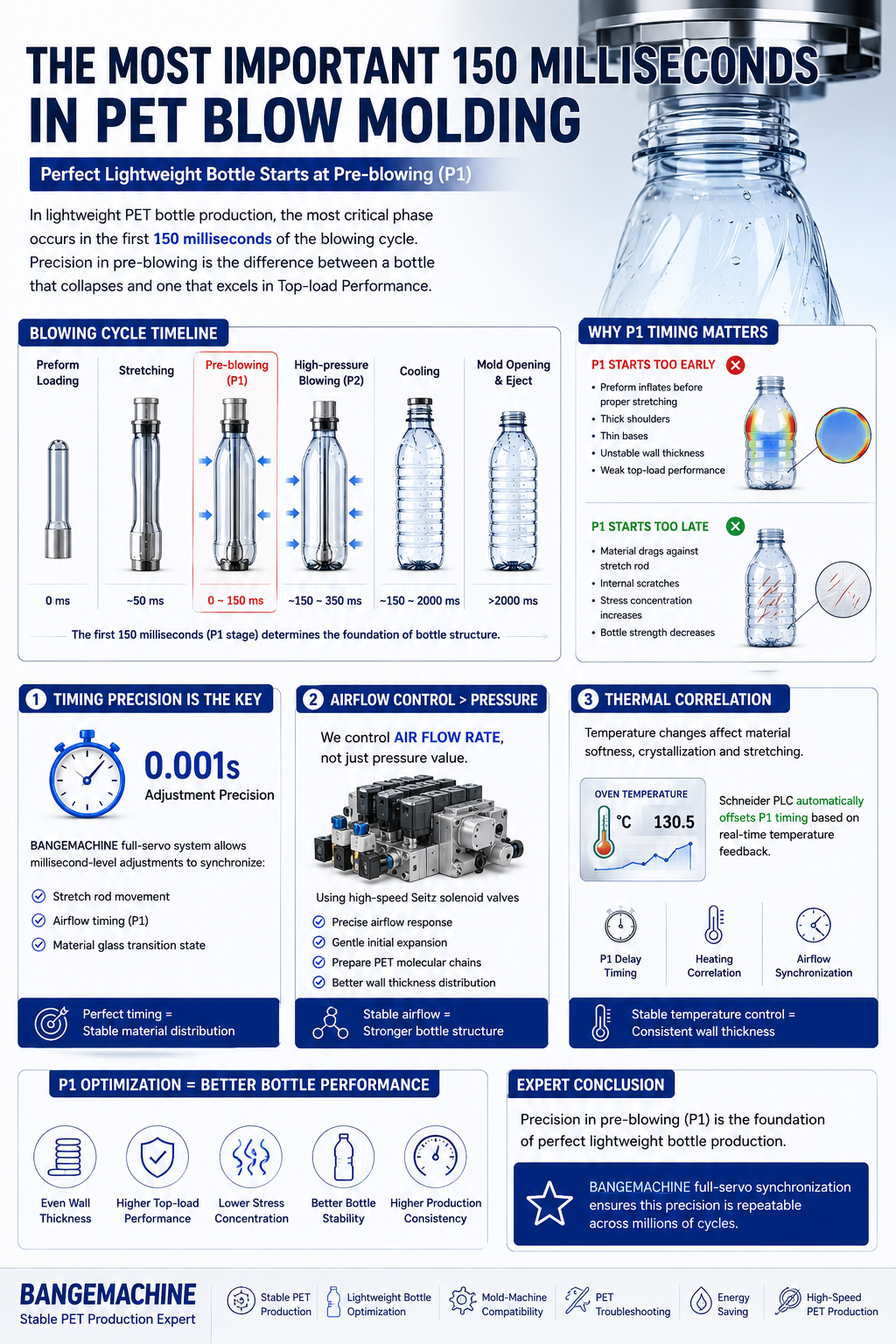
This is why stable PET production must be evaluated as a complete system:
Heating stability
Stretch synchronization
Pressure curve control
Cooling balance
Neck precision
Mold-machine compatibility
At BANGEMACHINE, we do not only focus on bottle appearance.
We focus on how the bottle performs during real industrial production conditions.
Because the true value of PET engineering is not making bottles that simply “look acceptable.”
It is producing bottles that remain stable across the entire production chain.