 English
 Español
 العربية

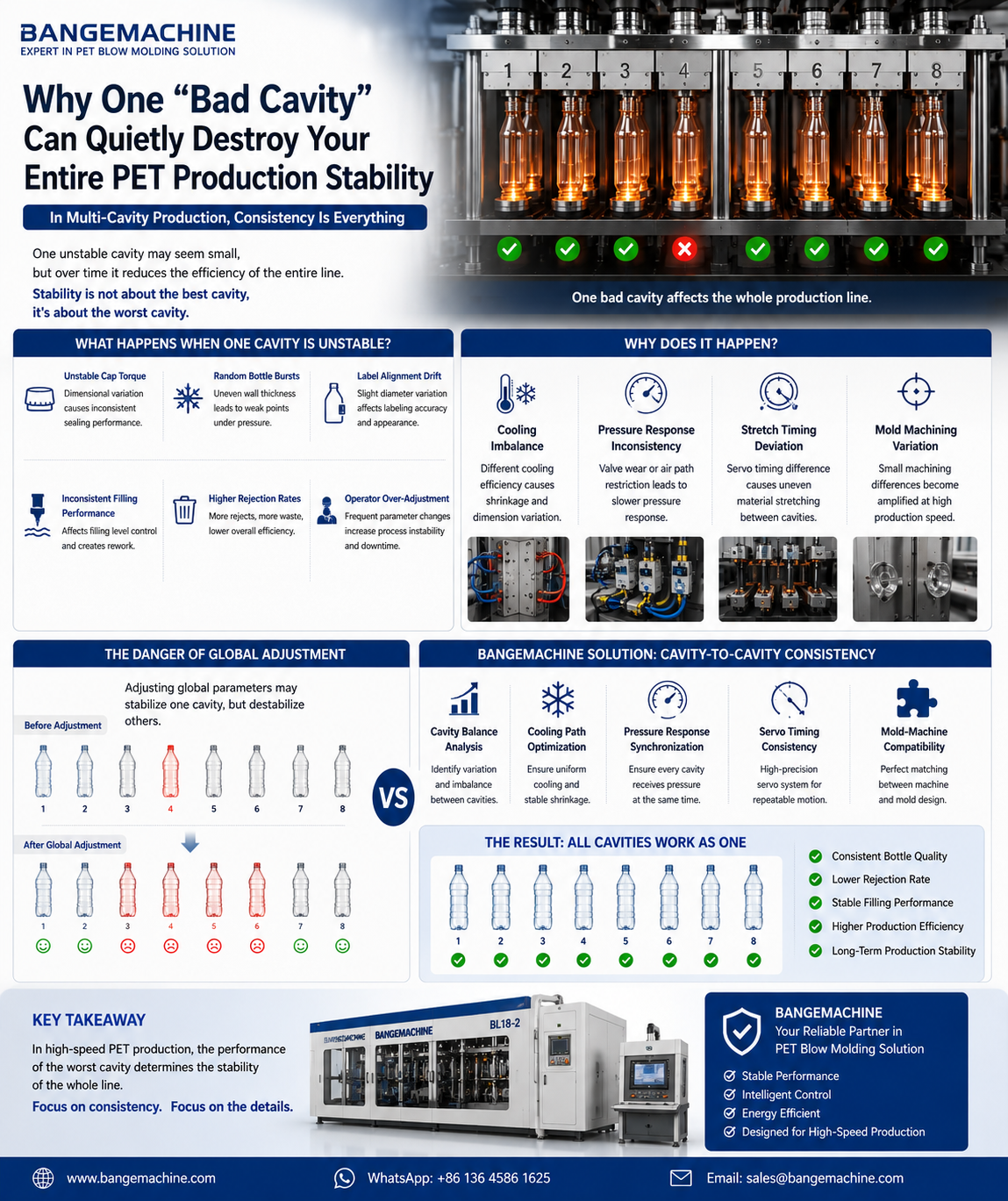
in high-speed PET production, consistency is everything.
Many factories believe that if only one cavity produces unstable bottles, the issue is small.
But in reality:
ONE UNSTABLE CAVITY CAN REDUCE THE STABILITY OF THE ENTIRE LINE.
Especially in multi-cavity, high-speed PET production systems.
WHAT FACTORIES USUALLY SEE
At first, the problem may look minor:
- Slight bottle variation
- Random cap leakage
- Occasional bottle burst
- Label alignment drift
- Small dimensional differences
But over time, these “small problems” become:
HIGHER REJECTION RATES
FILLING LINE INSTABILITY
OPERATOR OVER-ADJUSTMENT
LOWER OVERALL PRODUCTION EFFICIENCY
THE REAL PROBLEM: CAVITY-TO-CAVITY INCONSISTENCY
In PET production, stability is not determined by the best cavity.
IT IS DETERMINED BY THE WORST CAVITY.
Even tiny differences between cavities become amplified during continuous high-speed production.
Especially above:
18,000–28,000 BPH
At these speeds, the production tolerance window becomes extremely small.
ROOT CAUSE #1 — CAVITY COOLING IMBALANCE
If cooling efficiency differs between cavities:
- PET shrinkage becomes inconsistent
- Wall thickness distribution changes
- Neck finish precision drifts
- Base crystallization behavior becomes unstable
Result:
DIFFERENT BOTTLES FROM DIFFERENT CAVITIES
Even if the mold visually appears “normal.”
ROOT CAUSE #2 — PRESSURE RESPONSE INCONSISTENCY
If one blowing station responds slower because of:
- Valve wear
- Air path restriction
- Air recovery instability
Then the stretching sequence changes slightly.
This creates:
CAVITY-SPECIFIC PROCESS DRIFT
At low speed, this may remain hidden.
At high speed, it becomes a production problem.
ROOT CAUSE #3 — STRETCH TIMING DEVIATION
Even a very small servo timing difference can affect:
- Material orientation
- Wall thickness distribution
- Bottle symmetry
- Base stability
This is especially dangerous during:
LIGHTWEIGHT BOTTLE PRODUCTION
Because lightweight bottles have a smaller process tolerance range.
THE BIGGEST MISTAKE FACTORIES MAKE
When one cavity becomes unstable, many factories adjust global machine parameters.
This may temporarily stabilize one cavity.
But often:
IT DESTABILIZES ALL THE OTHER CAVITIES.
This creates continuous process drift across the machine.
HOW BANGEMACHINE SOLVES THIS
At BANGEMACHINE, we focus on:
CAVITY BALANCE ENGINEERING
Including:
- Cooling path optimization
- Pressure response synchronization
- Servo timing consistency
- Mold-machine compatibility
- Multi-cavity thermal stability
Because true PET production stability requires: