 English
 Español
 العربية

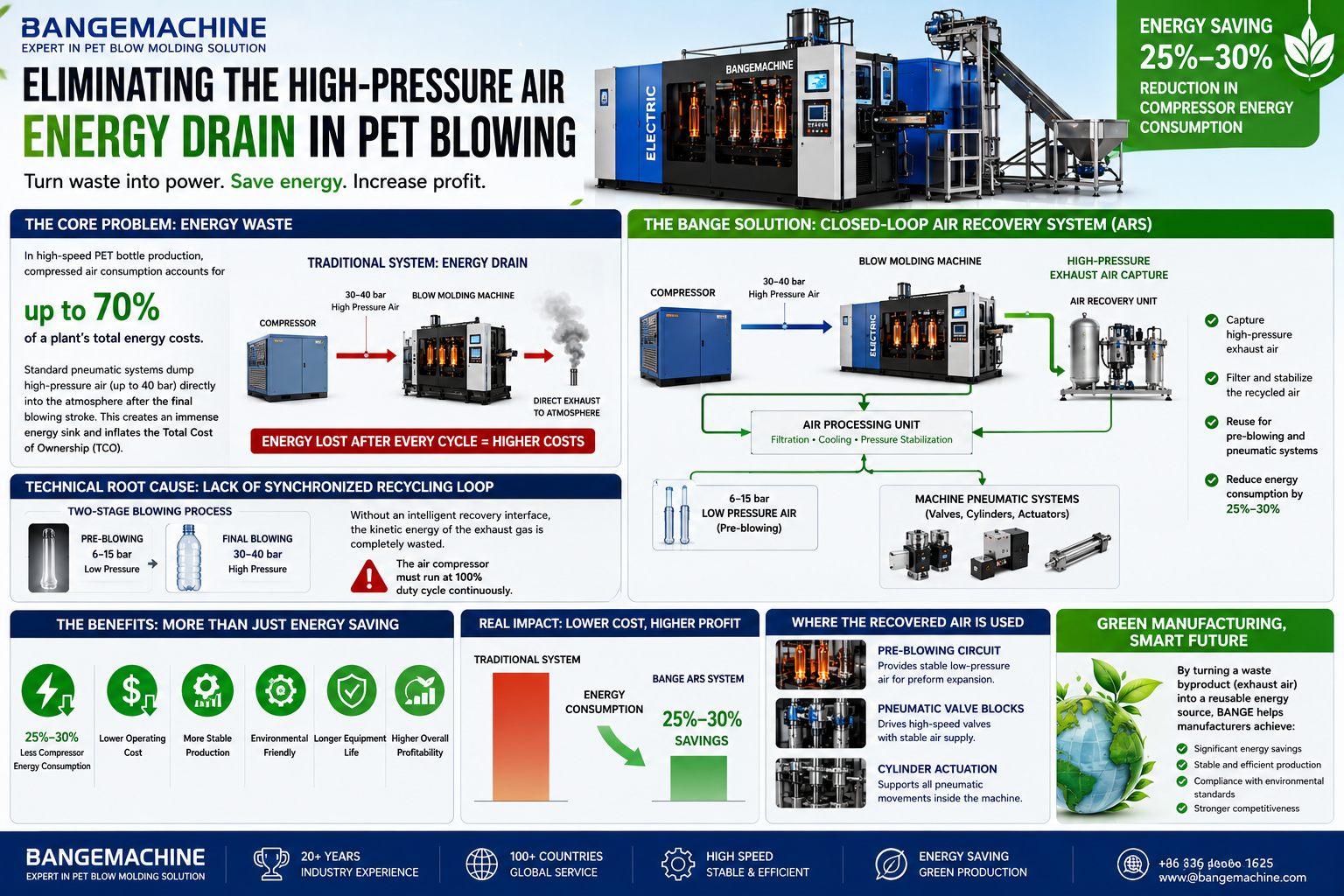
In PET bottle production, compressed air is not just a utility.
It is one of the largest hidden operating costs inside the factory.
In many high-speed PET blowing plants:
COMPRESSED AIR ACCOUNTS FOR UP TO 70% OF TOTAL ENERGY CONSUMPTION
Yet most traditional blowing systems still waste enormous amounts of usable high-pressure air during every production cycle.
Especially during:
HIGH-SPEED PET PRODUCTION
LIGHTWEIGHT BOTTLE MANUFACTURING
MULTI-CAVITY OPERATION
THE REAL PROBLEM: HIGH-PRESSURE AIR ENERGY DRAIN
During the final blowing stage, PET bottles require:
30–40 BAR HIGH-PRESSURE AIR
After bottle formation is completed, traditional pneumatic systems immediately discharge this air into the atmosphere.
Meaning:
THE ENERGY IS COMPLETELY LOST AFTER EVERY CYCLE
At high production speeds, this becomes a massive long-term energy sink.
The result is:
HIGHER ELECTRICITY COST
CONTINUOUS COMPRESSOR OVERLOAD
HIGHER MACHINE TCO
UNSTABLE AIR SUPPLY
INCREASED MAINTENANCE PRESSURE
Many factories focus only on machine purchase price.
But over years of operation:
AIR SYSTEM INEFFICIENCY BECOMES FAR MORE EXPENSIVE THAN THE MACHINE ITSELF
WHY TRADITIONAL SYSTEMS WASTE SO MUCH ENERGY
The core issue is:
THERE IS NO SYNCHRONIZED AIR RECOVERY LOOP
In PET blowing, the process normally includes:
PRE-BLOWING (6–15 BAR)
FINAL HIGH-PRESSURE BLOWING (30–40 BAR)
Traditional systems treat these two pressure stages separately.
High-pressure exhaust air is vented directly outside after final blowing.
Meanwhile, the machine still relies on compressors to continuously generate fresh low-pressure air for:
- Pre-blowing
- Pneumatic valves
- Cylinder movements
- Internal actuator systems
This creates:
CONSTANT COMPRESSOR FULL-LOAD OPERATION
Especially during 24-hour high-speed production.
THE BANGEMACHINE AIR RECOVERY ENGINEERING SOLUTION
At BANGEMACHINE, we treat compressed air as a reusable production resource — not disposable exhaust.
Our solution:
CLOSED-LOOP AIR RECOVERY SYSTEM (ARS)
Integrated directly into the pneumatic manifold system.
HOW THE SYSTEM WORKS
STEP 1 — HIGH-PRESSURE AIR CAPTURE
After final blowing, the remaining high-pressure exhaust air is collected instead of vented.
This recovered air still contains valuable kinetic energy.
STEP 2 — MULTI-STAGE FILTRATION & PRESSURE STABILIZATION
The recycled air passes through:
- Dedicated filtration units
- Pressure stabilization chambers
- Flow synchronization interfaces
This ensures:
CLEANER AIRFLOW
STABLE PRESSURE RESPONSE
LOWER PRESSURE FLUCTUATION
Especially during high-speed continuous production.
STEP 3 — DUAL-USE ENERGY OPTIMIZATION
Instead of wasting the recovered air, BANGEMACHINE reuses it to support:
LOW-PRESSURE PRE-BLOWING CIRCUITS
PNEUMATIC VALVE BLOCKS
CYLINDER ACTUATION SYSTEMS
Meaning:
THE SAME AIR IS USED MULTIPLE TIMES INSIDE THE MACHINE
This dramatically reduces compressor workload.
WHY THIS MATTERS IN REAL PET PRODUCTION
Energy saving is not only about reducing electricity usage.
It also improves:
AIR RECOVERY STABILITY
PRESSURE CURVE CONSISTENCY
HIGH-SPEED PROCESS SYNCHRONIZATION
THERMAL-PRESSURE BALANCE
LONG-TERM MACHINE RELIABILITY
Because unstable air supply often creates hidden production problems:
- Wall thickness variation
- Base instability
- Stretch timing mismatch
- Pressure response delay
- Bottle inconsistency
At high production speeds, even small pressure fluctuations become amplified.
REAL FACTORY BENEFITS
With BANGEMACHINE Air Recovery Engineering:
COMPRESSOR ENERGY CONSUMPTION CAN BE REDUCED BY 25–30%
Factories also benefit from:
LOWER OPERATING COST
REDUCED COMPRESSOR LOAD
MORE STABLE BLOWING PERFORMANCE
LOWER SCRAP RATE
LONGER EQUIPMENT LIFE
Most importantly: