 English
 Español
 العربية

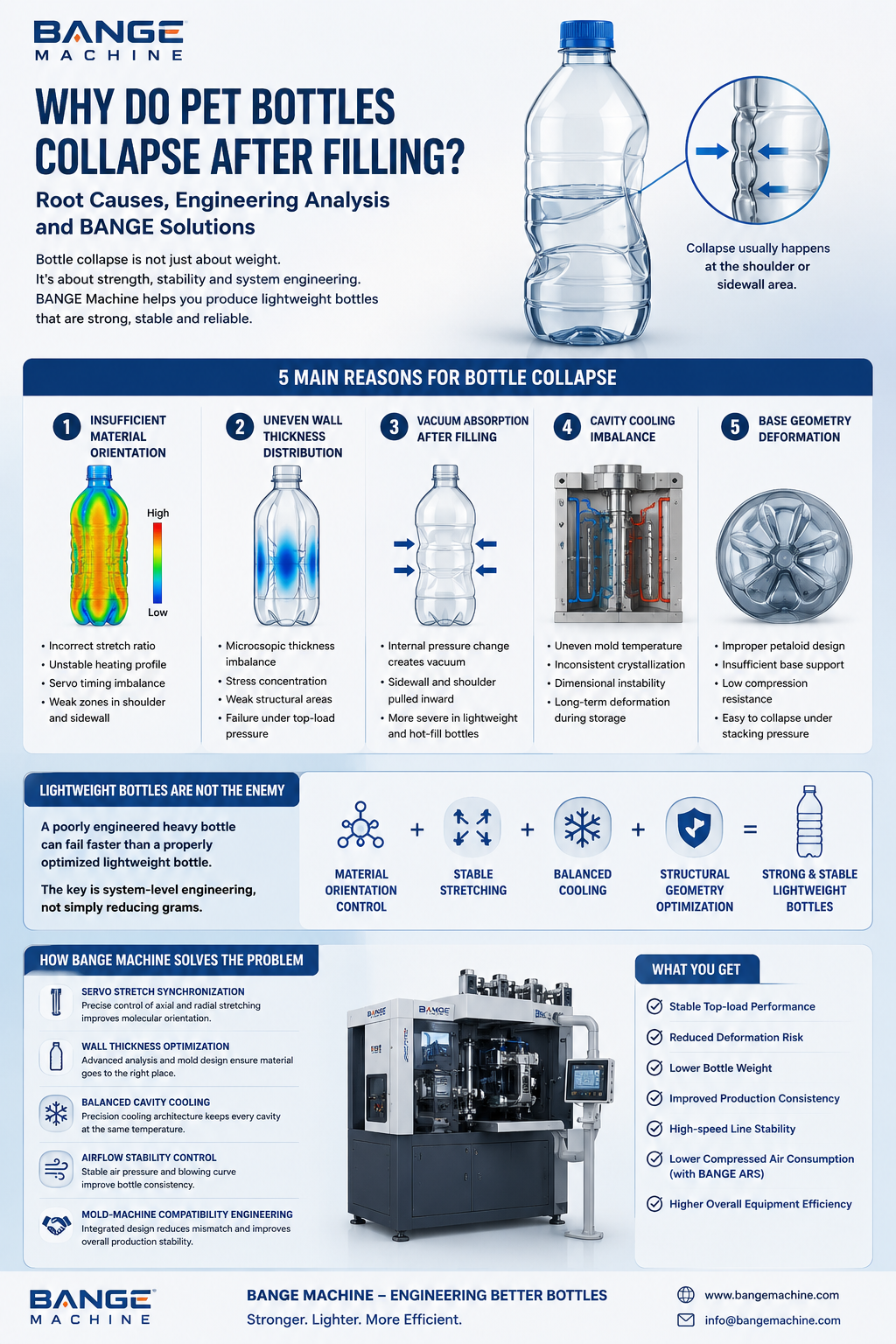
Why Do PET Bottles Collapse After Filling?
The Real Problem Is Usually Not the Bottle Weight
In PET bottle production, many manufacturers assume that bottle collapse after filling is caused by “lightweighting too aggressively.”
But in most high-speed production lines, the root cause is not simply bottle weight reduction.
The real issue is usually a combination of:
- Poor material orientation
- Uneven wall thickness distribution
- Vacuum instability after filling
- Shoulder crystallization weakness
- Base geometry deformation
- Cooling imbalance during blowing
At BANGE Machine, we’ve seen factories reduce bottle weight by 1–2 grams successfully — while other plants experience pallet collapse even with heavier bottles.
The difference is not the resin.
The difference is process engineering.
Why PET Bottles Collapse After Filling
1. Insufficient Material Orientation
PET bottles rely on biaxial molecular orientation to achieve structural rigidity.
During the blowing process, the material must stretch correctly in both:
- Axial direction
- Radial direction
If the servo stretching timing is unstable, or the infrared heating profile is uneven, part of the PET material remains insufficiently oriented.
This creates weak zones inside the bottle structure.
The most common failure area is:
- Shoulder transition zone
- Upper body panel
- Vacuum-sensitive sidewall area
Under pallet stacking pressure or hot filling conditions, these weak areas begin deforming first.
At BANGE Machine, our Servo Stretch Synchronization System is designed to stabilize molecular orientation during high-speed production, especially for lightweight bottle applications.
2. Uneven Wall Thickness Distribution
Many bottle failures begin with microscopic thickness imbalance.
Even if the bottle visually appears normal, non-uniform material distribution creates localized stress concentration points.
Typical causes include:
- Incorrect preform design
- Poor stretch ratio
- Unstable blowing pressure curve
- Transfer timing mismatch
- Inconsistent reheating
When one section becomes too thin, the bottle loses compression resistance.
This is why some bottles fail top-load testing even though average bottle weight remains within specification.
BANGE Machine uses Wall Thickness Distribution Analysis during bottle development to redistribute material precisely into critical structural zones.
Instead of adding more resin, we optimize where the material goes.
3. Vacuum Absorption After Filling
After hot filling or capping, internal pressure changes create vacuum forces inside the bottle.
If the bottle base and sidewall geometry are not optimized, the structure begins pulling inward.
This often appears as:
- Sidewall panel collapse
- Shoulder shrinkage
- Base instability
- Bottle leaning during conveyor transport
This problem becomes more severe in:
- Lightweight bottles
- Large-volume bottles
- High-speed filling lines
At BANGE Machine, we optimize:
- Petaloid base geometry
- Vacuum resistance structure
- Cooling stability
- Material transition zones
to improve bottle rigidity without increasing bottle weight excessively.
4. Cavity Cooling Imbalance
One overlooked factor in PET bottle collapse is thermal instability inside the blow mold.
If cavity cooling is unbalanced, bottles may leave the mold with inconsistent crystallization and residual internal stress.
Even a small cavity temperature deviation can create:
- Uneven shrinkage
- Dimensional instability
- Structural weakness
- Long-term deformation during storage
This issue is especially dangerous in high-cavity, high-speed PET production systems.
BANGE Precision Cooling Architecture is designed to maintain balanced thermal exchange across all cavities, helping stabilize bottle geometry and long-term stacking performance.
Lightweight Bottles Are Not the Enemy
Many factories believe heavier bottles are automatically safer.
In reality:
A poorly engineered heavy bottle can fail faster than a properly optimized lightweight bottle.
The key is not simply reducing grams.
The key is:
- Material orientation control
- Stable stretching
- Balanced cooling
- Structural geometry optimization
- Mold-machine compatibility
This is why successful lightweight bottle production requires system-level engineering, not isolated machine adjustments.
How BANGE Machine Helps Stabilize Lightweight PET Production
BANGE Machine integrates:
- Servo Stretch Synchronization
- Balanced Cavity Cooling
- Wall Thickness Optimization
- Airflow Stability Control
- Mold-Machine Compatibility Engineering
to help PET manufacturers achieve:
- Stable top-load performance
- Reduced deformation risk
- Lower bottle weight
- Improved production consistency
- High-speed line stability
Our goal is not only to produce bottles faster.
Our goal is to help factories produce lightweight bottles safely, consistently, and profitably.
Final Thought
When PET bottles collapse after filling, the bottle itself is usually only the symptom.
The real issue often lies deeper inside the interaction between:
- material behavior,
- thermal management,
- stretch dynamics,
- cooling balance,
- and structural engineering.
In modern PET production, stability is no longer determined by machine speed alone.
It is determined by how precisely the entire system works together.