 English
 Español
 العربية

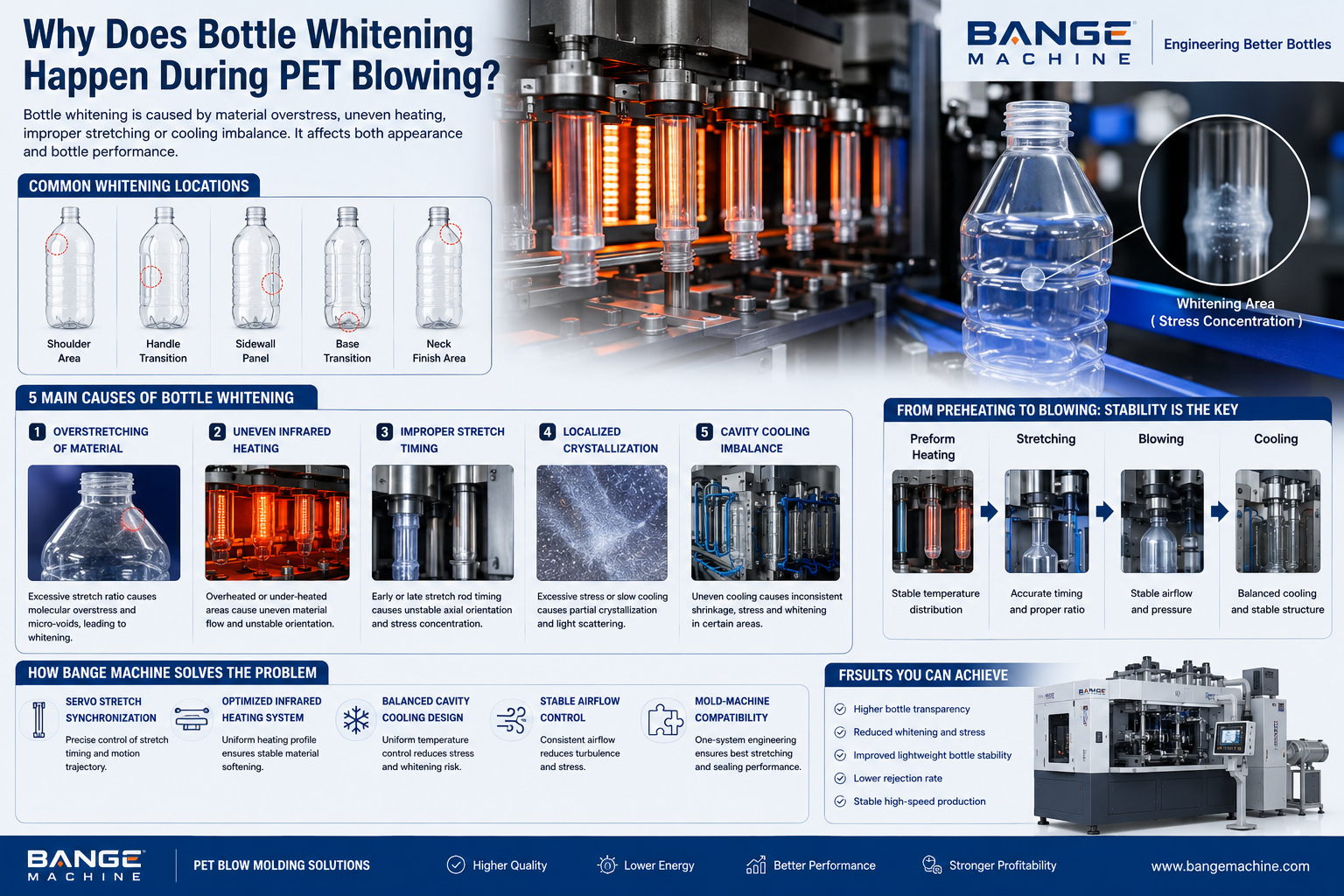
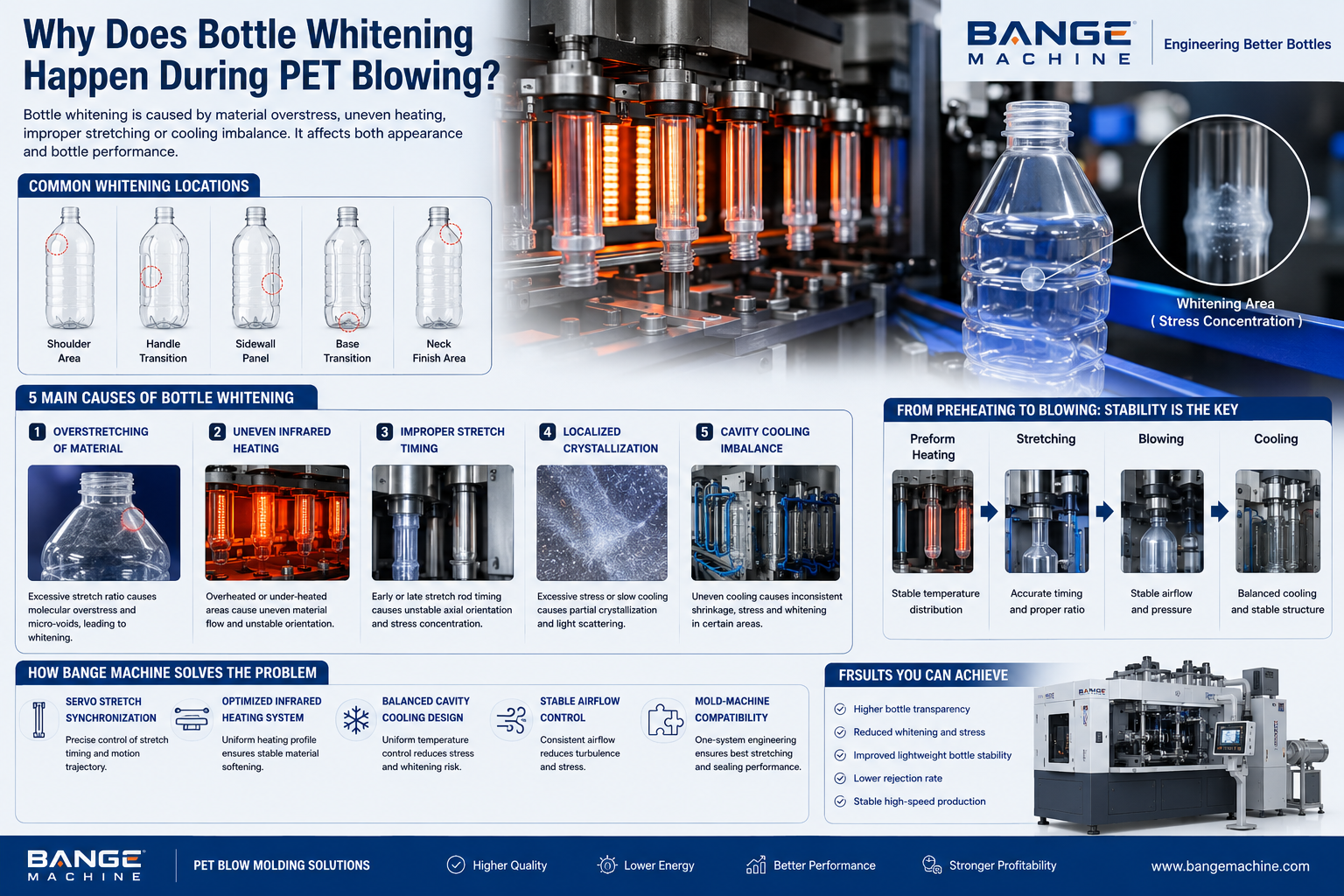
Why Does Bottle Whitening Happen During PET Blowing?
Whitening Is Not Just a Surface Defect
In PET bottle production, whitening is often treated as a cosmetic issue.
But in reality, bottle whitening is usually a warning signal of internal material stress and process instability.
When whitening appears during blowing, the problem is often much deeper than appearance alone.
It can indicate:
- Excessive molecular stress
- Overstretching during blowing
- Thermal imbalance
- Improper material orientation
- Infrared heating inconsistency
- Stretch timing mismatch
- Localized crystallization instability
At BANGE Machine, we view whitening not as an isolated defect, but as a symptom of unstable PET process engineering.
What Actually Causes PET Bottle Whitening?
1. Overstretching of PET Material
The most common cause of whitening is overstretching beyond the material’s orientation limit.
During the blowing process, PET material must stretch in a controlled biaxial direction.
If the stretch ratio becomes excessive in one localized area, the molecular chains become overstressed.
This creates:
- Microvoid formation
- Light scattering inside the material
- Visible white marks
- Stress concentration zones
The whitening usually appears in:
- Bottle shoulder
- Handle transition area
- Sharp geometry corners
- Base transition zones
This is especially common in:
- Aggressive lightweight bottle designs
- High-speed production
- Poorly optimized preform geometry
At BANGE Machine, our Servo Stretch Synchronization System helps stabilize axial stretching timing to reduce localized overstress during high-speed PET production.
2. Uneven Infrared Heating Profile
PET reheating consistency is critical before blowing.
If one section of the preform becomes overheated while another remains under-heated, the material stretches unevenly.
This creates unstable molecular orientation behavior.
Typical symptoms include:
- Random whitening patterns
- One-sided whitening
- Shoulder haze
- Neck transition whitening
- Inconsistent bottle transparency
Many factories incorrectly increase blowing pressure to solve this problem.
But the actual issue is often thermal imbalance before stretching even begins.
BANGE Machine uses optimized infrared heating architecture to maintain stable temperature distribution across the entire preform body.
Because stable stretching starts with stable heating.
3. Improper Stretch Rod Timing
In high-speed PET blowing systems, stretch timing synchronization becomes extremely important.
If the stretch rod enters too early or too late:
- Material flow becomes unstable
- Axial orientation becomes inconsistent
- PET stress distribution becomes uneven
This frequently creates whitening near:
- Bottle shoulder
- Gate area
- Lower body transition
At very high production speeds, even small timing deviations can amplify material stress dramatically.
This is why BANGE integrates servo-controlled stretching profiles to stabilize orientation consistency during continuous high-speed operation.
4. Localized Crystallization Instability
PET material naturally tends toward crystallization under excessive thermal or mechanical stress.
When certain areas experience:
- Excessive temperature
- Overstretching
- Slow cooling
- Thermal concentration
the material begins partially crystallizing.
This changes the optical behavior of the PET and creates the visible whitening effect.
But the real danger is structural.
Whitened areas often become:
- More brittle
- Less impact resistant
- More vulnerable to cracking
- Less stable during filling and transport
This is why whitening should never be treated as “only visual.”
It often signals deeper mechanical instability inside the bottle structure.
Why Lightweight Bottles Are More Sensitive to Whitening
As bottle weight decreases, process tolerance becomes much smaller.
There is less material available to absorb:
- Stretching stress
- Thermal fluctuation
- Airflow instability
- Cooling variation
This means lightweight bottle production requires much more precise control over:
- Stretch ratio
- Heating profile
- Blowing curve
- Cooling balance
- Material distribution
At BANGE Machine, our Lightweight Bottle Optimization System focuses on stabilizing the entire blowing process instead of simply increasing machine speed.
Because lightweight production without process stability eventually creates rejection costs elsewhere.
Why Whitening Often Appears Randomly
Many factories struggle because whitening does not always occur consistently.
For example:
- One cavity produces whitening
- Another cavity looks normal
- Problems appear only at high speed
- Defects disappear after machine slowdown
This is usually a sign of system instability rather than isolated material failure.
The root causes often involve:
- Cavity cooling imbalance
- Heating inconsistency
- Airflow fluctuation
- Stretch synchronization deviation
- Mold-machine mismatch
This is why solving whitening requires system-level engineering analysis.
Not just operator adjustment.
How BANGE Machine Reduces Whitening Risk
BANGE Machine integrates multiple stabilization systems to reduce PET stress instability during blowing:
- Servo Stretch Synchronization
- Infrared Heating Optimization
- Balanced Cavity Cooling
- Stable Airflow Control
- Mold-Machine Compatibility Engineering
This helps manufacturers achieve:
- Higher bottle transparency
- Stable molecular orientation
- Reduced stress concentration
- Improved lightweight bottle consistency
- Lower rejection rates
- Better high-speed production stability
Final Thought
Bottle whitening is rarely just a visual issue.
It is usually the visible evidence of hidden stress inside the PET structure.
In modern high-speed PET production, stable bottle quality depends on how well the entire process controls:
- heat,
- stretching,
- airflow,
- cooling,
- and material behavior together.
Because in PET engineering, transparency is not only about appearance.
It is about process stability.