 English
 Español
 العربية

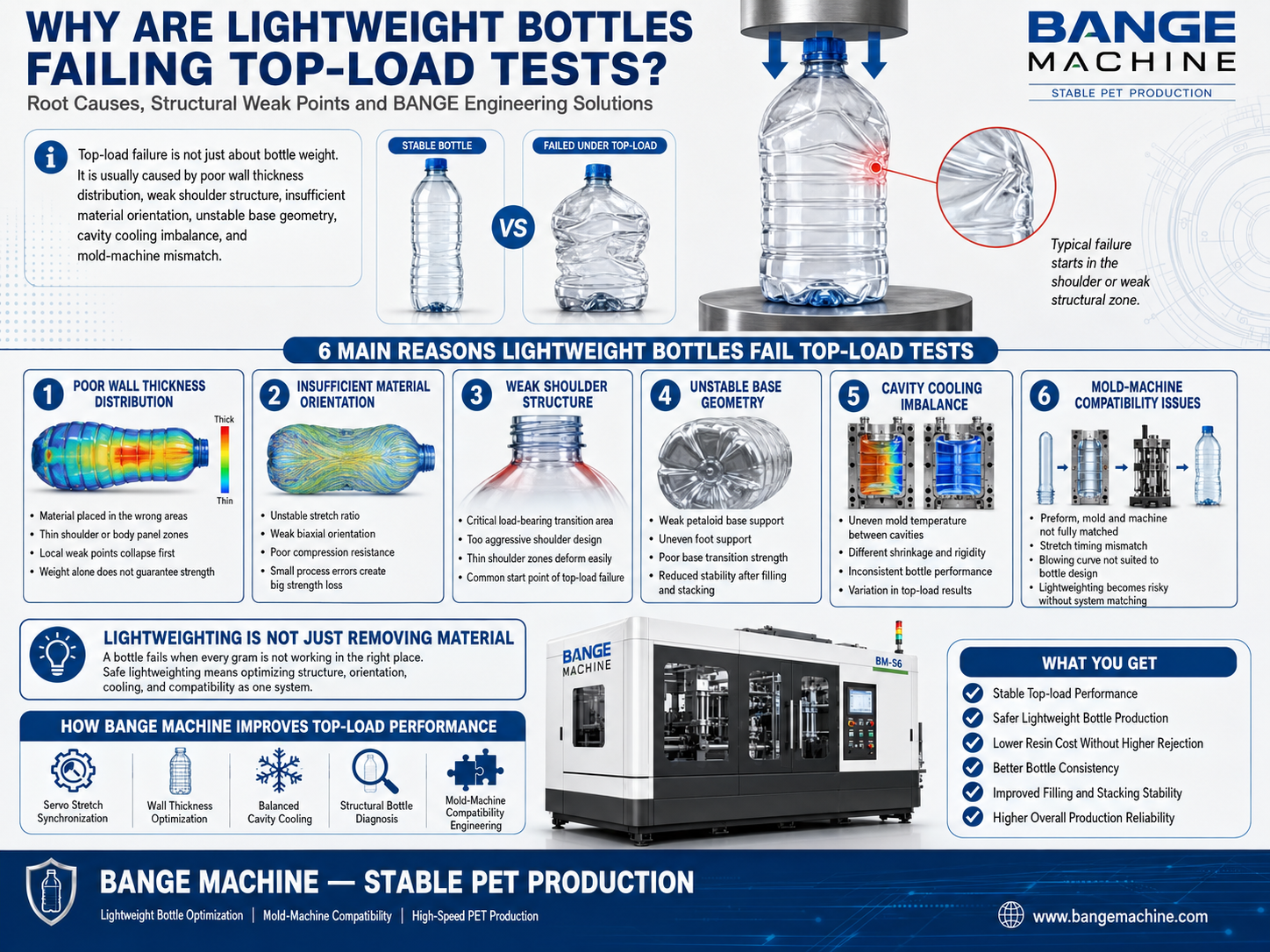
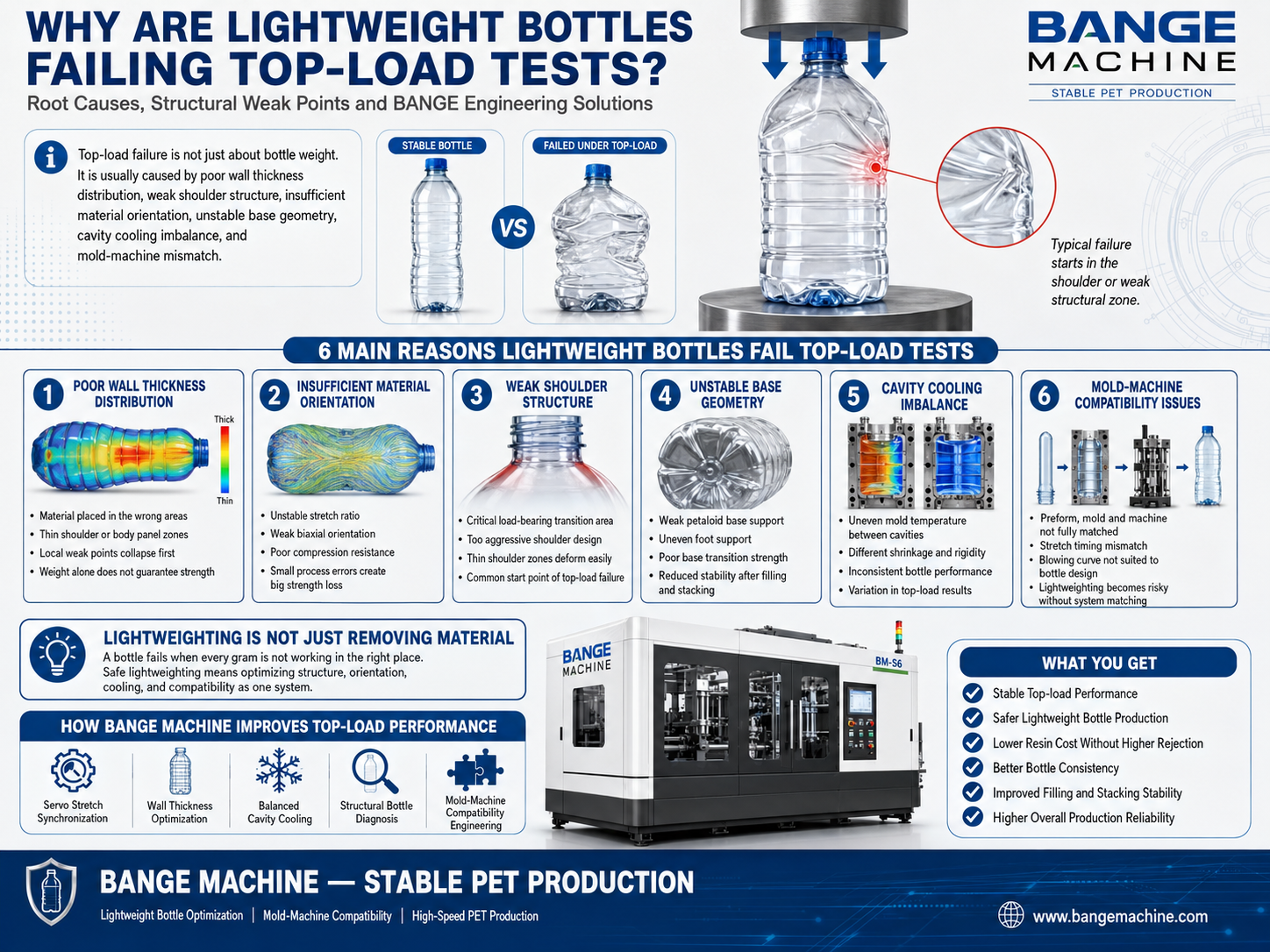
The Problem Is Not Always “Too Little Material”
Many factories believe that once a PET bottle fails a top-load test, the solution is simple:
Add more grams.
But in real PET production, this is not always the right answer.
A lightweight bottle does not fail only because it is lighter.
It usually fails because the material is not placed in the right position.
A 10g bottle with good wall thickness distribution may perform better than a 12g bottle with poor material orientation.
This is why lightweighting is not just a cost-saving decision.
It is an engineering decision.
At BANGE Machine, we always remind customers:
Reducing bottle weight is easy.
Keeping bottle strength after reducing weight is the real challenge.
Why Lightweight Bottles Fail Top-Load Tests
1. Poor Wall Thickness Distribution
Top-load failure often starts from one weak point.
The bottle may look normal from the outside, but inside the structure, the material distribution may already be unstable.
Common problems include:
- Shoulder area too thin
- Body panel thickness imbalance
- Base transition area too weak
- One side of the bottle thinner than the other
- Material concentrated in non-critical areas
When vertical pressure is applied during the top-load test, the weakest zone collapses first.
This is why average bottle weight is not enough to judge bottle strength.
A factory may say:
“The bottle weight is correct. Why does it still collapse?”
The answer is usually:
“The material is there, but it is not where the structure needs it.”
BANGE Machine uses wall thickness distribution analysis to help customers understand where the material should stay, where it can be reduced, and where it must not be removed.
This is the foundation of safe lightweight bottle optimization.
2. Insufficient Material Orientation
PET bottle strength comes from controlled molecular orientation.
During blowing, the preform must be stretched correctly in both directions:
- Axial stretching by the stretch rod
- Radial stretching by blowing air
If the material is not stretched enough, the bottle structure remains weak.
If the material is overstretched, whitening, brittleness, or deformation may appear.
Both situations can reduce top-load performance.
The most sensitive areas are usually:
- Shoulder transition
- Upper body
- Grip area
- Base support ring
For lightweight bottles, the process window becomes much smaller.
A small mistake in stretch timing, heating temperature, or blowing pressure may cause a big difference in compression strength.
BANGE Machine’s Servo Stretch Synchronization System helps control stretching movement more precisely, improving material orientation and reducing structural weak zones.
3. Shoulder Design Is Too Weak
Many top-load failures start at the shoulder.
Why?
Because the shoulder is the transition area between the neck and the body.
It must handle:
- Vertical compression
- Internal pressure change
- Material flow during blowing
- Cooling shrinkage
- Conveyor and packing stress
If the shoulder angle is too aggressive, or if the material becomes too thin in this area, the bottle will deform easily under vertical load.
This often happens when factories try to reduce weight quickly without redesigning the bottle structure.
The bottle becomes lighter, but the load path becomes weaker.
At BANGE Machine, we do not only look at machine parameters.
We also check:
- Bottle shape
- Preform design
- Stretch ratio
- Shoulder thickness
- Mold cooling
- Blowing curve
Because top-load performance is not created by one factor.
It is created by the whole system.
4. Base Geometry Is Not Stable Enough
The bottle base is another key factor in top-load performance.
If the base design is weak, the bottle may stand normally at first, but it becomes unstable during:
- Filling
- Capping
- Pallet stacking
- Warehouse storage
- Transportation
Common base-related issues include:
- Petaloid base deformation
- Uneven foot support
- Poor center push-up design
- Weak base transition area
- Insufficient cooling at the base
For lightweight bottles, base geometry must be more carefully controlled.
The base is not just the bottom of the bottle.
It is part of the bottle’s load-bearing structure.
BANGE Machine helps customers optimize base support, cooling balance, and material distribution, so the bottle can remain stable after filling and during storage.
5. Cavity Cooling Imbalance
Sometimes, one bottle passes the top-load test, but another bottle from the same machine fails.
This is a strong signal of cavity-to-cavity instability.
One overlooked reason is cavity cooling imbalance.
If one cavity cools faster and another cools slower, the bottles may look similar, but their internal stress and shrinkage behavior can be different.
This can cause:
- Different bottle height
- Different shoulder rigidity
- Different base stability
- Different top-load test results
- Long-term deformation after storage
In high-speed PET production, cooling imbalance becomes even more serious because the cycle time is shorter.
BANGE Precision Cooling Architecture is designed to improve thermal balance across mold cavities, helping reduce bottle variation and stabilize top-load performance.
6. Mold-Machine Compatibility Is Not Fully Matched
Top-load failure is sometimes blamed on the bottle design, the resin, or the machine.
But in many factories, the real issue is compatibility.
For example:
- The preform design does not match the bottle design
- The mold cooling does not match the cycle speed
- The stretch rod timing does not match material flow
- The blowing curve does not match the bottle structure
- The filling line pressure does not match the lightweight bottle
When the machine, mold, preform, and filling line are treated separately, lightweight bottle production becomes risky.
This is why BANGE Machine emphasizes integrated mold-machine engineering.
We do not only supply a blow molding machine.
We help customers connect:
Preform → Mold → Machine → Bottle Test → Filling Stability
Because only a matched system can produce lightweight bottles safely.
Lightweighting Is Not Removing Material
This is the key point.
Lightweighting does not mean simply reducing grams.
Real lightweighting means:
- Removing unnecessary material
- Protecting structural zones
- Improving wall thickness distribution
- Stabilizing molecular orientation
- Maintaining top-load performance
- Reducing resin cost without increasing rejection risk
A bad lightweighting project saves resin on paper but loses money in production.
It can cause:
- Higher rejection rate
- More bottle deformation
- Pallet collapse
- Filling line complaints
- Customer claims
- More internal arguments between departments
So the real question is not:
“How many grams can we reduce?”
The better question is:
“How many grams can we reduce safely?”
How BANGE Machine Helps Improve Top-Load Performance
BANGE Machine supports lightweight bottle optimization through system-level control:
Servo Stretch Synchronization
Helps improve molecular orientation and reduce weak stretching areas.
Wall Thickness Distribution Optimization
Helps move material from non-critical areas to load-bearing zones.
Balanced Cavity Cooling
Helps reduce cavity-to-cavity variation and improves bottle consistency.
Mold-Machine Compatibility Engineering
Helps match preform design, mold structure, blowing parameters, and production speed.
Bottle Structure Diagnosis
Helps identify whether the problem comes from the shoulder, base, sidewall, preform, or process settings.
The goal is not only to pass one laboratory test.
The goal is to make bottles stable in real production:
- During filling
- During capping
- During pallet stacking
- During transportation
- During warehouse storage
What Factories Should Check Before Reducing Bottle Weight
Before reducing bottle weight, factories should check:
- Is the shoulder strong enough?
- Is the base geometry stable?
- Is wall thickness distribution balanced?
- Is the stretch ratio suitable for the bottle design?
- Is the mold cooling balanced across all cavities?
- Is the filling line compatible with the lighter bottle?
- Is the top-load safety margin still acceptable after production speed increases?
If these points are ignored, lightweighting becomes a risk.
If they are controlled, lightweighting becomes profit.
Final Thought
Lightweight bottles fail top-load tests not because lightweighting is wrong.
They fail because the bottle structure, material orientation, cooling balance, and mold-machine compatibility are not controlled as one system.
In PET production, saving 1–2 grams per bottle can create real profit.
But only when the bottle still performs safely after filling, stacking, and transportation.
At BANGE Machine, we believe good lightweighting is not about making bottles thinner.
It is about making every gram work harder.