 English
 Español
 العربية

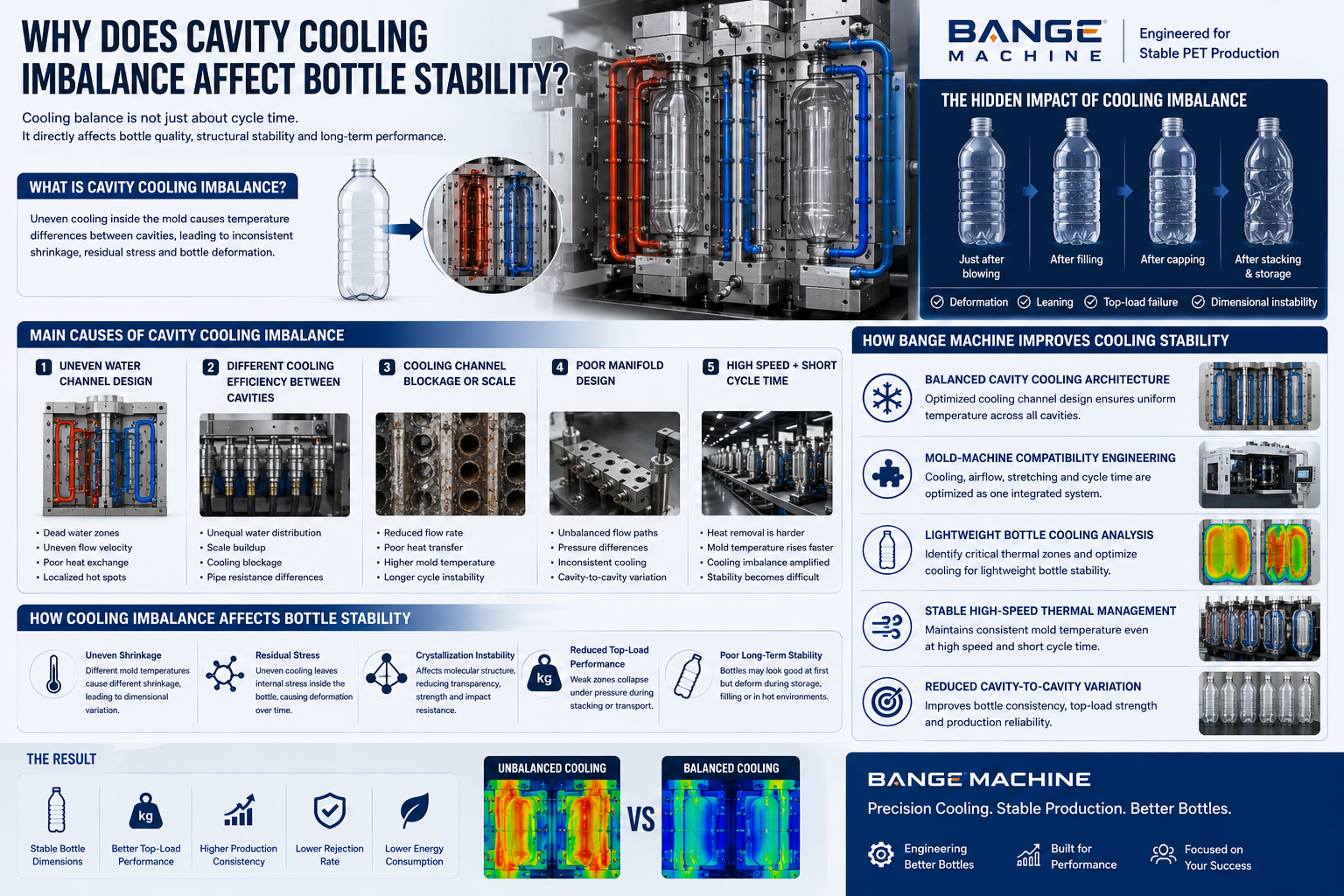
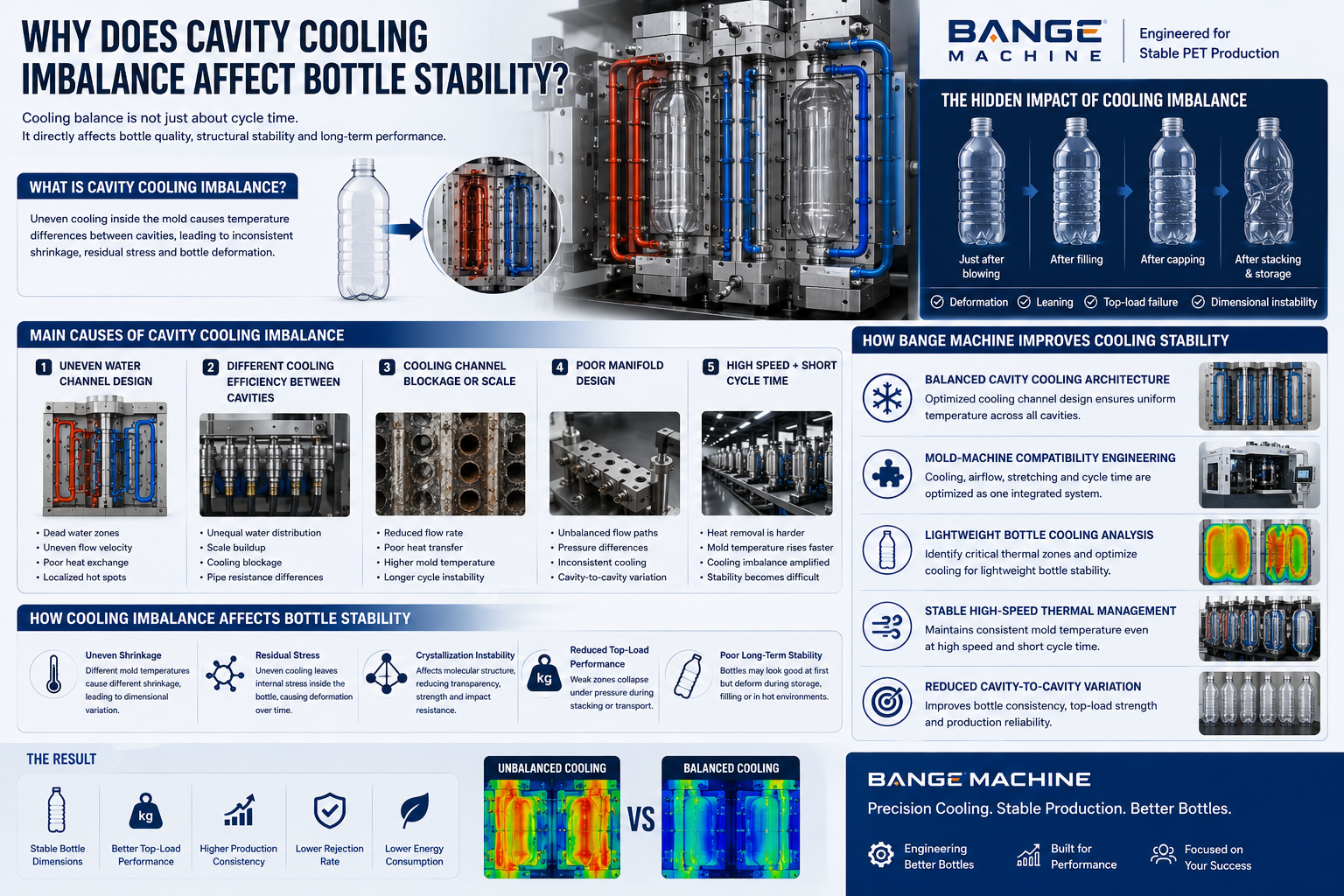
The Problem Often Starts Inside the Mold
In high-speed PET bottle production, many factories focus on:
- blowing pressure,
- cycle speed,
- preform quality,
- or bottle weight.
But one critical factor is often underestimated:
Cavity cooling balance.
A PET bottle may look visually acceptable after blowing, yet still develop:
- deformation,
- inconsistent rigidity,
- top-load instability,
- dimensional variation,
- or long-term collapse during storage.
Why?
Because unstable cooling creates unstable material behavior.
At BANGE Machine, we often see bottle problems caused not by the bottle design itself, but by uneven thermal management inside the mold.
Why Cooling Balance Matters in PET Blowing
During blowing, PET material is stretched while simultaneously being cooled inside the mold cavity.
Cooling directly affects:
- crystallization behavior,
- shrinkage consistency,
- molecular stability,
- bottle geometry,
- and structural rigidity.
If one cavity cools differently from another, the bottles may appear similar visually but behave very differently mechanically.
This becomes especially dangerous in:
- lightweight bottles,
- high-speed production,
- multi-cavity systems,
- and aggressive cycle-time operations.
What Causes Cavity Cooling Imbalance?
1. Uneven Water Channel Design
Poor cooling channel layout creates temperature differences across the mold.
Typical problems include:
- Dead water zones
- Uneven flow velocity
- Poor heat exchange efficiency
- Localized hot spots
- Long thermal recovery time
Even a small mold temperature deviation can affect:
- bottle shrinkage,
- shoulder rigidity,
- base stability,
- and wall thickness behavior.
At BANGE Machine, balanced cooling architecture is designed to improve uniform thermal exchange across all cavities.
2. Different Cooling Efficiency Between Cavities
In multi-cavity PET production, not all cavities always cool equally.
This can happen because of:
- unequal water distribution,
- scale buildup,
- cooling blockage,
- pipe resistance differences,
- or poor manifold design.
The result is cavity-to-cavity inconsistency.
One bottle may pass top-load testing, while another bottle from the same machine fails.
Factories often mistake this for:
- resin instability,
- operator error,
- or blowing parameter fluctuation.
But the real issue may simply be thermal imbalance.
3. Cooling Instability Changes PET Crystallization
PET material is highly sensitive to thermal behavior.
If cooling becomes unstable:
- molecular orientation changes,
- shrinkage becomes uneven,
- residual stress increases,
- and structural rigidity decreases.
This may create:
- bottle leaning,
- sidewall deformation,
- whitening,
- unstable neck dimensions,
- or pallet collapse after filling.
Cooling does not only affect appearance.
It affects the internal structure of the bottle.
Why Lightweight Bottles Are More Sensitive
As bottle weight decreases, cooling stability becomes even more critical.
Why?
Because thinner bottle walls lose heat faster and react more aggressively to temperature fluctuation.
A small cooling deviation may cause:
- uneven shrinkage,
- local deformation,
- reduced compression strength,
- or unstable top-load performance.
This is why many lightweight bottle projects fail after production speed increases.
The bottle design may be correct.
But the cooling stability is no longer sufficient for the smaller process window.
At BANGE Machine, lightweight bottle optimization always includes cooling analysis — not only bottle design analysis.
The Hidden Problem: Long-Term Bottle Deformation
Some cooling-related problems do not appear immediately.
The bottles may pass inspection after production but deform later during:
- warehouse storage,
- pallet stacking,
- hot environments,
- or transportation.
This happens because residual stress remains trapped inside the PET structure.
Over time, the bottle slowly changes shape.
Factories may incorrectly blame:
- transportation,
- filling pressure,
- or storage conditions.
But the root cause often started during cooling.
Why Cooling Balance Is Critical for High-Speed PET Production
At higher production speeds:
- cycle time becomes shorter,
- mold temperature rises faster,
- and thermal stability becomes harder to maintain.
This increases the risk of:
- cavity variation,
- bottle inconsistency,
- dimensional instability,
- and rejection rate growth.
A machine may still run fast.
But stable production becomes difficult.
This is why high-speed PET production is not only about machine speed.
It is about thermal consistency.
How BANGE Machine Improves Cooling Stability
BANGE Machine focuses on stable PET production through:
Balanced Cavity Cooling Architecture
Optimized water channel engineering improves thermal consistency across all cavities.
Mold-Machine Compatibility Engineering
Cooling design, cycle speed, bottle geometry, and airflow are optimized as one system.
Lightweight Bottle Cooling Analysis
Helps identify critical thermal zones in lightweight bottle production.
Stable High-Speed Thermal Management
Designed to improve cycle consistency during continuous production.
Reduced Cavity-to-Cavity Variation
Helps improve:
- bottle consistency,
- top-load performance,
- neck stability,
- and long-term dimensional reliability.
What Factories Should Check
If bottle stability problems appear randomly, factories should check:
- Are all cavities cooling equally?
- Is water flow balanced?
- Are there blocked cooling channels?
- Is mold temperature stable during high-speed operation?
- Is bottle deformation cavity-specific?
- Does the problem worsen after speed increases?
- Are lightweight bottles becoming more sensitive after cycle reduction?
Many PET instability problems are actually thermal problems in disguise.
Final Thought
Cavity cooling imbalance is not only a mold issue.
It is a production stability issue.
In PET blowing, stable bottles require stable thermal behavior.
Because even if every bottle looks similar visually, inconsistent cooling can create completely different internal stress conditions.
At BANGE Machine, we believe stable PET production starts with thermal balance.
Because precision cooling is not just about faster cycles.
It is about producing bottles that remain stable long after they leave the mold.