 English
 Español
 العربية

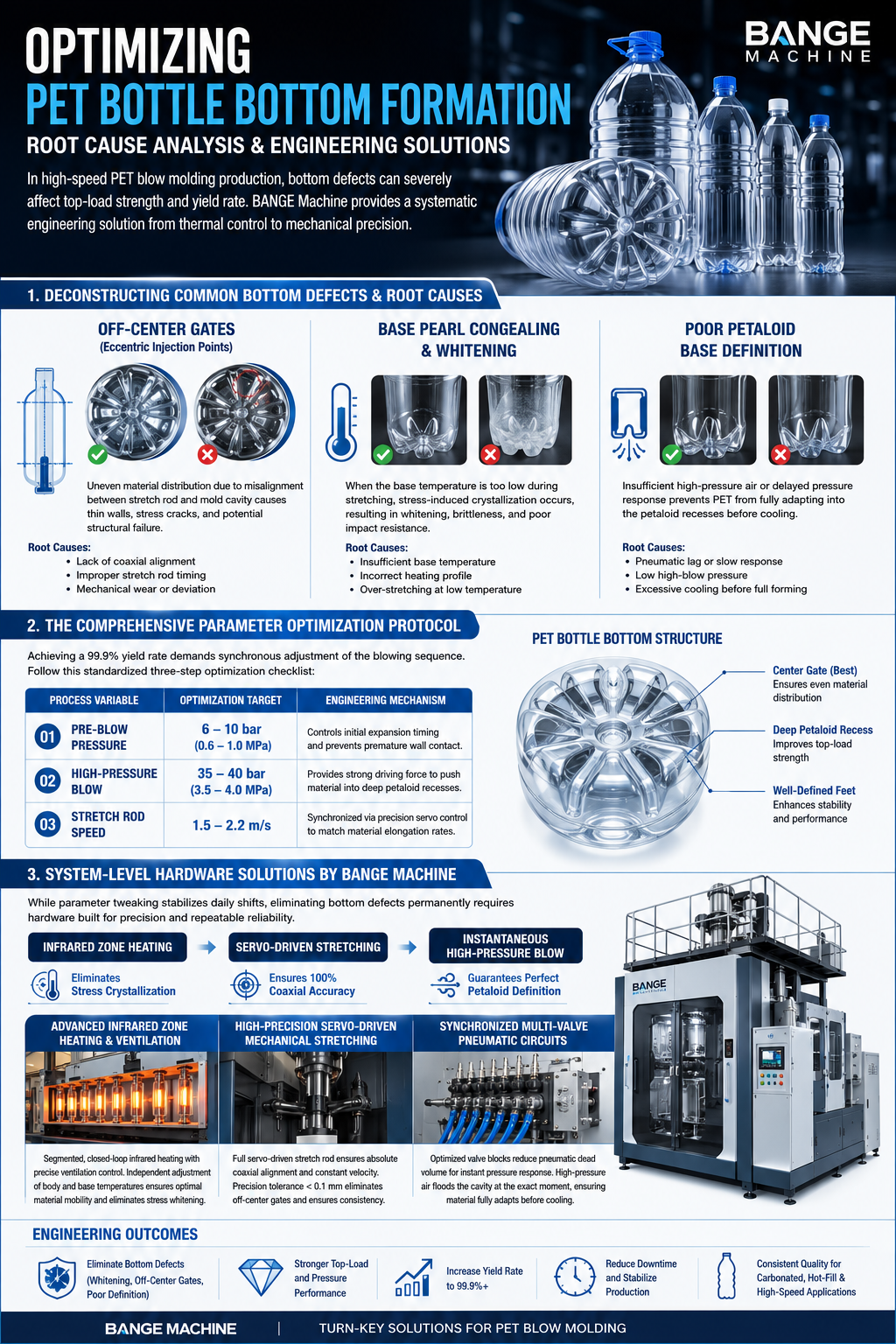
Root Cause Analysis & Engineering Solutions for High-Speed PET Blowing
In high-speed PET bottle production, the bottle bottom is often the first place where instability appears.
Typical defects include:
- Bottom whitening (stress pearling)
- Off-center gates
- Weak petaloid feet definition
- Base deformation under top-load pressure
Most factories try to solve these issues by adjusting one parameter at a time.
But in reality, bottom formation is not controlled by a single setting.
It is the result of:
- thermal distribution,
- stretch timing,
- pneumatic response,
- and mechanical alignment working together within milliseconds.
At BANGE Machine, we approach bottle bottom stability as a complete system—not an isolated defect.
1. Why Bottom Defects Actually Happen
Off-Center Gates (Eccentric Injection Points)
When the stretch rod is not perfectly coaxial with the mold cavity, PET material distribution becomes asymmetrical during stretching.
Result:
- one side of the base becomes thinner,
- stress concentration increases,
- and bottles fail during filling or top-load stacking.
In most production lines, this comes from:
- stretch rod deviation,
- unstable pneumatic cylinders,
- or incorrect stretch timing.
Bottom Whitening / Pearlescence
Whitening is not just a cosmetic issue.
It is a sign that PET molecular orientation failed during deformation.
When the preform base temperature falls below the correct stretching window, the material loses mobility.
Under high stretch force:
- micro-cracks form inside the polymer structure,
- stress crystallization appears,
- and the base becomes brittle.
The bottle may still look acceptable initially,
but impact resistance and long-term durability drop significantly.
Poor Petaloid Base Definition
For CSD bottles, weak petaloid feet directly reduce:
- standing stability,
- pressure resistance,
- and vacuum performance.
The root cause is usually pneumatic lag.
If high-pressure air arrives too slowly:
- the material cools against the mold surface before complete forming,
- preventing PET from fully entering the foot geometry.
Result:
- soft feet,
- shallow definition,
- unstable bottle bases.
2. Critical Process Optimization Parameters
Stable bottom formation depends on synchronization—not isolated parameter increases.
| Process Variable | Typical Range | Engineering Purpose |
|---|---|---|
| Pre-Blow Pressure | 6–10 bar | Controls initial expansion timing |
| High-Pressure Blow | 35–40 bar | Forces PET into deep petaloid geometry |
| Stretch Rod Speed | 1.5–2.2 m/s | Matches elongation rate with material temperature |
The key is timing coordination between:
- preform thermal state,
- stretch motion,
- and pressure curve response.
Even a small mismatch can create unstable material flow at the base.
3. BANGE System-Level Engineering Solution
At BANGE Machine, long-term bottom stability is achieved through integrated hardware coordination.
Infrared Zone Heating + Ventilation Control
We use segmented infrared heating with independent zone adjustment and controlled ventilation airflow.
This allows:
- separate thermal management of the body and base,
- stable polymer mobility,
- and elimination of stress whitening before stretching begins.
Result:
- smoother material flow,
- improved wall thickness distribution,
- and stable base transparency.
Full Servo Stretching System
Traditional pneumatic stretching systems suffer from pressure fluctuation and positional inconsistency.
BANGE integrates full servo-driven stretch rod assemblies to ensure:
- constant speed,
- stable stroke control,
- and precise coaxial alignment.
Mechanical tolerance is maintained within:
< 0.1 mm alignment deviation
This structurally eliminates off-center gates during high-speed production.
High-Speed Multi-Valve Pneumatic Architecture
Perfect petaloid definition depends on pressure arriving at the correct millisecond.
Our optimized valve blocks reduce pneumatic dead volume and accelerate pressure response speed.
Result:
- instantaneous cavity pressurization,
- deeper foot formation,
- and sharper base geometry consistency.
Final Engineering Insight
Bottle bottom quality is not determined by blowing pressure alone.
It depends on whether:
- heat penetration,
- stretch synchronization,
- and pressure delivery
arrive in the correct sequence before the material loses mobility.
In high-speed PET production, milliseconds determine whether the base becomes:
-
structurally stable,
or - the weakest point of the bottle.