 English
 Español
 العربية

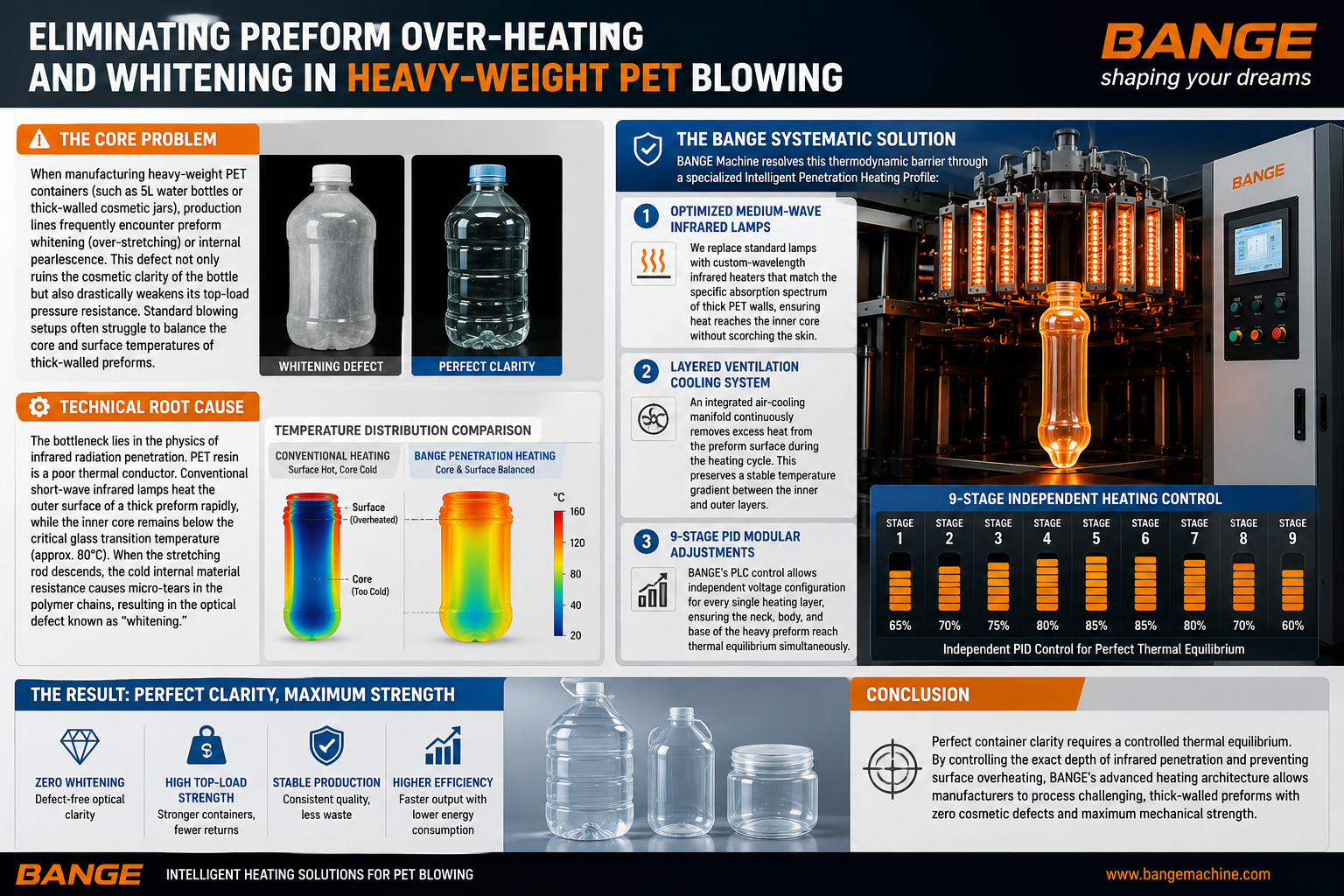
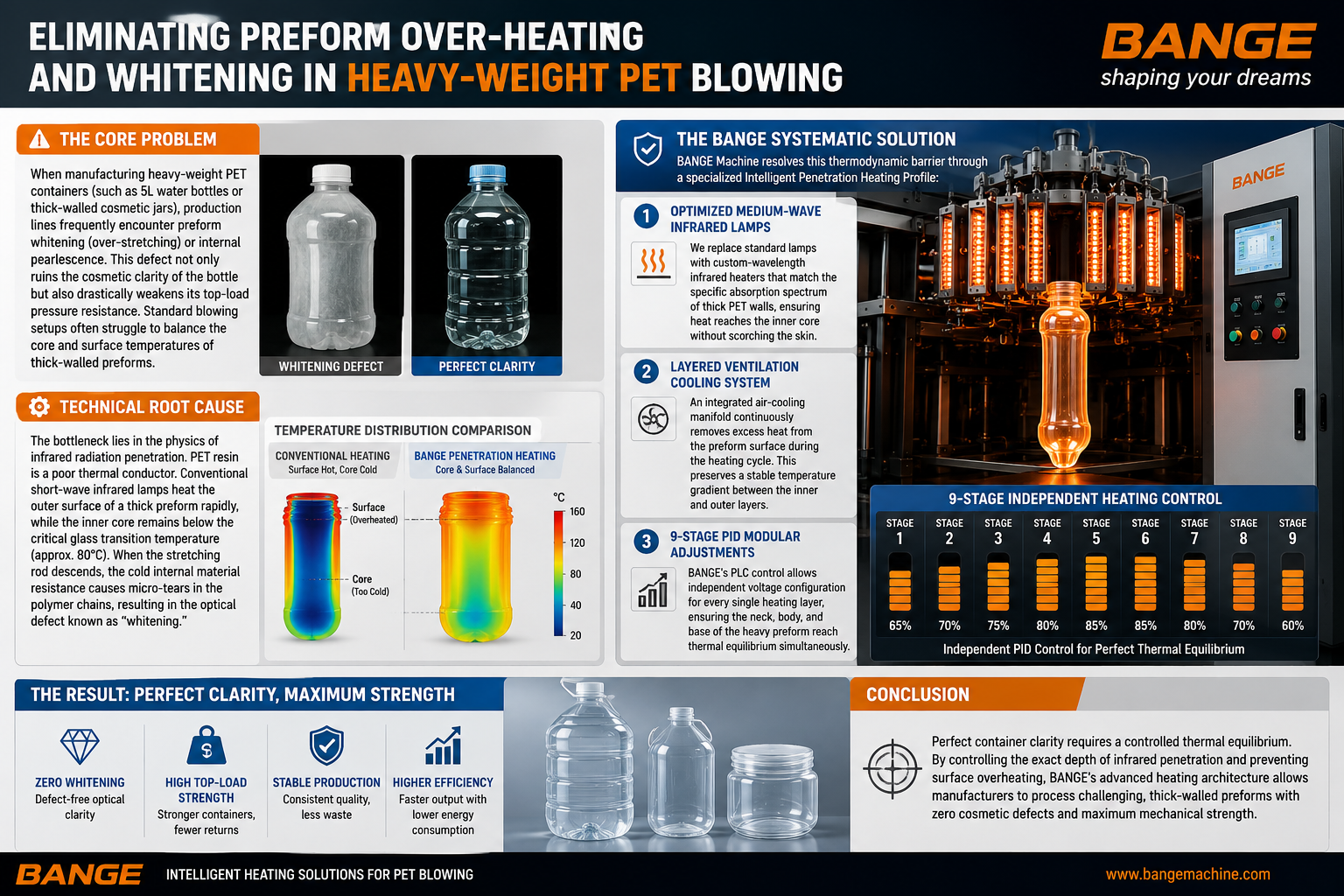 Optimizing PET Bottle Bottom Formation: Root Cause Analysis and Engineering Solutions
In high-speed PET blow molding production, bottle bottom defects—such as pearly folding (whitening), eccentric injection points (off-center gates), and insufficient feet definitions—are major bottlenecks that compromise top-load strength and yield rates. Resolving these issues requires a transition from superficial troubleshooting to a systemic approach combining thermal control, pneumatic coordination, and mechanical precision.
As a leading turn-key solution provider, BANGE Machine dissects the physics of bottom formation to deliver robust, high-yield manufacturing outcomes.
1. Deconstructing Common Bottom Defects & Root Causes
To eliminate bottom formation failure, production lines must look at the interplay between material temperature and mechanical alignment.
Off-Center Gates (Eccentric Injection Points)
When the injection gate shifts away from the exact geometric center, it triggers uneven material distribution. This structural imbalance leaves one side of the bottle wall too thin, leading to stress cracks and structural collapse during carbonated filling or hot-filling processes. This is primarily caused by a lack of coaxial alignment between the stretch rod and the blow mold cavity, or improper stretch rod timing.
Base Pearl Congealing & Whitening
Whitening at the base occurs when the PET material is stretched beyond its natural yield point at an incorrect thermal window. If the preform bottom temperature drops below the optimal glass transition range, stress-induced crystallization occurs, transforming the amorphous polymer into a brittle, pearlescent structure with poor impact resistance.
Poor Petaloid Base Definition
For five-fipple or petaloid carbonated soft drink (CSD) bottles, insufficient definition in the feet directly compromises stability. This defect stems from a critical pneumatic lag—where the high-pressure blow curve does not reach its peak before the material cools against the cold mold surface.
2. The Comprehensive Parameter Optimization Protocol
Achieving a 99.9% yield rate demands synchronous adjustment of the blowing sequence, structured as a standardized three-step checklist:
| Process Variable | Optimization Target | Engineering Mechanism |
|---|---|---|
| Pre-Blow Pressure | 6 to 10 bar (0.6 - 1.0 MPa) | Expansion timing control to prevent premature wall contact. |
| High-Pressure Blow | 35 to 40 bar (3.5 - 4.0 MPa) | Drives rapid material distribution into the complex petaloid recesses. |
| Stretch Rod Speed | 1.5 to 2.2 m/s | Synchronized via precision servo control to match material elongation rates. |
3. System-Level Hardware Solutions by BANGE Machine
While parameter tweaking stabilizes daily shifts, eliminating bottom defects permanently requires hardware built for precision and repeatable reliability. BANGE Machine integrates systematic, automated technologies to bypass human error and ambient variables:
Advanced Infrared Zone Heating & Ventilation
BANGE Machine utilizes segmented, closed-loop infrared heating lamps combined with precise internal air ventilation. By individually adjusting the thermal profile of the preform body versus the preform base, we ensure the bottom retains the exact polymer mobility needed for optimal material distribution, completely eliminating stress whitening.
High-Precision Servo-Driven Mechanical Stretching
Unlike legacy pneumatic cylinders that suffer from pressure fluctuations, BANGE Machine’s blow molding systems incorporate full servo-driven stretch rod assemblies. This guarantees absolute coaxial alignment and constant velocity throughout the entire stroke. By maintaining a precision tolerance of less than 0.1mm, off-center gates are structurally eliminated.
Synchronized Multi-Valve Pneumatic Circuits
Perfect base definition requires instantaneous pressure delivery. Our optimized valve blocks minimize pneumatic dead volume, allowing the high-pressure air (up to 40 bar) to flood the mold cavity at the exact millisecond the stretch rod reaches the bottom plate. This ensures rapid material adaptation into the furthest corners of the mold before cooling occurs.
Conclusion: The BANGE Machine Advantage
Solving PET bottle bottom defects is not just about altering a single setting; it is about managing a predictable system. By integrating precise infrared thermal zoning, rigid servo-driven mechanics, and optimized pneumatic pathways, BANGE Machine provides reliable, high-speed system solutions that maximize operational equipment effectiveness (OEE).
Partner with BANGE Machine to upgrade your production capabilities from simple machinery to intelligent, high-yield manufacturing ecosystems.