 English
 Español
 العربية
Strategic Energy Engineering in PET Blow Molding: High-Efficiency Air Recycling Calculations and Advanced Infrared Thermal Management
In modern rigid packaging manufacturing, operational expenditure (OPEX) is heavily dictated by two factors: the electrical power consumed by preform heating and the pneumatic energy required for high-pressure bottle blowing. As global energy costs fluctuate, maximizing Operational Equipment Effectiveness (OEE) demands more than standalone machinery—it requires integrated, thermodynamic system solutions.
BANGE Machine engineering frameworks optimize these twin energy sinks through precise, high-pressure air recycling matrixes and closed-loop smart infrared thermal profiling.
1. Thermodynamic Calculations of High-Pressure Air Recycling Systems
A standard PET blow molding machine vents massive volumes of compressed air at 35 to 40 bar directly into the atmosphere after each blowing cycle, resulting in pure energy loss. BANGE Machine’s Air Recycling System (ARS) captures this kinetic energy, redirecting the exhaust to power the low-pressure pneumatic actuators (6 to 10 bar) and pre-blow systems.
To understand the financial and operational impact, we can evaluate the standard mass-flow recovery using the ideal gas law and thermodynamic conservation:
Where:
- Vcavity: Total volumetric capacity of the blown bottles per cycle (m3).
- Phigh: Peak blowing pressure (3.5 − 4.0 MPa).
- Pback: System back-pressure sustained in the recovery storage tank (∼0.8 − 1.0 MPa).
- Patm: Ambient atmospheric pressure (0.101 MPa).
- η: Volumetric efficiency of the pneumatic recovery manifold (typically ≥85% in BANGE systems).
Engineering Case Study: The 30% Kinetic Payback
Consider a high-speed 6-cavity BANGE system producing 2.0L bottles at a rate of 12,000 Bottles Per Hour (BPH), operating at 3.8 MPa (38 bar) blowing pressure.
By implementing the BANGE multi-stage recovery valve block, up to 40% of the high-pressure exhaust air is instantly captured and routed back into the low-pressure grid. This drops the net compressed air demand on the primary compressor system by 30% to 35%, translating into thousands of dollars in annualized electrical savings per production line and drastically lowering the plant's carbon footprint.
2. Advanced Infrared Heating Module Control and Thermal Profiling
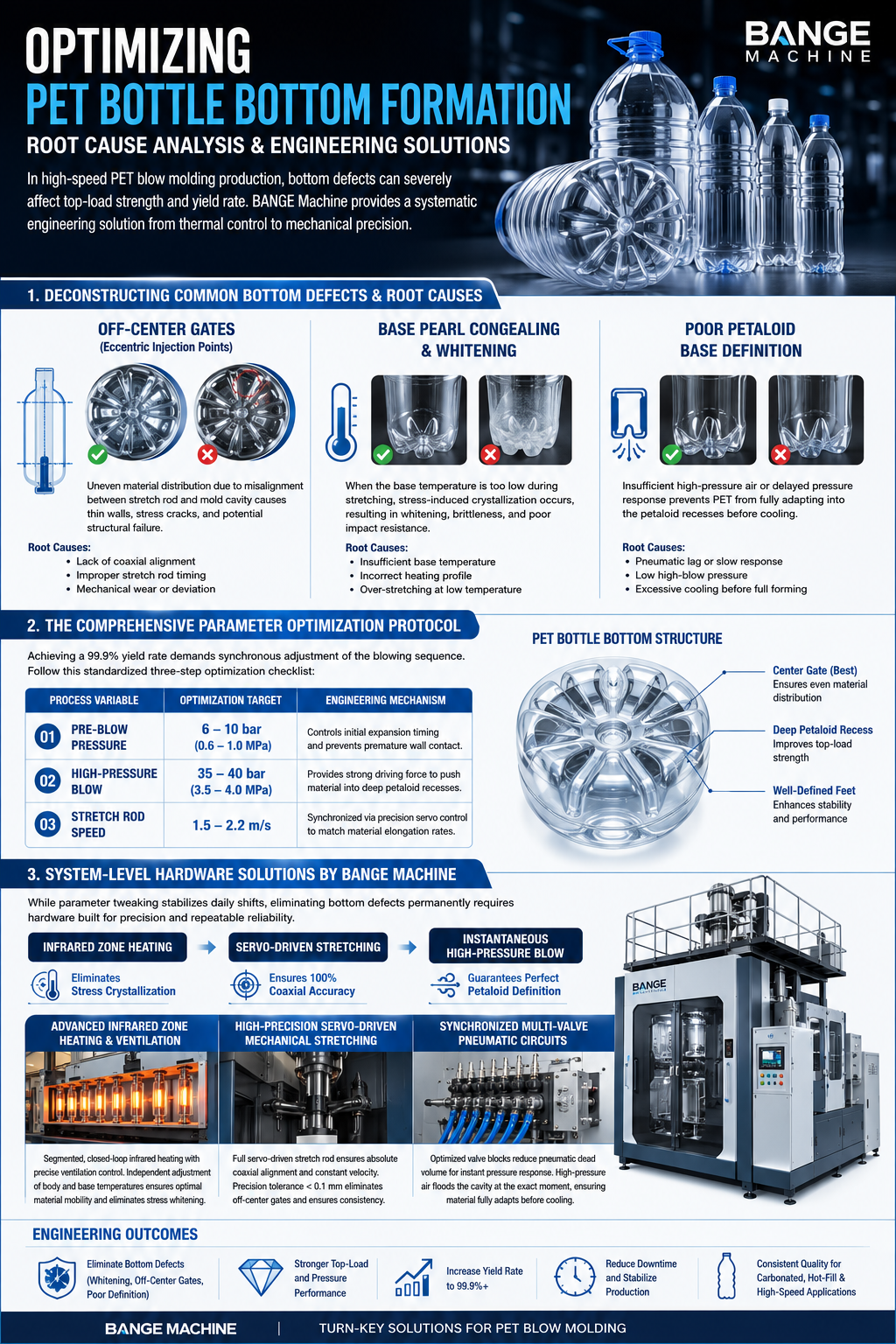
Achieving a high-yield production rate of 99.9% requires extreme consistency in the preform’s molecular temperature distribution before it enters the blow mold. Traditional heating ovens suffer from thermal inertia, where environmental drafts cause unpredictable temperature drifts.
Short-Wave Infrared (SWIR) Penetration Physics
BANGE Machine replaces inefficient medium-wave heating with precision Short-Wave Infrared (SWIR) lamps. SWIR wavelengths (0.78 to 1.4 μm) match the optimal absorption spectrum of polyethylene terephthalate (PET). Instead of merely scorching the outer skin of the preform, SWIR penetrates directly into the core of the material wall, ensuring a uniform temperature gradient from the inside out.
Closed-Loop SCR Power Control & Ventilation
To combat external factory temperature shifts, BANGE ovens implement an advanced thermodynamic feedback system:
- Non-Contact Infrared Pyrometers continuously scan the preforms as they exit the heating zone, measuring the actual material temperature rather than just the air temperature.
- Silicon Controlled Rectifiers (SCR) receive this real-time data, adjusting the voltage supplied to individual lamp zones within milliseconds.
- Variable Frequency Controlled Air Ventilation precisely counteracts surface overheating, maintaining a stable ±1°C process window even during continuous, multi-shift high-speed operations.
3. The BANGE Machine Advantage: Integrated System Solutions
A reliable supplier doesn't just deliver components; they provide predictable manufacturing ecosystems. BANGE Machine integrates both air recycling and intelligent thermal profiling into a singular, unified control interface.
| System Component | Core Technology | Operational Benefit |
|---|---|---|
| Pneumatic Circuit | Integrated Dead-Volume-Free Valve Blocks | Eliminates air pressure lag, increasing recovery velocity. |
| Thermal Matrix | 8-Zone Independent Lamella Adjustment | Allows precise material distribution for complex container shapes. |
| Control Architecture | Human-Machine Interface (HMI) Eco-Mode | Real-time monitoring of energy recovery metrics and KW/h savings. |
Conclusion
Energy efficiency in PET blow molding is an exact science. Through the deployment of thermodynamic air recovery algorithms and high-precision short-wave infrared management, BANGE Machine elevates production lines from high-overhead operations to lean, automated, high-yield smart factories.
Invest in technology built for sustainability, reliability, and precision engineering. Partner with BANGE Machine to deploy your next complete turn-key production system.