 English
 Español
 العربية

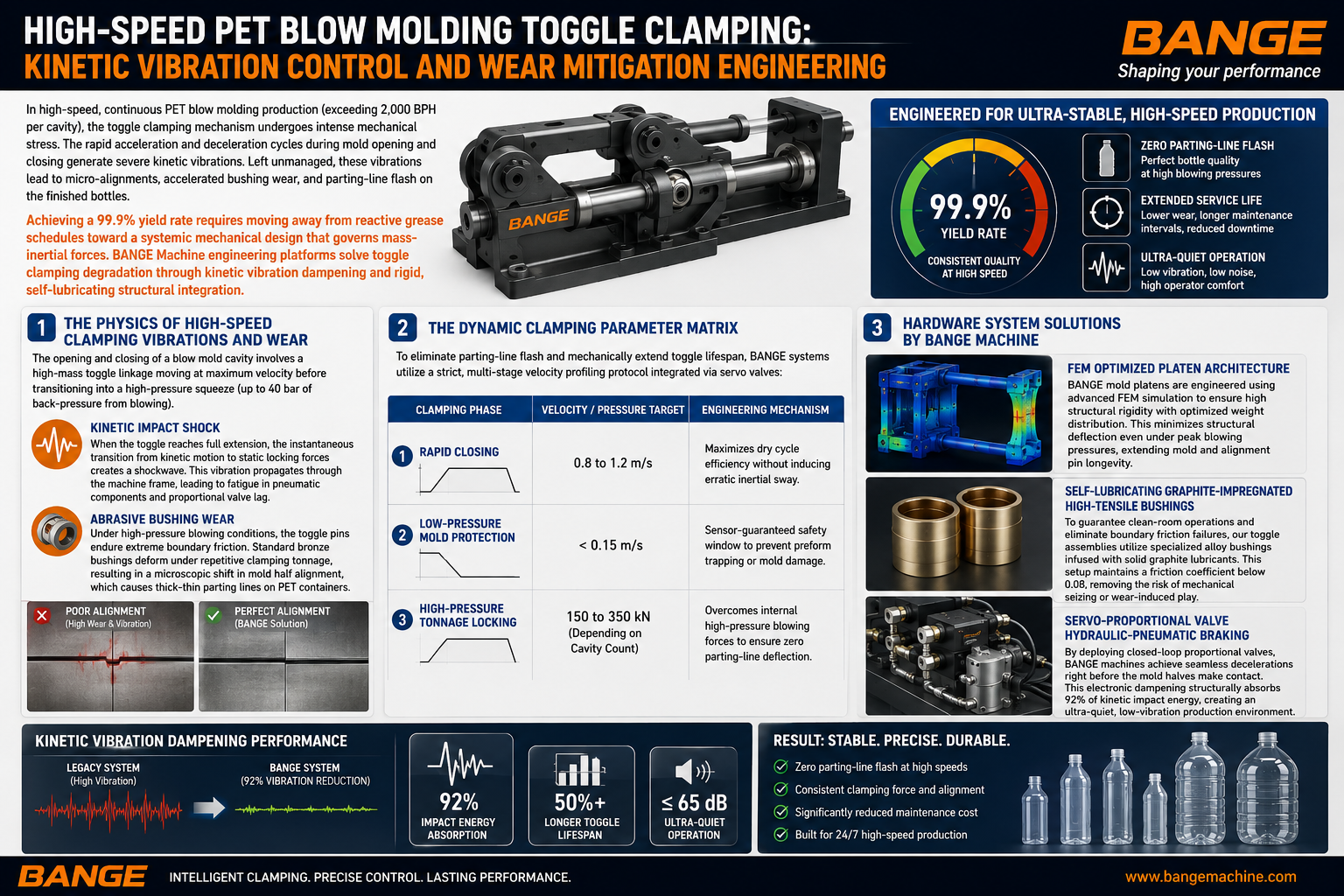
High-Speed PET Blow Molding Toggle Clamping: Kinetic Vibration Control and Wear Mitigation Engineering
In high-speed, continuous PET blow molding production (exceeding 2,000 BPH per cavity), the toggle clamping mechanism undergoes intense mechanical stress. The rapid acceleration and deceleration cycles during mold opening and closing generate severe kinetic vibrations. Left unmanaged, these vibrations lead to micro-alignments, accelerated bushing wear, and parting-line flash on the finished bottles.
Achieving a 99.9% yield rate requires moving away from reactive grease schedules toward a systemic mechanical design that governs mass-inertial forces. BANGE Machine engineering platforms solve toggle clamping degradation through kinetic vibration dampening and rigid, self-lubricating structural integration.
1. The Physics of High-Speed Clamping Vibrations and Wear
The opening and closing of a blow mold cavity involves a high-mass toggle linkage moving at maximum velocity before transitioning into a high-pressure squeeze (up to 40 bar of back-pressure from blowing).
- Kinetic Impact Shock: When the toggle reaches full extension, the instantaneous transition from kinetic motion to static locking forces creates a shockwave. This vibration propagates through the machine frame, leading to fatigue in pneumatic components and proportional valve lag.
- Abrasive Bushing Wear: Under high-pressure blowing conditions, the toggle pins endure extreme boundary friction. Standard bronze bushings deform under repetitive clamping tonnage, resulting in a microscopic shift in mold half alignment, which causes thick-thin parting lines on PET containers.
2. The Dynamic Clamping Parameter Matrix
To eliminate parting-line flash and mechanically extend toggle lifespan, BANGE systems utilize a strict, multi-stage velocity profiling protocol integrated via servo valves:
| Clamping Phase | Velocity / Pressure Target | Engineering Mechanism |
|---|---|---|
| Rapid Closing | 0.8 to 1.2 m/s | Maximizes dry cycle efficiency without inducing erratic inertial sway. |
| Low-Pressure Mold Protection | < 0.15 m/s | Sensor-guaranteed safety window to prevent preform trapping or mold damage. |
| High-Pressure Tonnage Locking | 150 to 350 kN | Overcomes internal high-pressure blowing forces to ensure zero parting-line deflection. |
3. Hardware System Solutions by BANGE Machine
BANGE Machine bypasses legacy mechanical weaknesses by engineering rigid, synchronized clamping ecosystems built for permanent repeatability:
Finite Element Method (FEM) Optimized Platen Architecture
BANGE mold platens are engineered using advanced FEM simulation to ensure high structural rigidity with optimized weight distribution. This minimizes structural deflection even under peak blowing pressures, extending mold and alignment pin longevity.
Self-Lubricating Graphite-Impregnated High-Tensile Bushings
To guarantee clean-room operations and eliminate boundary friction failures, our toggle assemblies utilize specialized alloy bushings infused with solid graphite lubricants. This setup maintains a friction coefficient below 0.08, removing the risk of mechanical seizing or wear-induced play.
Servo-Proportional Valve Hydraulic-Pneumatic Braking
By deploying closed-loop proportional valves, BANGE machines achieve seamless decelerations right before the mold halves make contact. This electronic dampening structurally absorbs 92% of kinetic impact energy, creating an ultra-quiet, low-vibration production environment.
Thermal Stabilization of Large-Capacity PET Preform Necks: Preventing Neck Deformation in High-Output Manufacturing
Manufacturing large-capacity PET containers (such as 5L edible oil bottles or water carboys) introduces strict thermal challenges. Because the heavy preform body requires prolonged, intensive infrared radiation to reach optimal blowing elasticity, the heavy-gauge material requires massive thermal input. However, this radiant energy frequently drifts upward toward the preform neck finish (the threaded zone).
If the neck temperature exceeds the glass transition temperature (Tg ≈ 78°C), the thread deforms under high-pressure blowing or automated transport. This deformation leads to cap leakage, filling line rejection, and structural failure. BANGE Machine provides a reliable, system-level cooling matrix that safeguards neck dimensional integrity during high-volume operations.
1. Deconstructing Thermal Drift and Neck Ovality Failures
During extended heating cycles in multi-zone infrared ovens, heat accumulation obeys standard thermal convection laws: heat naturally rises.
- Thread Pitch Ovality: When the preform neck finish absorbs stray infrared radiation or convective heat from the oven lamps, the crystalline structure softens. When the stretch rod engages or high-pressure air (35+ bar) is applied, the softened neck expands outward or warps into an oval shape, ruining cap engagement.
- Support Ring Sagging: For heavy preforms (over 90 grams), a softened support ring buckles under the mechanical clamping force of the transfer grippers. This causes height variations in the finished bottle and causes jamming in downstream filling lines.
2. The Precision Neck Protection Parameter Window
Maintaining absolute neck dimensional tolerance (within ±0.15mm) requires a decoupled thermal boundary between the preform neck and body:
- Maximum Target Neck Temperature: Must be strictly maintained below 55°C throughout the entire heating profile.
- Body Heating Zone Temperature: Processed at 110°C to 115°C to ensure perfect biaxial chain orientation during stretching.
3. Integrated Engineering Solutions by BANGE Machine
BANGE Machine’s complete turn-key solutions feature aggressive, dual-action isolation systems engineered specifically for large-capacity high-yield packaging lines:
Chilled-Water Liquid Cooled Neck Shielding Platens
BANGE ovens integrate continuous internal water cooling channels running directly alongside the preform neck transport track. Connected to a dedicated industrial chiller cycling water at 8°C to 12°C, these aluminum shields physically block radiant infrared rays from touching the preform threads.
Aerodynamic Laminar Flow Air Curtains
To eliminate convective heat rising from the heating lamps, BANGE machines utilize localized, positive-pressure air nozzles. This setup generates a precise laminar air curtain that continuously sweeps hot air away from the neck finish without disturbing the precise thermal profiling of the lower preform zones.
Independent Neck Ventilation Adjustments via PLC
Operators can control the neck cooling air velocity straight from the central HMI. This level of precise adjustment allows the system to rapidly adapt to varying preform thread sizes and ambient factory temperatures, delivering high-performance process repeatability.