 English
 Español
 العربية


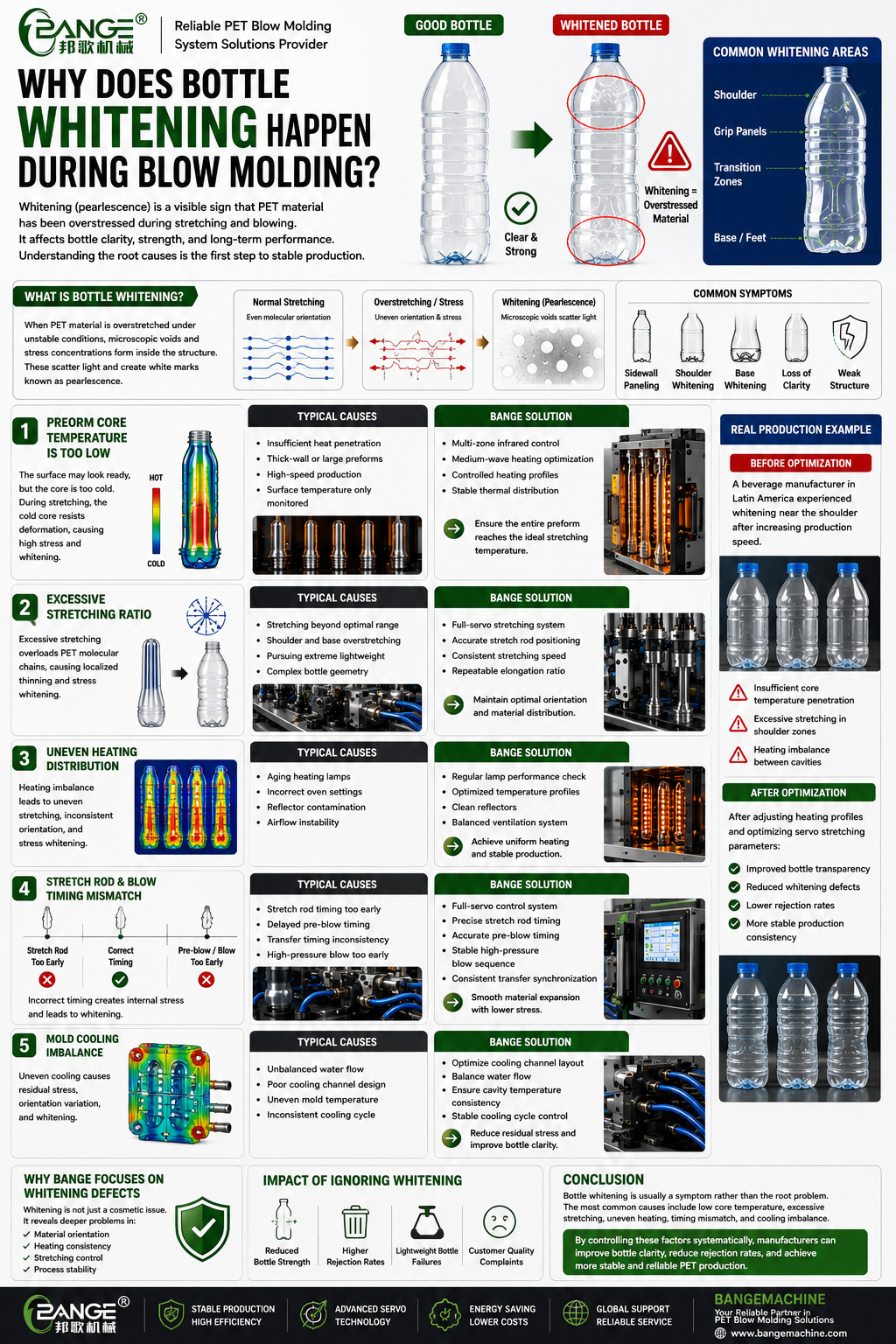
Why Does Bottle Whitening Happen During Blow Molding? Causes and Solutions
Few PET bottle defects create more confusion than bottle whitening, also known as pearlescence. The bottle may appear structurally complete—dimensions meet specifications and production lines run normally. However, white stress marks or hazy zones begin to appear in specific areas, such as the bottle shoulder, base, grip panels, and sharp geometric transition zones.
Quick Technical Summary for Engineers:
PET bottle whitening (pearlescence) is not cosmetic contamination. It is a structural warning sign caused by microscopic voids and micro-tears forming when the material experiences excessive stress beyond its natural stretch limits. The 5 root causes are: low preform core temperature, excessive stretching ratios, uneven heating profiles, stretch/blow timing mismatches, and mold cooling imbalances.
Root Cause 1: Preform Core Temperature Is Too Low
One of the most common causes of whitening is insufficient thermal penetration. Many factories monitor only the surface temperature of the preform. While the outer skin appears ready, the internal core remains too cold. When stretching begins, the outer layer elongates normally while the colder inner core resists deformation, driving internal stress up rapidly and causing micro-voids to scatter light as whitening.
- Typical Causes: Inconsistent oven ventilation, thick-walled preforms, or rapid fast-heating profiles that skip thermal equalization.
- The Industry Standard & BANGE Solution: True molecular stability requires deep thermal saturation rather than aggressive surface heating. BANGE addresses this with a multi-zone infrared heating system featuring penetration optimization. This ensures identical core-to-skin temperatures across the preform wall, eliminating cold-core mechanical stress.
Root Cause 2: Excessive Stretching Ratio
Lightweight bottle projects often push PET materials right to their processing limits. When the geometric expansion or stretch speed exceeds the polymer’s optimal bi-axial orientation window, the molecular chains overstrain, creating localized stress whitening in complex zones like shoulder transitions and deep grip designs.
- Typical Causes: Aggressive lightweighting designs without adjusting the preform geometry or stretching curve.
- The Industry Standard & BANGE Solution: Precision stretching curves prevent material over-exhaustion. BANGE’s high-speed full-servo stretching technology provides millisecond-level precision over the stretch rod positioning and speed profiles, maintaining stable material orientation without overstressing complex bottle geometries.
Root Cause 3: Uneven Heating Distribution
Thermal imbalance is another major contributor to pearlescence. If one section of the preform receives more heat than another, the material stretches unevenly during the pre-blow phase, triggering heavy stress concentrations and localized whitening on a single side or quadrant of the bottle.
- Typical Causes: Aging heating lamps, contaminated reflectors, or unstable internal oven airflow.
- The Industry Standard & BANGE Solution: Consistent thermal consistency is achieved through active oven monitoring. BANGE engineering teams integrate advanced ventilation balance and self-adjusting infrared profiles to counteract ambient temperature fluctuations, ensuring uniform material stretchability across all blowing cavities.
Root Cause 4: Stretch Rod and Blow Timing Mismatch
Even with perfect heating, poor process synchronization will induce whitening defects. For instance, if the stretch rod contacts the preform base too early before pre-blow air is introduced, or if high-pressure blowing triggers before the material stabilizes, the excessive friction and pressure shock generate massive internal stresses.
- Typical Causes: Inaccurate mechanical cam timing or drifting pneumatic valve response times on high-speed lines.
- The Industry Standard & BANGE Solution: Digital synchronization replaces mechanical guesswork. BANGE full-servo blowing systems allow individual, digital control over pre-blow, high-pressure blow sequence, and stretch rod actuation, providing smoother material expansion and drastically lowering defect rates.
Root Cause 5: Mold Cooling Imbalance
Cooling plays a vital role in locking in the optimal molecular orientation. When cooling is inconsistent across the mold cavity, residual thermal stress becomes trapped inside the PET matrix, resulting in haze or whitening post-production. Many plants mistakenly focus solely on the oven while neglecting cooling uniformity.
- Typical Causes: Clogged water channels, inadequate chiller pressure, or poorly designed mold cooling layouts.
- The Industry Standard & BANGE Solution: High-speed production demands balanced thermal dissipation. BANGE molds utilize an equidistant water channel layout with balanced cavity cooling, stabilizing mold temperatures to preserve bottle clarity, dimensional accuracy, and structural reliability.
Real Production Case Study
A prominent beverage manufacturer in Latin America (operating at 28,000 BPH) experienced a recurring 3.5% shoulder whitening defect after speeding up production. The bottles appeared acceptable immediately after blowing but showed a distinct, hazy pearlescence under warehouse lighting.
A comprehensive process audit by BANGE engineers revealed inadequate core temperature penetration and a minor timing mismatch during the high-pressure blow transition. By optimizing the multi-zone infrared profiles and adjusting the servo-stretching synchronization parameters, the plant achieved:
- Bottle transparency and clarity increased to premium standards
- Whitening defects dropped from 3.5% to below 0.1%
- Overall production rejection rates decreased significantly without raw material changes
Conclusion: Why BANGE Focuses on Whitening Defects
In PET manufacturing, whitening is a clear symptom of deeper process instability. Ignoring it doesn't just impact aesthetics; it risks reduced top-load strength and lightweight bottle failures in the supply chain.
At BANGE, our engineering targets the root cause—the delicate harmony between machinery and polymer physics. By ensuring precise heating penetration and servo stretching accuracy, we protect your bottle clarity and production stability from the factory floor to the end consumer.
Preview: LinkedIn Post Version
That white haze on your PET bottles? It’s not a cosmetic flaw—it’s a warning sign. ⚠️

Many manufacturers treat bottle whitening (pearlescence) as a minor visual defect. But in polymer physics, whitening means your PET material is overstressed.

When stretching conditions go wrong, microscopic voids form inside the plastic, scattering light and creating that familiar white look around the shoulders or bases.

Here are the 5 hidden process defects causing bottle whitening:
1️⃣ Low Preform Core Temperature – Surface looks ready, but the cold core resists stretching.
2️⃣ Excessive Stretching Ratio – Pushing lightweight materials past their physical orientation limits.
3️⃣ Uneven Heating Profiles – Causing material to pull unevenly across the cavity.
4️⃣ Timing Mismatches – Poor synchronization between the stretch rod and high-pressure blowing.
5️⃣ Mold Cooling Imbalance – Trapping residual thermal stress inside the bottle wall.

At BANGE, we solve whitening by analyzing the process behind the bottle. By utilizing multi-zone infrared penetration heating and full-servo precision stretching, we help plants eliminate stress defects while hitting lightweight targets.

💡 Don't change your material. Optimize your process.

🔗 Read our full engineering guide to fixing PET pearlescence: [bangemachine.com/blog/pet-bottle-whitening-causes]

#PETBlowMolding #BottleManufacturing #PlasticsEngineering #QualityControl #PETTroubleshooting #Lightweighting #BANGEMACHINE