 English
 Español
 العربية

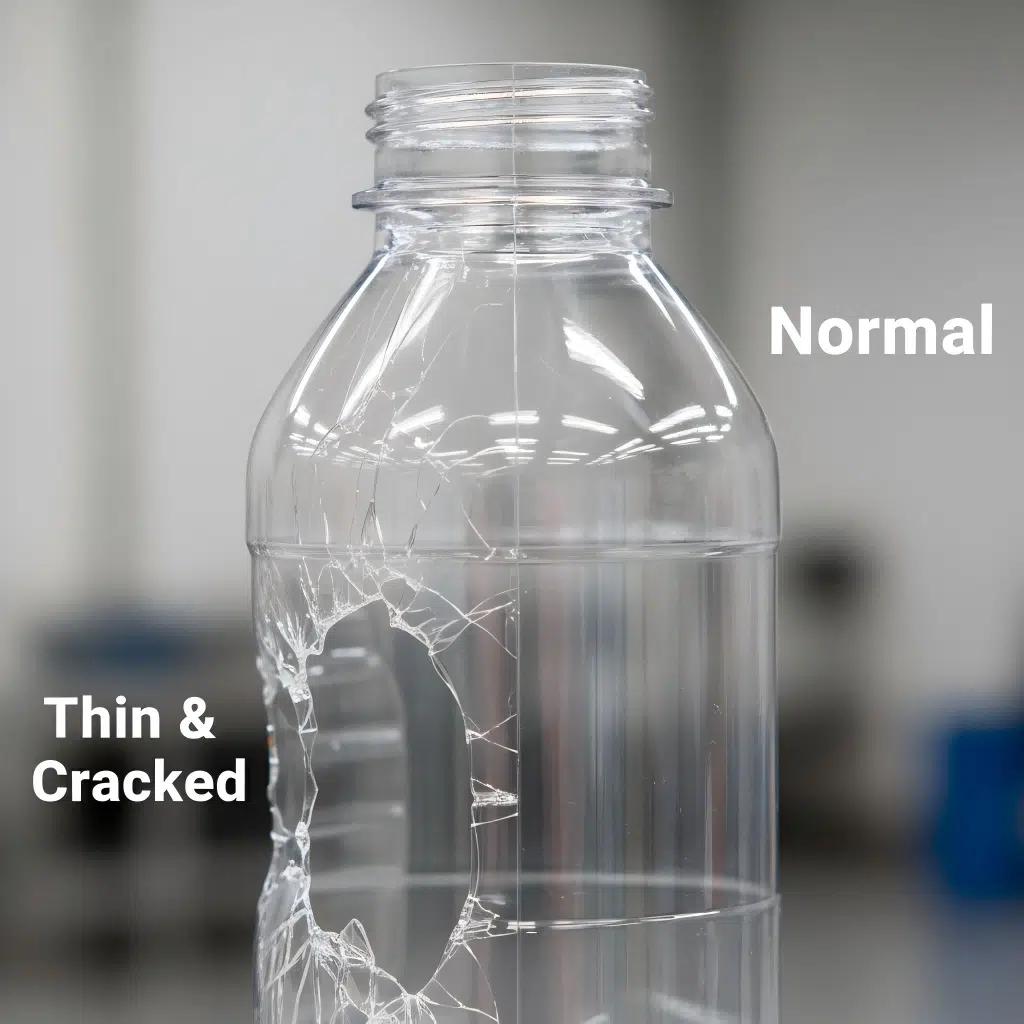
Why Do Identical Preforms Produce Different Bottles? Decoding Variances in PET Blow Molding
In high-speed PET stretch blow molding, achieving absolute consistency across millions of containers is the ultimate benchmark of production quality. However, a common and frustrating challenge frequently arises on the factory floor: identical preforms, sourced from the same batch and material specification, unexpectedly yield bottles with distinct physical variations.
When identical preforms produce different bottles, the root causes extend far beyond raw material quality. This phenomenon is driven by complex interactions between thermal thermodynamics, mechanical precision, pneumatic dynamics, and environmental factors.
1. Thermodynamic Profiles: The Phantom Impact of Preform Heating
Even if two preforms are physically identical before entering the heating oven, their thermal profiles right before the blowing stage can differ significantly. PET is highly temperature-sensitive; a variance of just 2°C to 3°C alters the material’s natural stretch ratio.
- Oven Lamp Degradation & Positioning: Infrared lamps age unevenly. If the ventilation or cooling airflow within the oven fluctuates, or if the distance between the preform and the lamp varies by fractions of a millimeter, the preforms will absorb different amounts of heat.
- Internal vs. External Temperature Gradient: A preform might feel hot on the outside but remain insufficiently heated on the inner wall. This uneven heat distribution causes the material to flow unpredictably during inflation, leading to localized wall thinning or material accumulation at the base.
2. Mechanical Kinematics: The Synchronization of Stretch Rods
The mechanical stretching phase determines the initial axial distribution of the PET material before high-pressure air expansion takes over.
- Stretch Rod Alignment and Speed: If a stretch rod is slightly bent, off-center, or experiences micro-frictions in its pneumatic cylinder/servo drive, it will not engage the center of the preform gate precisely.
- The Resulting Defect: An off-center stretch pushes more material to one side of the mold, creating a bottle with one dangerously thin wall and one excessively thick wall, leading to poor top-load strength and structural asymmetry.
3. Pneumatic Dynamics: Pre-Blow and Main-Blow Discrepancies
The inflation process relies on precise pressure management and split-second timing. Small discrepancies in the pneumatic valves across different blowing cavities can result in wildly different bottle outputs.
| Parameter | Operational Impact on PET Distribution |
|---|---|
| Pre-Blow Pressure & Timing | If pre-blow starts too early or the pressure is too high, the preform expands before it is axially stretched, locking material into the upper shoulder and thinning the base. |
| Main-Blow Delay | A microsecond delay in transitioning from pre-blow to high-pressure main blow (35 - 40 bar) allows the PET to cool down prematurely against the ambient air, preventing proper material flow into the mold corners. |
| Exhaust Valve Performance | Inefficient exhausting traps residual air, blocking the plastic from fully conforming to the mold design, resulting in poor label panel definition or soft corners. |
4. Cavity-to-Cavity Structural & Thermal Variances
- Mold Cooling Efficiency: PET crystallization relies heavily on rapid, uniform cooling upon contact with the mold walls. If the cooling water channels in Cavity 3 are partially clogged with scale or experience lower flow velocity than Cavity 4, the cooling rate changes. Insufficient cooling leads to excessive post-molding shrinkage or a hazy, over-crystallized appearance (pearlescence).
- Mechanical Wear of Mold Locking Mechanisms: Over time, high pressure can cause subtle wear in the mold locking toggles. A microscopic opening or flex at the parting line during high-pressure blowing alters the volume of the cavity, causing variations in bottle weight distribution and visible seam lines.
5. Environmental Ambient Conditions
PET is an inherently hygroscopic polymer, meaning it readily absorbs moisture from the surrounding atmosphere. If a batch of identical preforms is split—where half sits near a humid loading dock and the other half remains in a climate-controlled warehouse—their moisture content shifts. During heating, trapped moisture acts as a plasticizer, lowering the resin’s viscosity and causing the humid preforms to over-stretch, creating weak, thin-walled bottles compared to their dry counterparts.
Technical Solutions Checklist for Plant Engineers
To eliminate bottle variations and stabilize a 99.9% yield rate, technical teams should execute the following diagnostic workflow:
- Thermal Imaging Validation: Utilize infrared cameras to audit the surface temperature profile of preforms immediately as they exit the oven. Ensure cavity-to-cavity temperature deviation is strictly below ±1°C.
- Dynamic Pressure Graphing: Deploy real-time pneumatic sensors to cross-reference the pre-blow and main-blow pressure curves across all blowing stations to identify lagging valves.
- Mold Maintenance Protocols: Implement a rigorous cleaning cycle for internal cooling channels to prevent scale buildup, ensuring perfectly uniform heat transfer across all cavities.