 English
 Español
 العربية

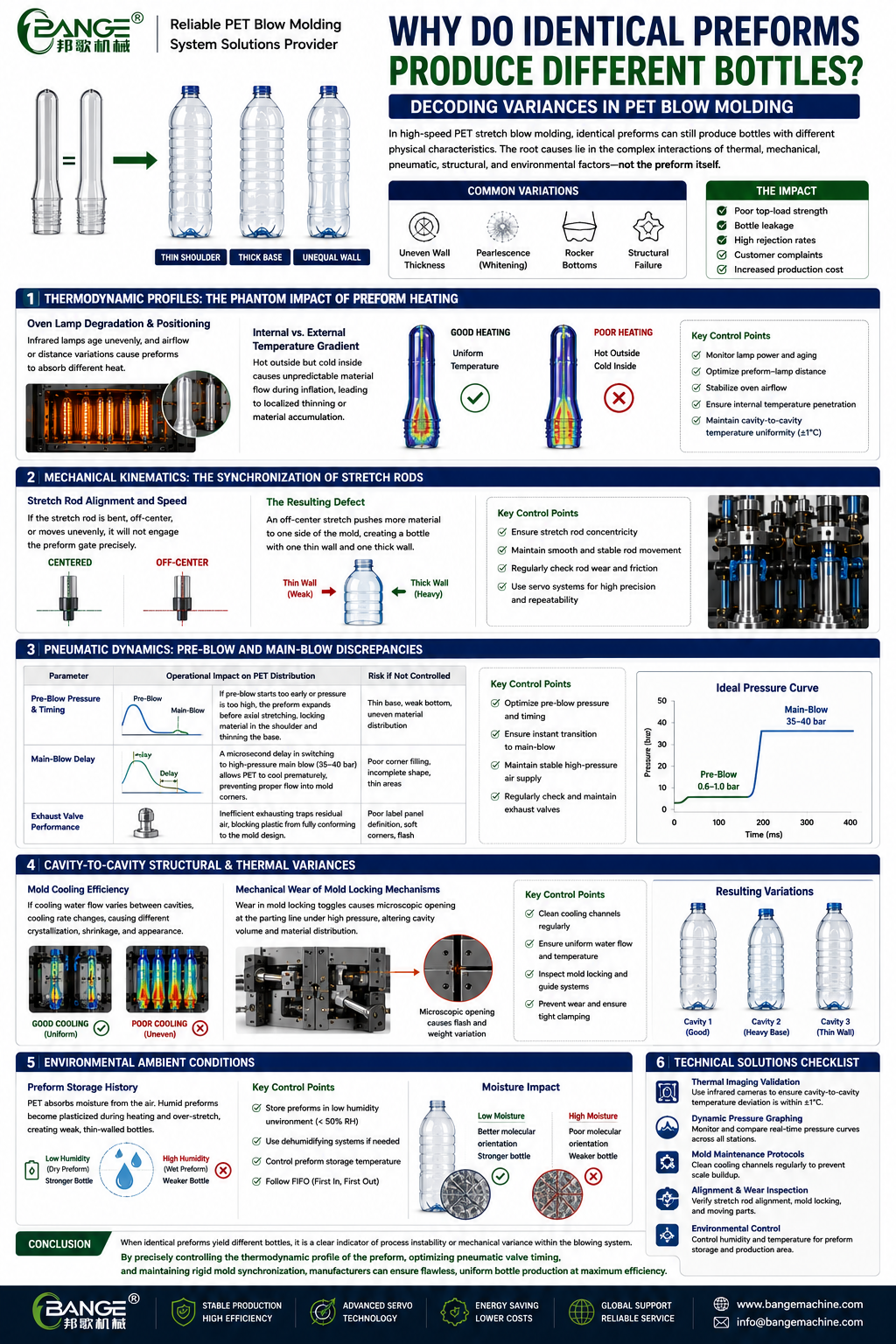
Why Does Cavity Cooling Imbalance Affect Bottle Stability? Insights from a Leading Chinese PET Blow Molding Machine Manufacturer
In the high-speed world of PET bottle production, achieving consistent bottle quality across all cavities is a constant challenge. One of the most critical yet frequently overlooked factors behind inconsistent bottle quality is cavity cooling imbalance. If your production line is suffering from warped bases, inconsistent wall thickness, or high reject rates, the root cause likely lies within your blow molding machine's cooling system.
As a professional PET blow molding machine manufacturer in China, Bange Machinery has dedicated years to optimizing thermal dynamics in stretch blow molding. In this article, we will dive deep into the science of cooling imbalance, how it compromises bottle stability, and how advanced Chinese engineering can solve it.
The Science: How Cooling Affects PET Material Properties
To understand why cooling imbalance is detrimental, we must look at the behavior of Polyethylene Terephthalate (PET). During the stretch blow molding process, the PET preheat temperature typically ranges between 90°C and 115°C. At this stage, the material is highly amorphous and stretchable.
Once the bottle is blown against the water-cooled mold walls, it must be cooled rapidly below its glass transition temperature ($T_g \approx 76^\circ\text{C}$) to "freeze" the polymer chains into their final crystalline structure. This process is crucial for establishing the bottle's mechanical strength and barrier properties.
What happens during a cooling imbalance?
When different cavities (or different zones within the same cavity) experience variance in cooling water flow or temperature, the PET material cools at non-uniform rates. This creates a cascade of structural defects.
3 Major Ways Cooling Imbalance Ruins Bottle Stability
1. Induced Residual Stress and Thermal Warpage
When one side of a PET bottle cavity cools faster than the other, the faster-cooling side contracts first, locking in high internal tensile stress. When the bottle is ejected prematurely from the mold, the warmer side continues to shrink. This uneven shrinkage leads to post-mold warpage, causing the bottle to tilt or deform. For beverage brands, a tilted bottle means failure on the filling line and poor shelf appeal.
2. Perpendicularity and Base Instability (The "Rocking Bottle" Syndrome)
The base design of a PET bottle (especially petaloid bases for carbonated soft drinks or heavy bases for hot-fill juices) requires precise cooling. The injection gate area at the very bottom of the preform is always the thickest part. If the mold base cooling circuit is clogged or unevenly distributed across cavities, the center of the base remains too hot. Upon ejection, internal pressure or gravity causes the base to drop or swell, resulting in a "rocker" bottle that cannot stand upright on conveyor belts.
3. Inconsistent Wall Thickness and Top-Load Failure
Cooling uniformity directly dictates material distribution during the stretch phase. In multi-cavity machines, if Cavity 1 runs hotter than Cavity 2, the preform in Cavity 1 will stretch more thinly because hotter PET offers less resistance. This leads to inconsistent wall thickness across the production batch. Thinned sections drastically reduce the bottle's top-load strength, making the packaging prone to crushing during palletizing and transportation.
The Bange Machinery Solution: Engineered for Absolute Thermal Consistency
At Bange Machinery, we understand that global packaging buyers demand perfection. To eliminate cavity cooling imbalances, our R&D team has implemented advanced thermodynamic solutions into our high-speed automatic PET blow molding machines:
- Independent Multi-Channel Cooling Circuits: Unlike standard machines that use a single looped cooling line, Bange machines feature independent, CNC-machined cooling channels for each individual cavity. This ensures that Cavity 1 and Cavity 8 receive the exact same water volume and pressure.
- Optimized Mold Base Cooling: We pay special attention to the base cup area. Our molds utilize specialized beryllium copper inserts paired with high-flow spiral cooling channels to rapidly pull heat away from the thickest part of the bottle gate.
- Intelligent Thermal Management Systems: Integrated with premium heating ovens and precise ventilation controls, our machines maintain a stable thermal equilibrium throughout the entire production cycle, minimizing ambient temperature interference.
Conclusion: Partner with a Professional Chinese PET Machine Factory
In the competitive packaging industry, bottle stability is non-negotiable. Addressing cavity cooling imbalance isn't just about tweaking your water chiller; it requires a robustly engineered blow molding machine built with precision tolerances.
As a premier OEM/ODM PET blow molding machine factory in China, Bange Machinery provides turnkey blowing solutions designed to maximize OEE (Overall Equipment Effectiveness) and eliminate defects like thermal warpage. Contact our engineering team today to optimize your PET production line.