 English
 Español
 العربية

Why Do PET Bottles Deform During Storage? Causes, Solutions, and Engineering Best Practices
By BANGE Machinery Technical Center
For bottled water producers, beverage manufacturers, and PET packaging suppliers, bottle deformation during storage is more than a cosmetic issue. A deformed bottle can reduce shelf appeal, create filling line instability, increase transportation damage, and ultimately lead to customer complaints.
Many factories assume warehouse temperature or pallet stacking is the primary cause. While these factors contribute, the real root cause often begins much earlier—during the PET stretch blow molding process.
At BANGE Machinery, we frequently help customers investigate storage deformation problems. In most cases, the issue is linked to residual stress, poor material distribution, insufficient cooling, or lightweight bottle designs that were not properly validated.
Why Do PET Bottles Deform During Storage?
PET bottles are formed by stretching and blowing heated preforms into a mold cavity.
During this process, PET molecules are stretched and oriented, creating the strength needed for the bottle to withstand internal pressure, transportation, and pallet loads.
When heating, stretching, or cooling parameters are not optimized, internal stress remains trapped inside the bottle wall.
Over time, especially during:
- Long-term warehousing
- High ambient temperatures
- Pallet stacking
- Transportation vibration
the molecular structure gradually relaxes.
As the stress releases, the bottle begins to change shape, leading to:
- Sidewall deformation
- Paneling
- Shoulder collapse
- Bottom distortion
- Reduced top-load strength
This phenomenon is known as structural relaxation.
The Five Most Common Causes of PET Bottle Deformation
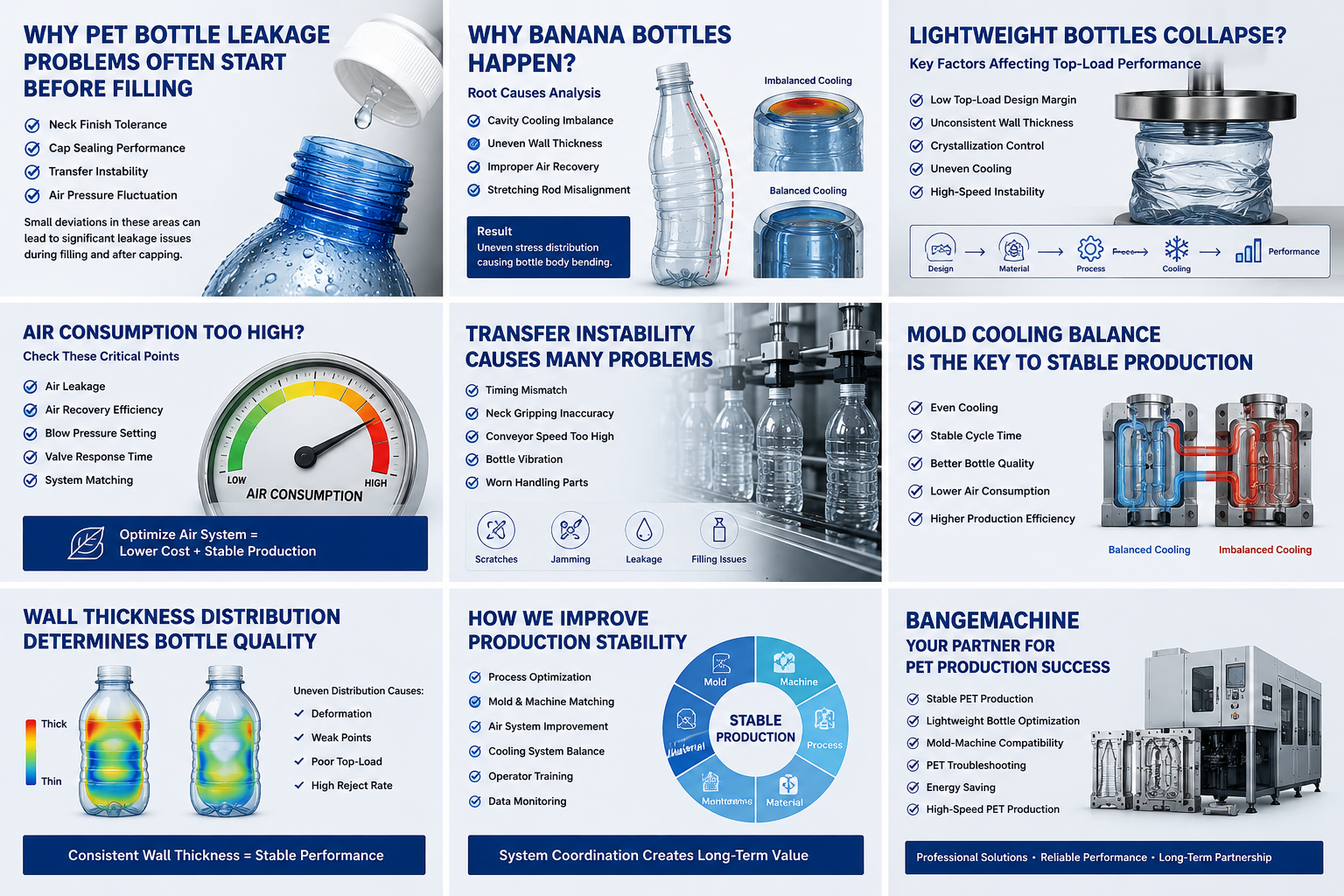
1. Uneven Wall Thickness Distribution
One of the most common causes is poor material distribution.
When bottle walls are not evenly stretched:
- Thin areas become weak points
- Thick areas cool slowly
- Stress becomes concentrated
During storage, these stress concentrations can trigger deformation.
Common causes include: Incorrect heating profiles, stretch rod misalignment, poor preform design, or transfer timing mismatch.
2. Excessive Residual Stress
Residual stress is invisible but extremely damaging.
If PET is stretched too aggressively or cooled too quickly, molecular chains become locked in an unstable state.
Weeks later, the bottle may begin to shrink or deform even though it passed inspection immediately after production.
Signs include: Bottle whitening, shoulder deformation, sidewall dimples, and unexpected dimensional changes.
3. Insufficient Mold Cooling
Cooling is often underestimated.
The bottle base, gate area, and shoulder require balanced cooling to stabilize molecular orientation.
If bottles leave the mold while still retaining excessive heat, the base may sag and storage deformation becomes more likely.
4. Lightweighting Beyond Structural Limits
Reducing bottle weight saves resin costs. However, many manufacturers discover that removing just 1–2 grams can significantly reduce top-load performance without optimized preform design and controlled material distribution.
5. High Storage Temperatures
High warehouse temperatures accelerate stress relaxation. Risk increases when bottles are stored near heat sources or inside containers exposed to direct sunlight in tropical climates.
Real Factory Case: South America Bottled Water Producer
A bottled water manufacturer in South America reduced bottle weight by 1.5 grams to lower packaging costs. Initial production results appeared successful. However, after approximately 30 days of warehouse storage, operators noticed severe sidewall deformation and reduced pallet stability.
BANGE engineers conducted a full production audit and identified uneven wall thickness and insufficient gate-area cooling. After optimizing heating zone settings, servo stretch parameters, mold cooling balance, and base geometry, the deformation rate dropped dramatically while maintaining the lightweight bottle target.
How BANGE Machinery Reduces Storage Deformation
Full Servo Stretching Technology: BANGE full-servo systems provide precise positioning and stable stretch velocity, resulting in lower residual stress and improved cavity-to-cavity repeatability.
Intelligent Preform Heating Control: Utilizes multi-zone infrared heating and independent ventilation control to maintain stable core-to-skin temperature profiles, improving wall thickness distribution.
Mold Cooling Balance Optimization: Focuses on independent cooling circuits and rapid gate-area heat extraction to lock molecular orientation into a stable structure before ejection.
Bottle Structure Verification: We evaluate bottle geometry, shoulder design, and top-load performance limits to ensure mold-machine compatibility.
Frequently Asked Questions
Q: Why do PET bottles deform after storage but look normal after production?
A: Because residual stress remains trapped inside the bottle wall. As the stress gradually relaxes, deformation becomes visible days or weeks later.
Q: Does lightweighting increase deformation risk?
A: Yes. Lightweight bottles have a smaller structural safety margin and require more precise control of material distribution and bottle geometry.
Q: Can cooling imbalance cause bottle deformation?
A: Absolutely. Uneven cooling creates different shrinkage rates throughout the bottle, increasing the likelihood of future deformation.
Q: How does servo stretching improve bottle stability?
A: Servo stretching delivers consistent material orientation and wall thickness distribution, reducing residual stress.
Q: Is warehouse temperature the main cause?
A: Usually not. Storage temperature accelerates deformation, but the root cause is often created during the blow molding process.