 English
 Español
 العربية

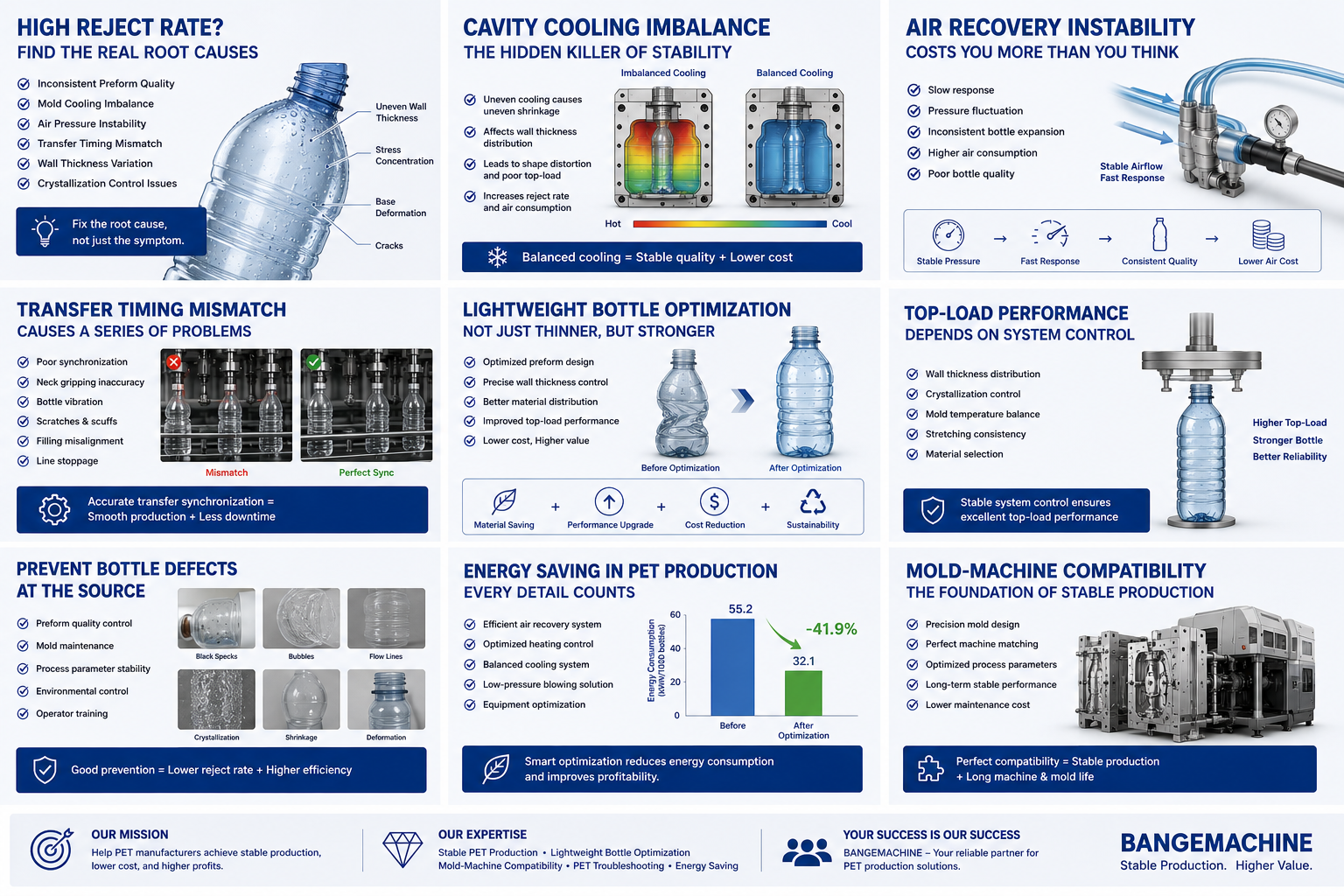
How to Improve PET Bottle Dimensional Accuracy? Causes, Solutions, and Machinery Calibration
By BANGE Machinery Technical Center
For high-speed beverage production, commercial water bottling, and automated packaging lines, PET bottle dimensional accuracy is critical. A variance of just a few millimeters in bottle height, diameter, or neck perpendicularity can cause major disruptions downstream. It can lead to filling valve jams, fluid mismeasurements, capping failures, and labeling errors.
When dimensional variation occurs across different mold cavities, factory operators often suspect batch-to-batch preform quality or wear on the aluminum mold surfaces. However, standard industrial audits show that poor dimensional accuracy is fundamentally tied to thermodynamic instability, uneven material distribution, and mechanical stretching deviations during production.
At BANGE Machinery, our engineering teams regularly partner with packaging plants to diagnose precision issues. By analyzing the structural mechanics of the blow molding process, we help operators lock in tight dimensional tolerances for stable production.
Why Do PET Bottles Lose Dimensional Accuracy?
PET bottles maintain their final shape through strain-induced crystallization, which occurs when a heated preform is blown and pressed against a cooled mold wall.
If the material does not cool uniformly or fails to reach the mold surfaces with equal pressure, different zones within the container will shrink at different rates after ejection.
Over time, this uncontrolled shrinkage results in dimensional drift, triggering issues like:
- Height shrinkage or variance across cavities
- Ovality or non-round body circumferences
- Sunken shoulders or neck tilting
- Base swelling or gate misalignment
Achieving absolute dimensional accuracy requires eliminating variations in thermal energy, pressure curves, and mechanical movement across every single cavity.
The Four Most Common Causes of Poor Dimensional Precision
1. Cavity-to-Cavity Cooling Imbalance
Cooling is the primary mechanism for locking in a bottle’s dimensional profile. If the internal cooling water lines are choked, poorly balanced, or using a single loop across multiple cavities, the temperature of each mold block will vary.
Bottles coming out of warmer cavities cool down much slower outside the machine, leading to higher post-mold shrinkage and smaller final dimensions compared to colder cavities.
2. Unstable Preform Core-to-Skin Heating
When the preform wall is heated unevenly—where the outer skin is significantly hotter or cooler than the inner core—the resin flows unpredictably during expansion. This irregular material distribution yields uneven wall thickness, concentrating shrinkage forces on thin sections and pulling the bottle out of its true geometric alignment.
3. Pressure Variations in High-Pressure Blowing (P2)
If the high-pressure blowing phase drops below 35 bar or exhibits time lag across different stations, the material won't press completely against the fine details of the mold cavity. This inadequate pressure prevents the geometric details, structural ribbing, and base contours from crisp formation, causing dimensional collapse once internal pressure drops upon ejection.
4. Mechanical Stretching Deviations
Traditional pneumatic stretch rods can introduce slight variations in travel speed and timing due to pressure fluctuations in the air supply line. This lack of precision causes variations in material distribution down the length of the container, compromising consistency across multi-cavity systems.
Real Factory Case: Middle East CSD Bottling Plant
A Carbonated Soft Drink (CSD) manufacturer experienced severe capping failures due to slight variances in bottle neck heights and base diameter ovality across a 12-cavity machine. The filling line suffered frequent jams, leading to high scrap rates.
BANGE technical field engineers audited the production line and identified an 8°C temperature delta between cavity molds caused by a single-looped cooling system, alongside pneumatic stretch lag. By retrofitting independent mold cooling matrices and switching parameter controls to digital servo tracking, the plant brought bottle height variation down to within ±0.2mm, completely halting capping faults on the line.
How BANGE Machinery Ensures Absolute Dimensional Accuracy
Full Servo Stretching Kinematics: BANGE replaces traditional pneumatic setups with a full-servo system. This delivers constant speed, micro-second positioning accuracy, and identical stretch parameters across all cavities to stabilize material layout.
Independent Spiral Cooling Circuits: Our molds feature independent, CNC-routed spiral cooling lines coupled with beryllium-copper base inserts. This combination removes heat uniformly across every cavity, ensuring equal shrinkage profiles for all bottles.
Intelligent Infrared Heating Controls: Advanced multi-zone infrared heating ovens feature independent ventilation settings to regulate core-to-skin temperature profiles, minimizing structural wall variations.
Precise Dual-Pressure Regulation: Integrated high-pressure valves maintain a stable blow pressure curve up to 40 bar, ensuring crisp geometric details and full structural replication before mold opening.
Frequently Asked Questions
Q: Why does bottle height vary between different cavities?
A: It is usually caused by an uneven cooling water flow or temperature distribution among the molds, which causes different post-mold shrinkage rates.
Q: How does wall thickness affect dimensional accuracy?
A: Thin walls lose heat rapidly and experience different shrinkage stresses compared to thick walls, pulling the bottle out of its intended roundness or symmetry.
Q: Can high-pressure blowing stability impact bottle sizing?
A: Yes. If blow pressure drops or cuts short, the polymer cannot fully adapt to the mold walls, resulting in a loosely formed, under-dimensioned bottle.
Q: What is the optimal mold cooling temperature for high accuracy?
A: For standard PET, mold water temperature is typically kept between 8°C and 12°C with a high flow rate to ensure structural orientation locks in quickly.
Q: Does servo stretching improve accuracy compared to pneumatic?
A: Absolutely. Servos eliminate pneumatic speed drift, providing uniform stretch timing and material placement across every single production run.