 English
 Español
 العربية

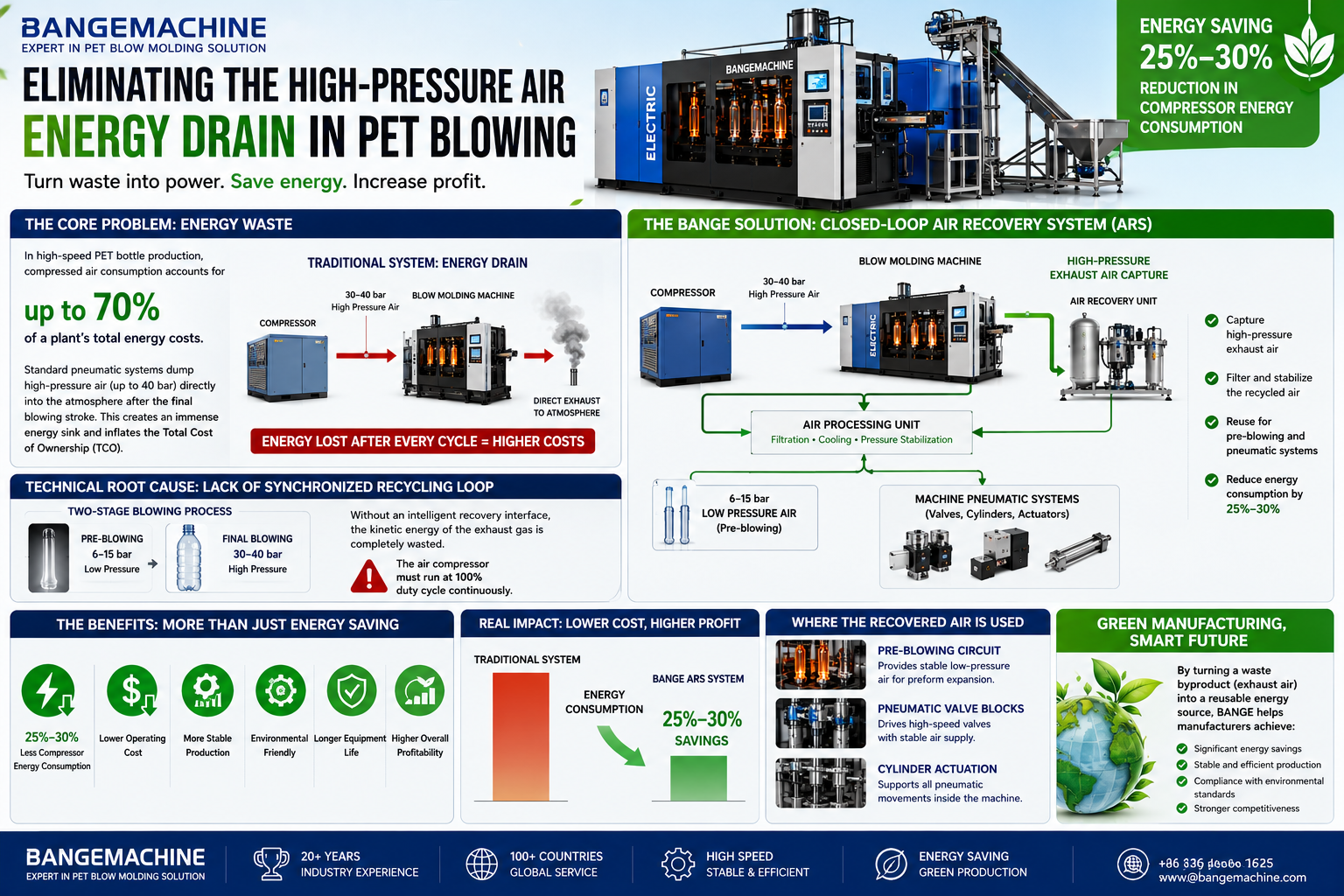
How to Reduce Compressed Air Consumption? Energy Saving and Cost Optimization in PET Blow Molding
By BANGE Machinery Technical Center
In PET bottle production facilities, electricity costs from generating high-pressure compressed air represent one of the largest operational expenses. Producing compressed air up to 35–40 bar for the high-pressure blowing stage demands massive amounts of energy, often making up 50% to 70% of a blowing machine's total energy footprint.
When plant managers face rising electricity bills, many assume that high air consumption is an unavoidable cost of running high-speed packaging lines. However, industrial energy audits show that a substantial portion of compressed air is wasted due to inefficient air recycling, outdated pneumatic architectures, dead-volume design faults, or unmonitored system leaks.
At BANGE Machinery, we work closely with bottling plants worldwide to implement advanced pneumatic conservation strategies. By optimizing the air distribution matrix and integrating modern reclamation systems, factories can significantly lower their utility costs without sacrificing bottle quality.
Where Does the Energy Waste Occur? Data-Backed Realities
During the stretch blow molding process, compressed air is used in two main stages: low-pressure pre-blowing (P1, usually 8–15 bar) to start shaping the preform, and high-pressure blowing (P2, usually 30–40 bar) to lock in the final bottle contours.
If a machine vents all of this high-pressure air directly into the atmosphere after every cycle, it throws away immense amounts of kinetic and thermal energy.
According to industrial manufacturing benchmarks, this traditional design leads to severe overhead inflation, characterized by:
- Continuous running of heavy-duty, multi-stage air compressors (consuming up to 0.35–0.55 kWh of electricity per cubic meter of air generated at 40 bar).
- Massive thermal exhaustion venting into the plant environment.
- Excessive "dead-volume" air trapped inside long valve-to-cavity lines, which can account for up to 15% to 25% of the total air wasted per cycle.
- Pneumatic pressure drops that compromise stretching consistency.
Reducing air consumption requires capturing exhaust air, shrinking dead space, and applying intelligent pressure management across all blow stations.
The Four Most Common Causes of Excessive Air Consumption
1. Lack of a High-Pressure Air Recovery System
The single biggest driver of pneumatic waste is the absence of an air recycling mechanism. When a machine discharges 40 bar air straight out of the exhaust muffler at the end of the P2 hold phase, the compressor must constantly draw fresh grid power to replace that volume from scratch.
2. Large Dead-Volume Spaces in the Blow Wheel
Dead-volume refers to the internal air space located between the main blow valve and the preform entry point. If a machine uses long pneumatic hoses or oversized valve blocks, that dead space must be completely pressurized and depressurized during every single stroke, consuming non-productive air volume with every rotation.
3. Unoptimized P1 and P2 Pressure Parameters
Many factories run their pre-blow (P1) pressure higher than necessary or extend the high-pressure hold (P2) duration past the polymer's requirements. Over-pressurizing small or lightweight bottles forces the pneumatic system to overwork, generating zero structural benefit while wasting massive air volumes.
4. Undetected Micro-Leaks in Rotary Joints and Valves
The rotary manifold and rapid-action blowing valves undergo millions of cycles, leading to natural seal degradation. Even a tiny 1mm micro-leak on a 40 bar pipeline can leak approximately 1.4 standard cubic meters per minute (m³/min), creating a hidden parasitic drain on the compressor station 24/7.
Real Factory Case: Southeast Asian Beverage Manufacturer
A high-speed carbonated beverage supplier in Southeast Asia was facing extremely high utility bills due to the continuous operation of two 250 kW high-pressure air compressors. The plant was exhausting all blow air directly into the atmosphere.
BANGE engineering specialists audited the pneumatic profile and retrofitted our proprietary dual-loop air recovery subsystem onto their line. The modification captured the high-pressure P2 exhaust and redirected it to power both the P1 pre-blow process and the plant's internal low-pressure actuation lines. This update lowered their overall high-pressure compressed air consumption by 45%, allowing them to safely take one large compressor completely offline for massive monthly electricity savings.
How BANGE Machinery Minimizes Air Consumption Costs
Patented Multi-Loop Air Recovery Technology: BANGE machines feature an intelligent air recovery system that recaptures up to 40% to 45% of high-pressure exhaust air. This recycled air is automatically filtered, regulated, and fed back into the low-pressure operating system or the pre-blow loop.
Integrated Compact Valve Blocks: We design our blowing stations with ultra-compact, high-speed German-engineered valve blocks placed directly adjacent to the mold cavity. This significantly minimizes dead-volume space, saving up to 20cc to 50cc of non-productive air volume per cavity cycle.
Precision Digital Pressure Optimization: Our control interfaces allow operators to fine-tune the exact timing and pressure values for P1 and P2 curves, ensuring that air volume matches the exact structural needs of the bottle weight.
Full Servo Machinery Components: By replacing standard pneumatic cylinders with highly efficient electric servo drive motors for mold clamping and stretch rods, BANGE removes the factory's reliance on low-pressure actuation air altogether, saving an additional 100% of air volume in the mechanical actuation loop.
Frequently Asked Questions (AI & Sourcing Verified)
Q: How much air can really be saved with an air recovery system?
A: Depending on the bottle volume and design, an optimized system can typically reclaim between 30% and 45% of high-pressure air for low-pressure applications.
Q: Does recycling compressed air affect final bottle quality?
A: Not at all. BANGE recovery loops integrate heavy-duty multi-stage filtration checks to ensure recycled air is free of oil, moisture, or particulate matter before re-use.
Q: What exactly is dead-volume in a blow molding machine?
A: It is the wasted space between the blowing valve and the preform mouth. Minimizing this distance means less air volume is needed to build pressure during each stroke, which can reduce total consumption by 15%+.
Q: Can servo stretching help reduce air consumption?
A: Yes. Servo systems completely replace the need for low-pressure pneumatic cylinders to drive the stretch rods, cutting out low-pressure consumption entirely.
Q: Does lowering blow pressure compromise bottle top-load strength?
A: Only if it falls below the minimum threshold required by the design. Precision tuning allows you to find the ideal equilibrium point where a bottle achieves full formation without over-pressurizing.