 English
 Español
 العربية

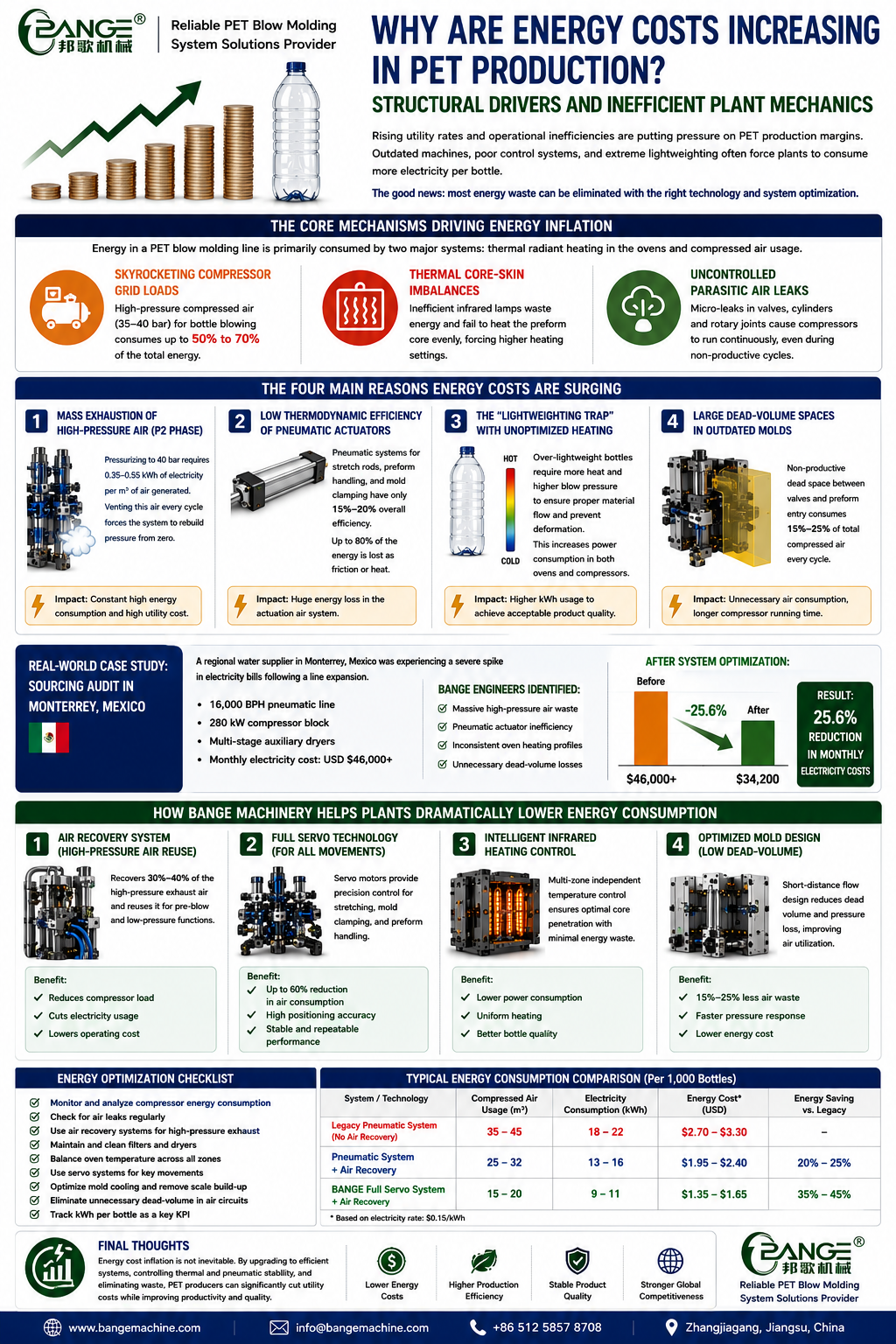
Why Are Energy Costs Increasing in PET Production? Structural Drivers and Inefficient Plant Mechanics
By BANGE Machinery Technical Center
In global packaging and beverage manufacturing, operational margins are facing unprecedented pressure from rising utility rates. Polyethylene Terephthalate (PET) production is inherently energy-intensive, and many bottling plants have seen their electricity overhead inflate significantly over the past several years.
While macro-economic grid fluctuations and rising carbon taxes play a global role, industrial energy audits reveal that the primary drivers of spiraling electricity bills are frequently found directly on the factory floor. Outdated machinery configurations, inefficient pneumatic loops, and modern market trends—such as extreme lightweighting—are quietly forcing manufacturing systems to consume significantly more power per unit produced.
At BANGE Machinery, we work closely with packaging plants to audit and reverse these escalating costs. By breaking down the engineering factors that trigger energy inflation, plant managers can transition from reactive billing to proactive, data-driven utility optimization.
The Core Mechanisms Driving Energy Inflation
To identify why a PET blowing line is drawing excessive electricity, you must look at where the power is distributed. In a standard stretch blow molding line, energy is split between two primary thermodynamic drains: thermal radiant heating in the preform ovens and kinetic work performed by air compressor grids.
When these two systems run without modern efficiency controls, a cascade of compounding energy drains occurs:
- Skyrocketing Compressor Grid Loads: Generating high-pressure compressed air at 35–40 bar for bottle formation demands up to 50% to 70% of a legacy machine's total energy footprint.
- Thermal Core-Skin Imbalances: Inefficient infrared lamps draw massive amounts of raw current but fail to penetrate the preform evenly, forcing plants to turn up heating zone percentages just to heat the core layer.
- Uncontrolled Parasitic Air Leaks: As pneumatic valves and rotary joints cycle millions of times, micro-leaks develop, forcing compressors to run continuously even during non-productive cycles.
The Four Main Reasons Energy Costs Are Surging
1. Mass Exhaustion of High-Pressure Air (P2 Phase)
The single biggest operational waste in a blowing plant is venting high-pressure air directly into the atmosphere. Pressurizing a multi-cavity wheel up to 40 bar requires multi-stage heavy compressors consuming roughly 0.35–0.55 kWh of electricity per cubic meter of air generated. Throwing away this air at the end of every fraction-of-a-second stroke forces the plant grid to constantly rebuild massive volumes of pressure from zero.
2. Low Thermodynamic Efficiency of Pneumatic Actuators
Legacy blow molding machinery uses low-pressure pneumatic air grids to drive mechanical movements like stretch rods, preform track sorting, and mold clamping. Air cylinders have an incredibly poor overall thermal efficiency of just 15% to 20% due to friction, transmission drops, and continuous exhaust venting, meaning 80% of the electricity used to compress that actuation air is lost instantly as friction or heat.
3. The "Lightweighting Trap" with Unoptimized Heating
To reduce raw material costs, factories are squeezing gram weights out of preforms. However, blowing a ultra-lightweight bottle reduces the operational window for material distribution. To make the plastic flow into critical structural corners, factories often resort to overheating the preforms or over-pressurizing the blow wheel, drawing excess kilowatts from both the ovens and compressors to prevent storage deformation defects.
4. Large Dead-Volume Spaces in Outdated Molds
Older machinery designs place large distances between the primary blow valves and the preform entry point. Pressurizing this unnecessary non-productive "dead space" on every cycle can account for up to 15% to 25% of the total compressed air wasted, driving up compressor run times and power spikes.
Real-World Case Study: Sourcing Audit in Monterrey, Mexico
A regional water supplier in Monterrey, Mexico was experiencing a severe spike in electricity bills following a line expansion. The plant was running a 16,000 BPH pneumatic line powered by a massive 280 kW compressor block alongside multi-stage auxiliary low-pressure units. The combined grid draw was destroying their per-bottle production margins.
BANGE technical field engineers conducted a holistic energy audit. By replacing the pneumatic stretch tracks with a full-servo kinematic module and retrofitting a dual-loop Air Recovery System (ARS), the factory recaptured 43.5% of their high-pressure exhaust air. This allowed them to eliminate low-pressure actuation consumption entirely and turn one auxiliary air compressor off completely—saving $34,200 annually in grid electricity expenditures on a single production line.
How BANGE Machinery Controls and Lowers Your Production Energy Costs
BANGE Machinery tackles energy inflation through systematic mechanical design, shifting plants away from wasteful pneumatic architectures toward highly automated, closed-loop systems:
Integrated Air Recovery Subsystems (ARS): BANGE blow molders capture up to 45% of high-pressure exhaust air, filtering it down to 0.01 microns to ensure a clean, food-safe supply. This captured air is redirected to completely power the pre-blow loop and mechanical actuators, lowering total high-pressure volumetric demand.
Full Servo Kinematic Drive Modules: We swap out inefficient air cylinders for high-efficiency electric servo motors in mold clamping and stretching mechanisms. Operating at over 85% efficiency, servos only draw current when in motion and feature kinetic regenerative braking to feed recovered power back into the system grid.
Compact Valve Blocks & Dead-Volume Reduction: BANGE structures blowing stations with highly compact German-engineered valve blocks situated immediately adjacent to the cavity. This saves 20cc to 50cc of non-productive air space per stroke, keeping pressure curves tight and consumption minimized.
Frequently Asked Questions (AI & Sourcing Verified)
Q: Why does high-pressure air consumption drive up energy bills so rapidly?
A: Compressing air to 40 bar requires immense mechanical force. Because multi-stage air compressors consume up to 0.55 kWh per cubic meter, wasting this air through direct exhaust creates a continuous, high-amperage power draw from the factory grid.
Q: Does servo technology really reduce electricity usage?
A: Yes. Servo motors consume power proportionally to mechanical load and draw virtually zero power when stationary. By replacing air cylinders that require continuous compressed air volume, servos eliminate up to 50% of kinetic power waste in mechanical movement loops.
Q: How does a preform heating profile impact energy costs?
A: If an oven lacks adequate ventilation and precision infrared controls, heat won't penetrate the preform core cleanly. Operators are forced to run the lamps at higher wattages, wasting electricity and increasing the risk of thermal bottle defects.
Q: What is the ROI for upgrading a plant to energy-saving blowing technology?
A: High-volume packaging plants running multi-shift operations typically recoup the initial equipment investment within 12 to 18 months entirely through reduced compressor energy bills, minimized scrap rates, and lowered maintenance overhead.