 English
 Español
 العربية
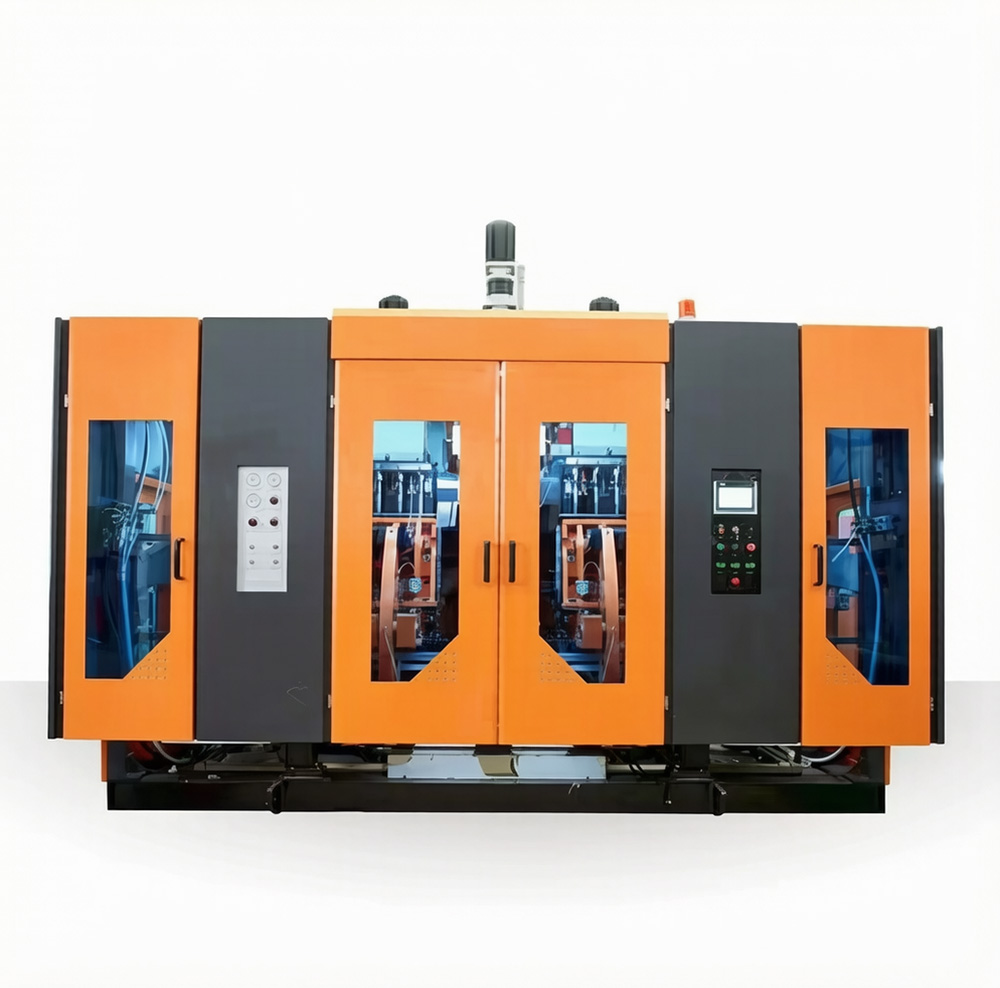
BANGE MACHINE manufactures PET blow molding machines for bottle producers worldwide, with models covering 50ml to 20L container sizes and export experience across 80+ countries [citation:2]. The company’s product documentation and project experience inform this sourcing guide, which is structured around the decisions a buyer actually makes: what to specify, what to verify, and what to plan before the machine arrives.
Stage 1: Define the Application Brief Before Contacting Suppliers
A supplier cannot quote accurately without a complete application brief. The brief is not a request for a brochure. It is the technical foundation for every subsequent comparison.
Essential Application Brief Elements
| Element | What to Specify | Why It Drives Machine Selection |
|---|---|---|
| Bottle specification | Volume (ml/L), neck finish (e.g., PCO 1881), body diameter, height, weight, wall thickness target | Determines cavity count, clamping force, and heating profile |
| Preform specification | Weight, neck standard, body tube dimensions, resin grade (virgin or PCR blend) | Heating system must match preform mass and resin thermal behavior |
| Target output | Accepted bottles per hour, operating shifts per day, annual volume | Drives cavity count and machine platform selection |
| Utility constraints | Available power (kW), high-pressure air capacity, cooling water temperature and flow | Machine power consumption and air demand must fit existing infrastructure |
| Mold plan | Number of SKUs, changeover frequency, whether molds are supplied by the machine maker or separately | Mold interface design and changeover system affect long-term flexibility |
BANGE’s large container series illustrates how application drives configuration. The 5L–20L machines use servo stretch systems and concentrated heating with a lamp distance of 101mm (versus 240mm on conventional designs) to achieve uniform wall thickness in thick-section containers [citation:2][citation:3]. A brief that specifies “20L water jug, 300–600 pcs/hr, single cavity” points directly to the BG-20L platform, which has a stated yield of 300–600 pcs/hr and actual power consumption of 18kW against a 120kW total connected load [citation:3].
Stage 2: Evaluate the Supplier’s Evidence, Not the Brochure
The critical distinction in supplier evaluation is between capability claims and configuration evidence. A manufacturer that builds machines for multiple applications may have extensive experience—but the relevant question is whether the specific configuration offered can produce your bottle at your required rate.
What to Request from Each Supplier
- Configuration sheet for the offered model: Not the product family brochure, but the specific configuration: cavity count, heating zone count, servo vs. pneumatic clamping, PLC brand and model, and included auxiliaries.
- Trial plan using your preform and mold: If your mold is available, the trial should use it. If not, the supplier should specify a comparable mold and document the bottle quality parameters that will be measured.
- Utility consumption data at an agreed boundary: Power, high-pressure air, low-pressure air, and cooling water, measured during a defined production run. BANGE’s BG-20L specification provides this level of detail: working pressure 0.7–0.9 MPa, blowing pressure 2.5–0.5 kg/cm², cooling water 50 L/min [citation:3].
- Reference projects with contactable customers: A reference is only useful if the application matches. Ask whether the reference bottle is comparable in volume, neck finish, and resin type.
- Documentation sample: Operation manual, maintenance schedule, and electrical schematic. The quality of documentation predicts the ease of local maintenance and troubleshooting.
The supplier’s response to these requests is itself a data point. A manufacturer that provides specific, documented answers has engineering depth. A manufacturer that responds with general claims and references to “many satisfied customers” is asking the buyer to accept unverified risk.
Machine Configuration Comparison: What to Verify by Function
| Function | Verification Question | Why It Matters |
|---|---|---|
| Heating system | Number of zones, lamp type and power, lamp-to-preform distance tolerance, cooling air distribution | Heating uniformity directly determines wall thickness distribution in the blown bottle |
| Clamping system | Hydraulic or pneumatic; clamping force repeatability; mold mounting pattern | Inconsistent clamping causes mold shift and uneven wall thickness |
| Stretch system | Servo or pneumatic; stroke repeatability; speed profile control | Stretch rod timing and speed affect material distribution in base and body |
| Control system | PLC brand and model; recipe storage capacity; fault diagnostics; remote access capability | Determines ease of changeover and troubleshooting support |
Stage 3: Define Acceptance Testing Before Comparing Prices
Factory acceptance testing (FAT) is the buyer’s opportunity to verify performance before shipment. The test must be defined in writing before the machine is built, not negotiated after it is complete.
Acceptance Test Protocol Elements
- Product specification: Bottle volume, weight, wall thickness at defined points, base clearance, and neck dimensions. These are the acceptance criteria, not the machine’s nameplate output.
- Material and preform source: The test should use the buyer’s preform specification or a documented equivalent. If the buyer’s mold is not available, the supplier’s mold must be identified and its cavity count and condition documented.
- Test duration: A continuous run of at least four hours, with reject bottles counted and classified by defect type. Short demonstrations do not reveal thermal drift or intermittent faults.
- Output measurement: Accepted bottles per hour, measured at the machine’s output, not the theoretical cavity count × cycle rate.
- Utility measurement: Power consumption at the machine’s supply terminals during the acceptance run, expressed as kWh per 1,000 accepted bottles. Air and cooling water consumption measured at the same time.
BANGE’s stated performance for the BG-20L provides a reference point: 300–600 pcs/hr for 20L containers, with actual power consumption of 18kW [citation:3]. A buyer specifying this model should verify those figures under their own preform and ambient conditions, not accept them as guaranteed.
Stage 4: Plan Installation Before the Machine Ships
Installation failures are often planning failures, not machine failures. The machine arrives with specific requirements for power, air, water, floor space, and environmental conditions. If those requirements are not met, commissioning delays are inevitable.
Installation Planning Checklist
| Utility / Infrastructure | What the Machine Requires | What to Verify at the Plant |
|---|---|---|
| Power supply | Total connected load (e.g., 120kW for BG-20L); voltage and phase | Transformer capacity, cable sizing, grounding, and voltage stability |
| High-pressure air | Pressure (e.g., 2.5–0.5 kg/cm²) and flow (e.g., 4000 L/min) | Compressor capacity, receiver tank volume, dryer performance, and piping diameter |
| Low-pressure air | Pressure (0.7–0.9 MPa) and flow (e.g., 2600 L/min) | Separate compressor or shared supply; filtration and moisture removal |
| Cooling water | Pressure (0.3–0.5 MPa), temperature (10°C range), flow (e.g., 50 L/min) | Chiller capacity, water quality, and circuit isolation |
| Floor space | Machine dimensions (e.g., 4.1 × 1.8 × 3.0 m for BG-20L) plus clearance for operation and maintenance | Floor load capacity, access for forklift and rigging, and clearance for mold changes |
Source: BANGE BG-20L technical specification [citation:3]
For export projects, the installation plan must also account for shipping, customs clearance, and the availability of local technical support. BANGE’s service model includes remote troubleshooting and on-site support, with a stated 24/7 support commitment [citation:2]. Buyers should clarify the response time and cost structure for on-site service before the contract is signed.
Frequently Asked Questions
What is the most important specification when comparing PET blow molding machines?
Guaranteed output and bottle quality with your preform and your mold, verified under defined acceptance conditions. A machine rated at a higher theoretical output with a reference mold may underperform with your production mold if the heating profile and mold interface are not optimized. Require the supplier to state performance for your specific application.
How long does installation and commissioning typically take?
For a single machine with standard utilities already in place, mechanical installation and commissioning can typically be completed in one to two weeks, depending on the supplier’s scope and the availability of qualified local technicians. First-article approval and stable production may require additional time for process optimization. The contract should define the supplier’s installation scope, the buyer’s responsibilities, and the criteria for commissioning sign-off.
Does BANGE MACHINE provide training for local operators?
BANGE’s service model includes technical support and training as part of the project scope [citation:2]. The specific training duration, location (factory or buyer’s site), and topics covered should be defined in the purchase agreement. For buyers in regions with limited local blow molding expertise, on-site training during commissioning is recommended.
What spare parts should be stocked at the plant from day one?
At minimum: heating lamp elements, blow nozzles, stretch rod tips, and pneumatic seals for the clamping and stretching systems. BANGE’s documentation should identify the wear parts for the specific model and provide part numbers and lead times. For export customers, ordering a first-year spares kit with the machine is more economical than emergency orders after a failure.