 English
 Español
 العربية
How Smart PLC Control Improves PET Bottle Production Stability
An Advanced Technical Analysis of Programmable Logic Controllers, Closed-Loop Servo Synchronization, and Real-Time Process Optimization in Stretch Blow Molding
1. Introduction to Digital Intelligence in PET Blow Molding
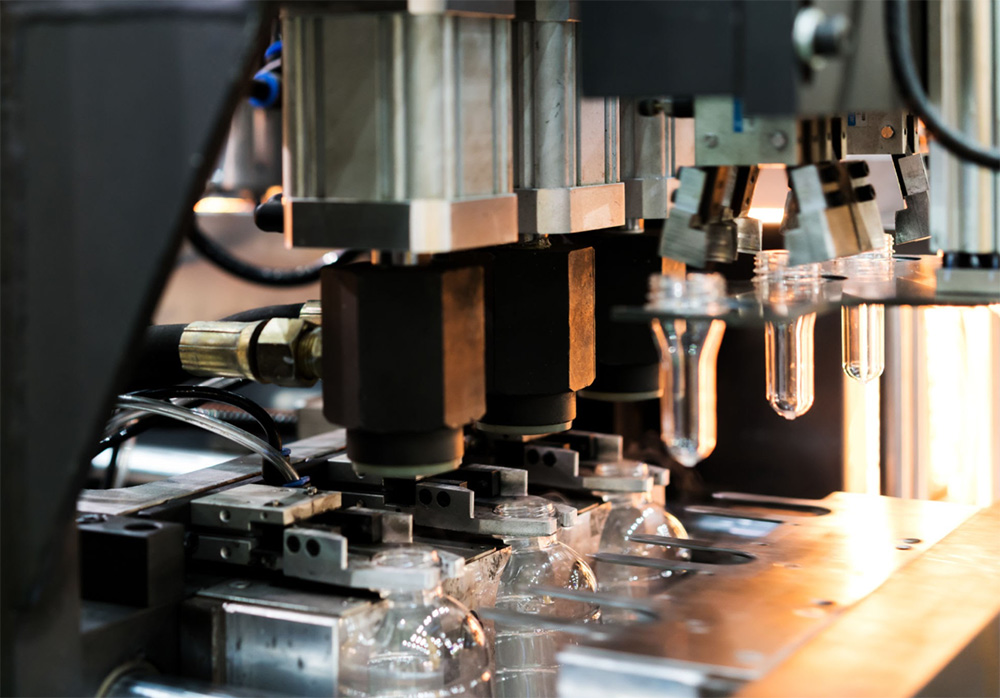
In high-speed rigid packaging lines, production stability and consistency are the definitive factors separating profitable manufacturing plants from those plagued by excessive downtime and high defect rates. As stretch blow molding (SBM) systems scale to higher cavities and faster cycle speeds, manual operator tuning becomes obsolete. Modern intelligent automation relies heavily on Advanced Programmable Logic Controllers (PLCs) paired with touchscreen Human-Machine Interfaces (HMIs). As an industry-leading PET blow molding machine manufacturer and professional turnkey project expert, Bangemachine integrates state-of-the-art smart PLC architectures into all rotary and linear platforms to guarantee maximum production stability.
2. Core Mechanisms of Smart PLC Control in Blow Molding
1. Closed-Loop Synchronization of Servo Axes
Traditional mechanical cam systems suffer from wear, backlash, and timing drift over extended operation. Smart PLC control systems govern high-precision servo motors for preform transfer, mold clamping, and stretch rod actuation. By maintaining microsecond-level synchronization across all axes, the PLC ensures that preform positioning, stretching speed, and blowing pressures align with absolute mathematical precision on every single cycle.
2. Dynamic Thermal Profiling and PID Regulation
Preform conditioning in the infrared oven is highly sensitive to ambient temperature fluctuations and batch-to-batch polymer variations. Intelligent PLC algorithms utilize closed-loop PID (Proportional-Integral-Derivative) control coupled with real-time pyrometer feedback. This allows the system to adjust infrared lamp intensity dynamically, preventing wall thickness deviation, pearlescence, or thermal shock.
3. High-Pressure Pneumatic Timing and Fault Diagnostics
Compressed air management requires exact millisecond coordination between pre-blow, high-pressure blow, and exhaust stages. Smart PLCs govern high-response proportional valves while continuously monitoring line pressure drops, flow rates, and sensor feedback. Integrated diagnostic libraries automatically flag anomalies, preventing catastrophic mechanical jams and reducing unplanned downtime.
3. Comparative Performance Analysis: Traditional vs. Smart PLC Systems
| Operational Parameter | Traditional Relay & Fixed Timer Systems | Bangemachine Smart PLC Architecture |
|---|---|---|
| Timing Accuracy | Millisecond drift via mechanical cams | Microsecond precision via digital electronic CAM |
| Thermal Regulation | Manual manual dial adjustments | Automated PID closed-loop real-time compensation |
| Fault Response Time | Reactive after operator visual inspection | Instantaneous automated error detection & safe stop |
| Overall Equipment Efficiency (OEE) | Moderate (frequent micro-stoppages) | High (stable 24/7 continuous operation) |
4. Why Partner with Bangemachine
As a premier Chinese enterprise specializing in the research, development, and manufacturing of high-performance PET blow molding machines, Bangemachine combines robust mechanical engineering with cutting-edge PLC software architectures. Whether deploying high-speed rotary systems or flexible linear machines, our expert turnkey solutions ensure your plant achieves ultimate stability, minimal energy loss, and world-class product quality. Contact Bangemachine today to elevate your packaging automation standards.