 English
 Español
 العربية

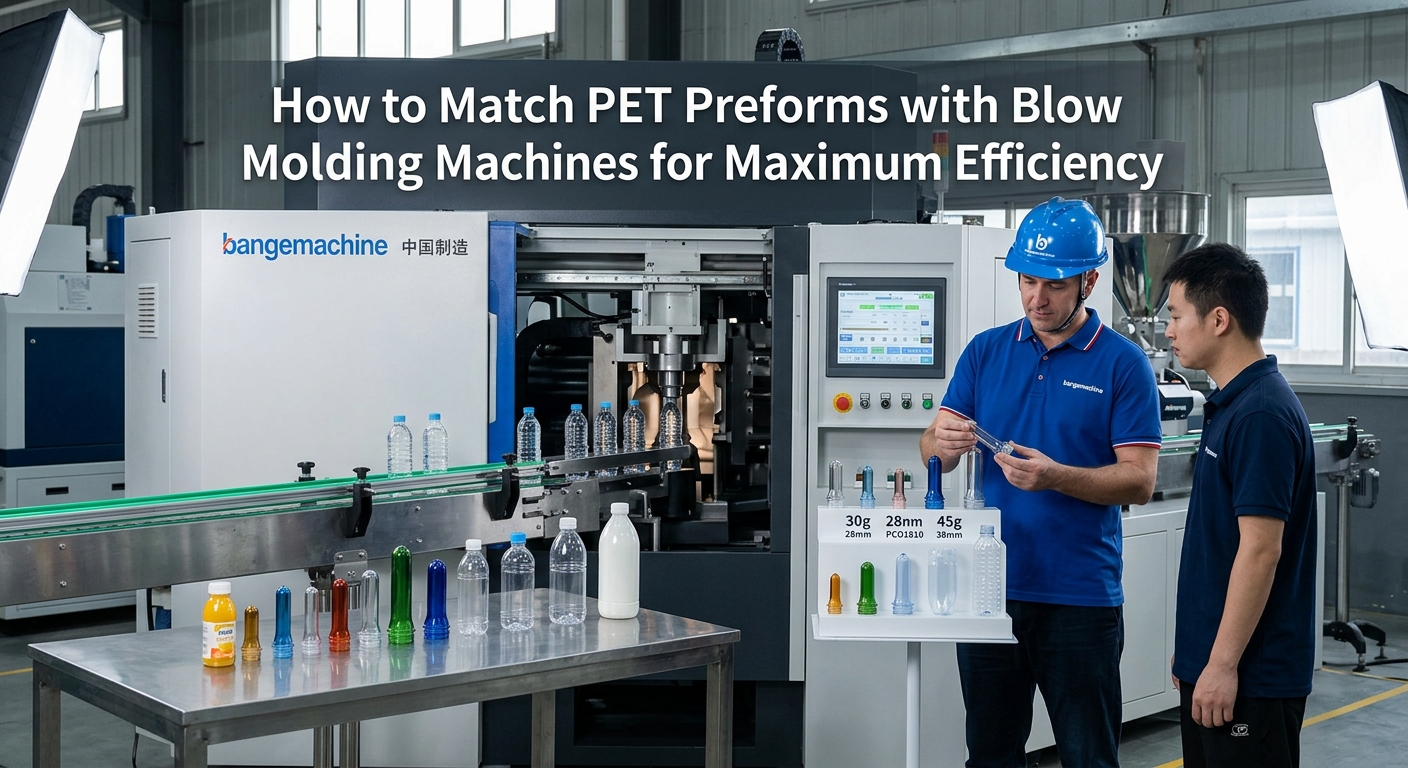
How to Match PET Preforms with Blow Molding Machines for Maximum Efficiency
An Advanced Technical Guide on Preform Weight Specifications, Stretch-Blow Ratios, and Thermal Conditioning Optimization
1. Introduction to Preform and Machine Synchronization
In high-speed rigid packaging production, achieving superior container integrity, precise wall distribution, and optimal Overall Equipment Efficiency (OEE) relies heavily on the precise synchronization between PET preforms and stretch blow molding (SBM) machinery. Selecting an incompatible preform design can lead to wall asymmetry, excessive haze, structural weakening, or high energy consumption. As an industry-leading PET blow molding machine manufacturer and professional turnkey solution expert, Bangemachine provides comprehensive engineering guidance to help global packaging producers perfectly match preform specifications with rotary and linear blow molding systems.
2. Key Technical Parameters for Preform-Machine Matching
1. Preform Weight and Container Capacity Ratios
The relationship between preform weight and final bottle volume dictates the stretch ratio and material thinning limits. Operators must calculate the appropriate stretch-to-blow ratio (typically between 6:1 and 8:1 for hoop and axial orientation) to ensure adequate mechanical strength and drop impact resistance without inducing stress whitening or pearlescence.
2. Neck Finish Compatibility and Support Ring Design
The preform neck finish (e.g., PCO 1881, 29/25, or 38mm sports cap) must match the machine's transfer starwheels, neck grippers, and blow nozzle seating mechanisms precisely. Improper neck support can cause preform jamming during high-speed transfer or lead to air leakage and thread stripping during high-pressure blowing.
3. Intrinsic Viscosity (IV) and Thermal Conditioning
PET resin IV (typically between 0.78 to 0.84 dl/g) directly influences how preforms absorb infrared radiation in the heating oven. Bangemachine's advanced rotary and linear blow molders feature intelligent PID lamp zoning and dual-zone cooling guards, allowing precise thermal conditioning tailored to specific preform wall thicknesses and polymer crystal structures.
3. Comparative Matrix of Preform Matching Criteria
| Preform Parameter | Critical Design Factor | Impact on Blow Molding Performance |
|---|---|---|
| Weight & Wall Thickness | Gram weight vs. finished bottle volume | Determines structural rigidity, drop test results, and material cost |
| Neck Finish Standard | PCO 1881 / 38mm / custom threads | Ensures seamless transfer and airtight sealing during high-pressure blowing |
| Intrinsic Viscosity (IV) | Polymer chain length and purity | Affects thermal absorption window and resistance to environmental stress cracking |
4. Why Partner with Bangemachine
As a premier Chinese enterprise specializing in the research, development, and manufacturing of high-performance PET blow molding machines, Bangemachine delivers expert turnkey packaging solutions tailored to international standards. Whether configuring high-speed rotary systems or flexible linear machines, our engineering team ensures optimal preform-to-machine integration for maximum productivity. Contact Bangemachine today to elevate your bottling plant efficiency.