 English
 Español
 العربية
In modern plastic packaging manufacturing, energy consumption represents one of the highest operating expenses (OPEX). For factories running high-speed PET blow molding lines, electrical energy is primarily consumed in two areas: the infrared preform heating process (around 50-60%) and the high-pressure compressed air system (around 30-40%). Improving energy efficiency directly translates to enhanced profitability and a smaller carbon footprint.
As a leading Chinese PET blow molding machine manufacturer, Bange Machine has engineered advanced hardware and software solutions to address this issue. This guide provides a deep technical analysis of where energy is lost in the blowing process and details actionable mechanical and operational adjustments to maximize your factory's efficiency.
1. Decoupling the Energy Consumption Drivers in PET Blowing
To systematically lower energy demand, we must isolate the thermodynamic and mechanical components of the PET blowing cycle. The total energy required (Etotal) can be modeled as:
Where heating and compression consistently dominate. Let us examine how targeted technological designs from Bange Machine optimize both sectors.
2. Optimizing the Thermal Process: Intelligent Infrared Preform Heating
The PET preform must reach its optimal glass transition temperature range (typically between 90°C and 115°C depending on the resin specifications) to ensure uniform wall thickness and optical clarity during stretching and blowing.
A. Precise Pitch Heating Ovens
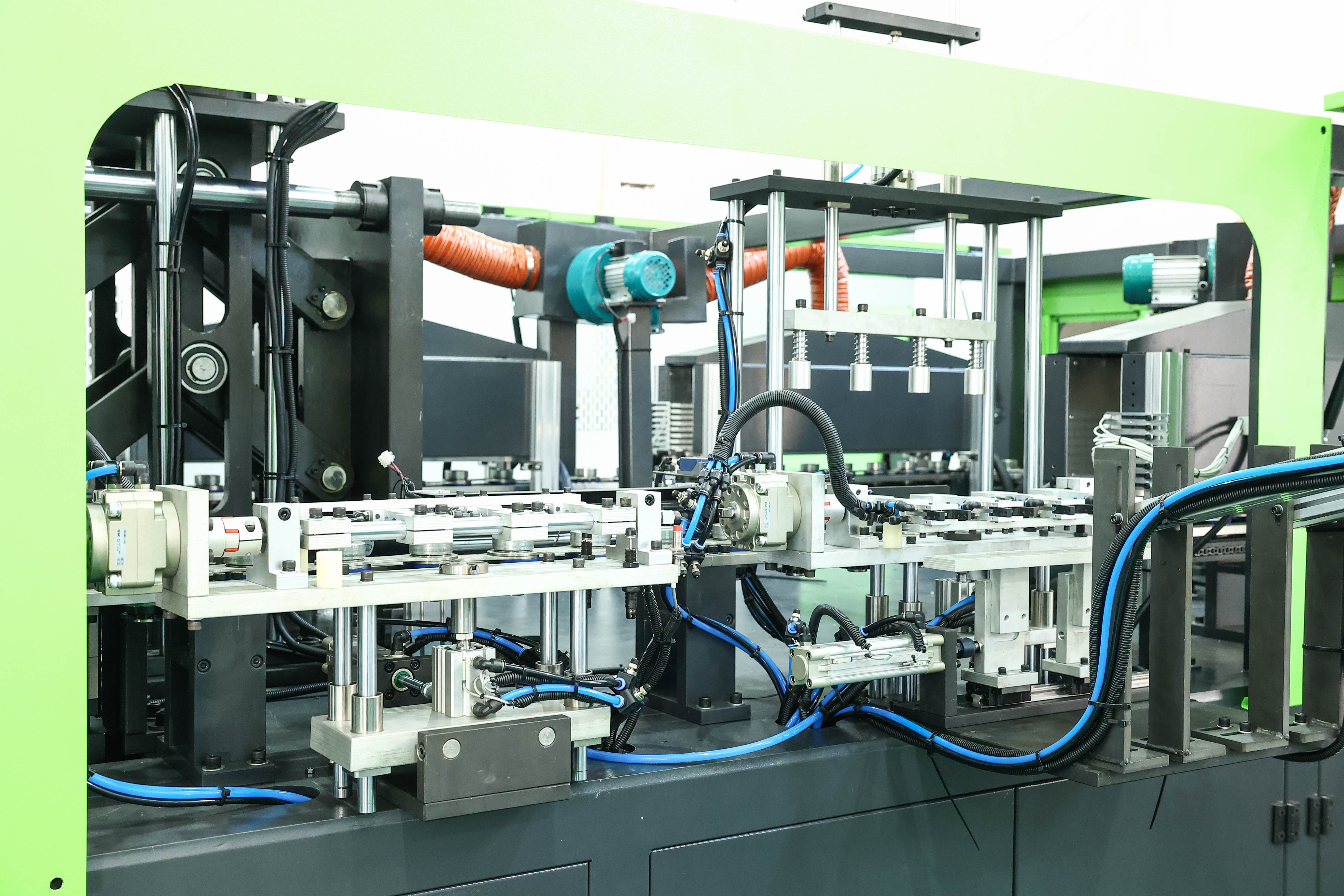
Conventional systems space preforms widely inside the heating oven, wasting vast amounts of heat radiation on empty air. Bange Machine utilizes a tight-pitch heating structure. By minimizing the physical distance between preform mandrels, our heating tunnel ensures that infrared radiation is focused almost exclusively on the preform bodies. This dense configuration reduces thermal energy dissipation by up to 25% compared to older semi-automatic or wide-pitch lines.
B. Zone-Controlled Short-Wave Infrared Lamps
Instead of continuous high-power heat, we implement zone-controlled, short-wave infrared lamps. Short-wave IR penetrates the PET wall depth faster and more uniformly than medium-wave alternatives, eliminating the risk of surface-burning while leaving the core cold. Each lamp segment is modularly controlled via an intelligent PLC algorithm, adjusting voltage by ΔV in real-time to match the ambient room temperature and humidity fluctuations.
If a preform is heated unevenly, the blowing process requires higher blowing pressures to force cold spots into the mold corners. Uniform heating through Bange Machine's short-wave IR system reduces the required mechanical pressure from 38 bar to 30-32 bar, yielding double energy savings.
3. Revolutionizing the Compressed Air System
High-pressure compressed air is the most expensive utility in a PET bottle plant. Generating and venting 30 to 40 bar air continuously demands heavy-duty industrial air compressors.
A. Air Recovery Systems (ARS)
A standard PET blowing machine vents the high-pressure air directly into the atmosphere after the bottle is formed. Bange Machine integrates a highly-efficient multi-stage Air Recovery System (ARS). When the blowing cycle finishes, the high-pressure air (P1 ≈ 35 bar) is redirected back into storage tanks to serve as low-pressure pre-blowing air (P2 ≈ 8-12 bar) or to drive the machine's pneumatic actuators (P3 ≈ 6-8 bar).
| System Type | Blow Pressure (High) | Recycled Air Use | Estimated Energy Saving |
|---|---|---|---|
| Standard Blow Molding | 35 - 40 Bar | None (Vented) | 0% (Baseline) |
| Bange ARS (Stage 1) | 35 - 40 Bar | Pre-blowing Air (8-10 Bar) | Up to 25% Reduction |
| Bange Dual ARS (Stage 1+2) | 35 - 40 Bar | Pre-blowing & Pneumatic Actuators | Up to 45% Reduction |
4. Advanced Mechanical Integration: High-Efficiency Servo Drives
Older generation PET blowers rely heavily on hydraulic pumps and pneumatic cylinders for clamping and stretching, which leak pressure and consume power even when the machine is idle. Bange Machine features all-servo-driven execution:
- Servo Clamping: Ensures precise mold synchronization, fast lockup, and lowers clamping power consumption by 30%.
- Servo Stretching: Replaces traditional pneumatic stretching rods, providing infinitely adjustable stretching speed profiles, which optimize material distribution and reduce scrap rates.
5. Industry 4.0 Energy Management Dashboard
You cannot manage what you do not measure. Bange's custom PLC interface tracks energy metrics in real-time, displaying kilowatts consumed per thousand bottles produced. Any drop in heating efficiency or leak in the high-pressure pneumatic circuit triggers an automated alert, allowing maintenance engineers to step in before energy waste scales up.
By implementing precise heating control, multi-stage air recovery, and fully synchronized servo mechanics, Bange Machine delivers PET blowing plants that operate up to 45% more energy-efficiently than standard setups. For tailored layouts, mold designs, or factory upgrades, visit www.bangemachine.com.
PET blow molding machine, Energy-saving blow molding, Bange Machine, PET bottle blowing energy consumption, Automatic PET blowing machine, Air recovery system PET blowing, Chinese PET blow molding manufacturer, High-speed PET bottle machine, PET blow molding factory solutions, PET preform heating efficiency, Servo-driven blow molding machine