 English
 Español
 العربية
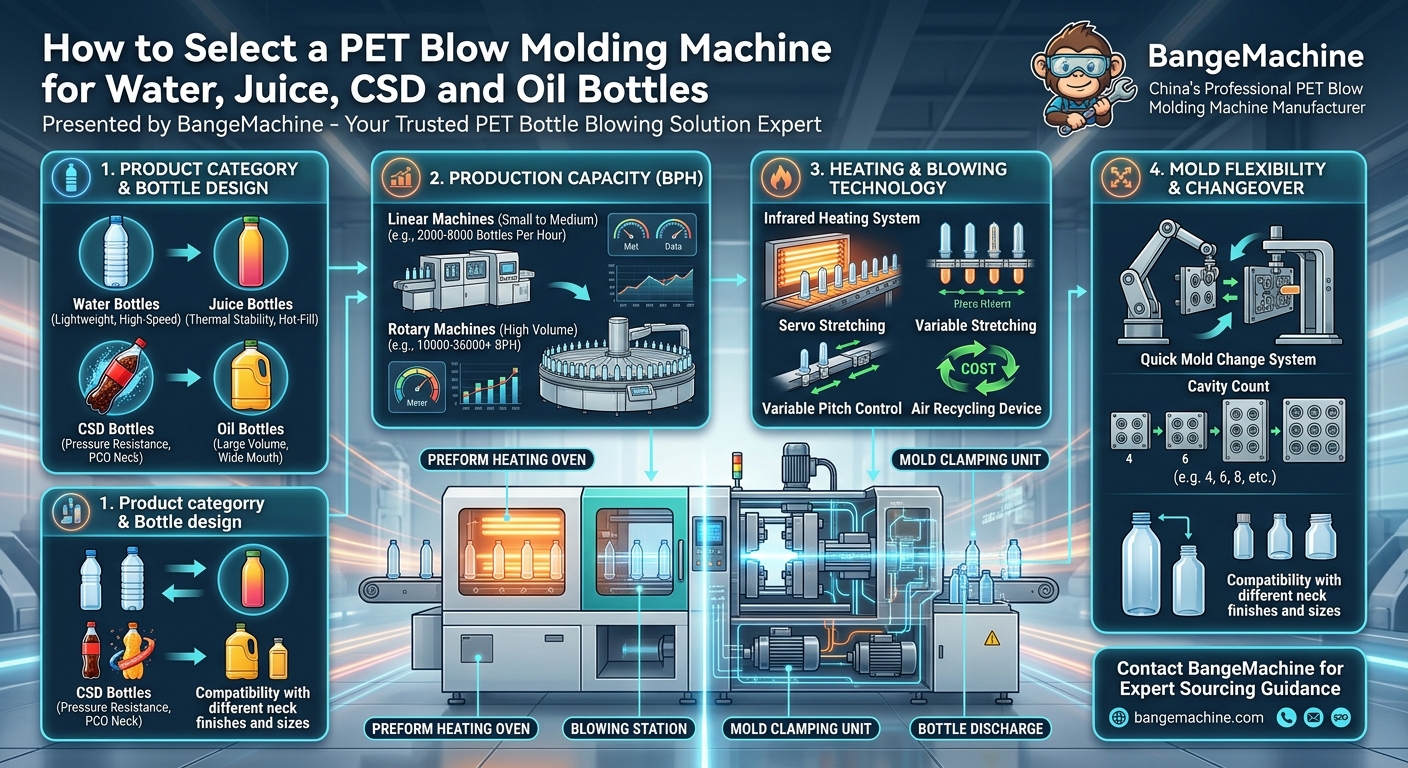
How to Select a PET Blow Molding Machine for Water, Juice, CSD and Oil Bottles
Selecting the right PET stretch blow molding machine (SBM) is a crucial decision for beverage producers, edible oil manufacturers, and packaging contract suppliers. Different liquid products present unique physical, thermal, and mechanical demands on the final PET container. A blowing machine designed for standard lightweight mineral water bottles will struggle or fail when tasked with heat-resistant hot-fill juice bottles, pressure-resistant carbonated soft drink (CSD) containers, or heavy-grammage edible oil jugs.
At BangeMachine, a professional Chinese manufacturer specializing in high-speed, fully automatic, and semi-automatic PET blow molding equipment, we provide tailored turn-key solutions engineered to meet exact liquid filling standards. This technical engineering guide breaks down the core technical criteria required to evaluate and select the optimal PET blow molding machine based on bottle type, production capacity, heating configuration, and mechanical stability.
1. Tailoring Blow Molding Technology to Specific Bottle Applications
To achieve flawless container performance, the stretch blow molding process must align with the container's structural requirements and liquid characteristics:
A. Mineral Water Bottles (Lightweight & High-Speed Output)
Water packaging focuses primarily on material reduction (lightweighting) and rapid production cycles. Because water is non-carbonated and ambient-filled, thin-walled preforms with lightweight necks (such as 29/25 or 1881) are standard.
- Machine Requirement: High-speed linear or rotary blow molders equipped with precise infrared preform heating, quick mold-clamping systems, and air recycling devices to lower operating costs[cite: 4, 8].
- Key Feature: Servo-driven stretching and clamping units to ensure ultra-fast cycle times without compromising base thickness consistency.
B. Juice & Tea Bottles (Hot-Filling & Thermal Resistance)
Juice and tea beverages often undergo hot filling (typically 85°C – 92°C) to ensure pasteurization and shelf stability. Standard PET bottles deform under these thermal conditions.
- Machine Requirement: Specialized Heat-Set PET Blow Molding Machines equipped with dual oil-temperature mold heating controllers (mold temperature held between 120°C and 140°C).
- Key Feature: Controlled crystallization processes during the blowing phase to enhance the thermal resistance of the bottle walls, along with vacuum-panel bottle base designs.
C. Carbonated Soft Drink (CSD) Bottles (Pressure Resistance & Base Structural Integrity)
Carbonated beverages exert continuous internal pressure (up to 4–5 bar). Poor stress distribution lead to bottle cracking or base distortion.
- Machine Requirement: High-pressure blowing systems (30–40 bar) paired with robust mold clamping mechanisms to prevent mold seam parting under pressure[cite: 5].
- Key Feature: Petaloid base mold design capability and multi-stage pressure blowing controls to ensure uniform material distribution across the stress-bearing base arches.
D. Edible Oil Bottles & Large Containers (Wide Handles & Heavy Grammage)
Edible oil containers range from 1L to 5L (and up to 20L / 5-gallon water jugs), requiring deep structural ribs, handle insertion features, and thick preforms[cite: 3, 9].
- Machine Requirement: Heavy-duty blow molders with extended heating zones, deeper oven penetration, and wide-platen clamping systems[cite: 1, 3, 9].
- Key Feature: Intense infrared penetration heaters capable of evenly heating thick-walled preforms without burning the outer surface.
2. Technical Selection Matrix by Bottle Category
| Application Category | Blowing Pressure (Bar) | Heating & Mold Thermal Control | Structural Base Type | Recommended BangeMachine Solution |
|---|---|---|---|---|
| Purified / Mineral Water | 18 – 25 Bar | Standard Infrared Oven | Flat / Lightweight Ribbed Base | High-Speed Fully Automatic Series (4 / 6 / 8 Cavities)[cite: 4, 6, 8] |
| Hot-Fill Juice & Tea | 25 – 30 Bar | Oil-Heated Thermal Heat-Set System | Vacuum-Panel / Heat-Resistant Base | Specialized Thermal-Set Automatic Blow Molder |
| Carbonated Soft Drinks (CSD) | 30 – 40 Bar | Precise Multi-Zone Temperature Control | Petaloid High-Pressure Base | High-Clamping High-Pressure Automatic Series[cite: 5] |
| Edible Oil / Large Jugs (1L–20L) | 25 – 35 Bar | Deep-Penetration Long-Pitch Oven | Heavy Flat or Recessed Base | Wide-Platen Automatic / Semi-Automatic Large Molder[cite: 1, 3, 9, 10] |
3. Crucial Engineering Factors When Choosing Your Blowing Equipment
A. Heating Oven Efficiency & Penetration Depth
The heating system is the heart of any PET stretch blow molding machine. BangeMachine utilizes modular rotary heating ovens with micro-adjustable infrared lamps. Independent zone temperature regulation allows precise heat profiles for different preform lengths and neck finishes, preventing material degradation and reducing energy consumption by up to 25%.
B. Clamping Force & Structural Rigidity
High blowing pressures (up to 40 bar) exert tremendous force trying to push mold halves apart. Insufficient clamping leads to unsightly flash, uneven bottle walls, or dimension errors. BangeMachine incorporates toggle-locking or hydraulic-assisted clamping systems engineered to withstand intense pressure while maintaining high-speed operation[cite: 2, 4].
C. Pneumatic System & High-Pressure Air Recovery
Air compressors represent a significant portion of operating costs in a PET bottling plant. BangeMachine equips its blowing systems with integrated high-pressure air recovery units. Up to 30% of the high-pressure exhaust air from the blowing cycle is captured and reused for low-pressure cylinder movement and pre-blowing actions, drastically reducing overall power demand.
D. Automation Level & Line Integration
Depending on your plant layout and budget, choose between:
- Fully Automatic PET Blow Molders: Integrated with auto-unscramblers, preform elevators, and direct air-conveyor connections to filling lines for high-volume factories[cite: 4, 5, 8].
- Semi-Automatic PET Blow Molders: Ideal for small-to-medium enterprises, specialty container shapes, wide-mouth jars, or 5-gallon bottle lines where manual loading flexibility is preferred[cite: 1, 9, 10].
4. Why Partner with BangeMachine as Your Blow Molding Solution Specialist?
As a professional PET packaging machinery manufacturer in China, BangeMachine delivers complete packaging solutions customized to your specific production demands[cite: 2]. Our advantage lies in precision engineering, durable components, and end-to-end technical support:
- Turn-Key Project Delivery: From preform design and blow mold manufacturing to air compressors, chillers, and line integration.
- Proven Machine Stability: Built with international brand pneumatic and electric components (such as Festo, Schneider, and Omron) for smooth 24/7 continuous operation[cite: 5].
- Tailored Engineering: Customized cavity layouts and stretch ratios designed around your exact bottle drawings and preform availability.
Conclusion: Optimize Your Bottling Line Efficiency
Selecting the right PET blow molding machine requires a thorough evaluation of your beverage characteristics, target bottle weight, output capacity, and long-term energy costs. Matching the machine's heating, clamping, and blowing capabilities directly to your application ensures maximum uptime, low scrap rates, and superior container clarity.
Planning to set up a new PET bottle production line or upgrade your current blowing machinery? Contact the technical specialists at BangeMachine today for expert machinery selection and customized plant layout solutions.