 English
 Español
 العربية

1. Introduction to PET Blow Molding Quality Optimization
Polyethylene Terephthalate (PET) stretch blow molding (SBM) is a highly refined precision manufacturing process utilized worldwide for packaging carbonated beverages, water, edible oils, pharmaceuticals, and cosmetics. Achieving optimal container structural integrity, crystal-clear clarity, and precise wall thickness distribution requires rigorous control over thermal profiles, preform conditioning, stretch rod kinetics, and blow pressure stages. As a leading PET blow molding machine manufacturer, Bangemachine provides advanced engineering solutions designed to eliminate operational downtime and minimize container defect rates.
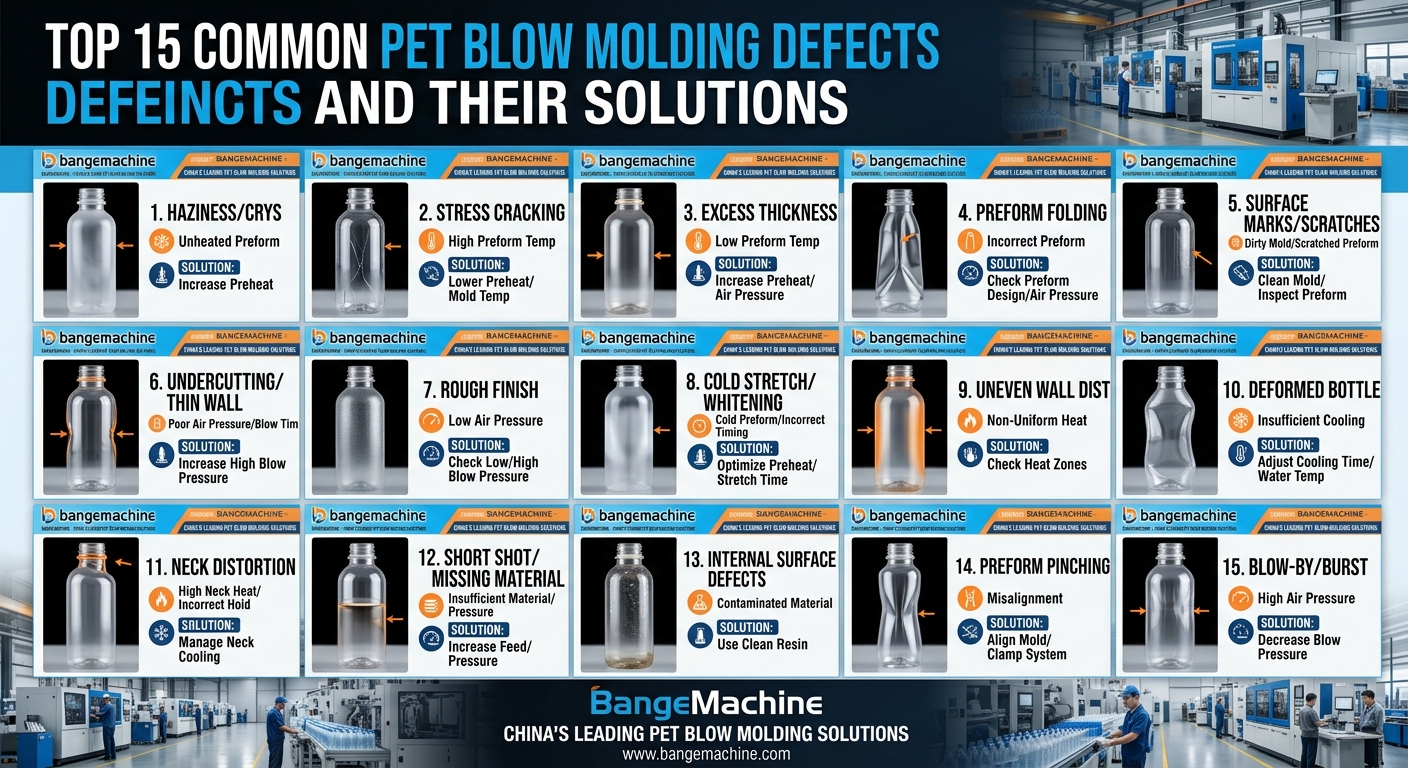
2. Comprehensive Analysis of the Top 15 PET Blow Molding Defects
1. Wall Thickness Asymmetry (Uneven Wall Distribution)
Causes: Preform temperature imbalance across the circumferential axis, incorrect preform centering, or delayed stretch rod descent velocity.
Solutions: Calibrate infrared lamp zones in the preform conditioning oven, inspect rotation mechanisms of preform spindles, and optimize stretch rod speed profiling during the initial pre-blow stage.
2. Base Sagging (Bottom Sag / Heavy Base)
Causes: Excessive preform heating temperature at the gate area, insufficient pre-blow pressure, or premature pre-blow timing.
Solutions: Reduce the lower heating zone lamp intensity, advance the pre-blow start timing, and increase pre-blow pressure to ensure rapid radial stretching before gravitational sagging occurs.
3. Base Pinpoint Off-Center (Gate Off-Center)
Causes: Mechanical misalignment between the stretch rod and the mold cavity center, or excessive preform thermal softening causing distortion upon contact.
Solutions: Perform mechanical alignment of the stretch nozzle assembly, verify mold alignment pins, and lower overall preform temperature if thermal distortion is detected.
4. Top Pinch / Neck Deformation
Causes: Excessive clamping force damaging the neck finish or incorrect nozzle sealing pressure pressing down on the support ring.
Solutions: Adjust mold clamping tonnage parameters, inspect blow nozzle seating alignment, and verify neck support ring dimensions against preform specifications.
5. Haze / Cloudiness (Crystallization / Stress Whitening)
Causes: Preform overheated in the infrared oven inducing undesired crystalline structures, or over-stretching at incorrect temperatures.
Solutions: Lower oven heating percentages across affected zones, increase cooling airflow around the preform handling area, and optimize the stretch-to-blow ratio.
6. Stress Cracking (Environmental Stress Cracking / ESCR Failure)
Causes: Residual internal stresses from rapid quenching, uneven molecular orientation, or aggressive chemical interaction with container contents.
Solutions: Optimize stretch blow molding thermal parameters to ensure uniform molecular chain orientation, enhance bottle base cooling efficiency, and test raw material intrinsic viscosity (IV).
7. Surface Scratches and Scuffs
Causes: Mechanical friction during preform transfer, worn mold vent channels, or foreign particle accumulation inside the blow mold cavity.
Solutions: Implement rigorous preventative maintenance schedules, clean mold interior surfaces ultrasonically, and inspect starwheels and transfer rails for burrs or misalignment.
8. Bottom Pinch-Off Failure (Flash at Base)
Causes: Excessive clamping pressure crushing the base material, worn mold parting lines, or excessive high-pressure blowing energy.
Solutions: Recalibrate mold clamping limits, inspect base seal inserts for wear, and optimize high-pressure blow duration and switchover points.
9. Panel Inward Collapse (Vacuum Paneling / Panel Distortion)
Causes: Rapid cooling of hot contents sealed inside containers, improper vacuum relief in hot-fill applications, or insufficient panel rib structural design.
Solutions: Modify container vacuum absorption rib geometry, adjust cooling tunnel temperatures after filling, and optimize resin crystallization levels.
10. Pearlescent Effect (Silver Streaks / Over-Stretching)
Causes: Cold core temperature of the preform combined with excessive stretch rod velocity, causing localized micro-voids and structural whitening.
Solutions: Increase preform oven temperature profiles, reduce stretch rod descent speed, and verify ambient room temperature stability.
11. Entrapped Air Bubbles / Blisters
Causes: Moisture trapped within PET resin during injection molding due to inadequate dehumidifying dryer performance.
Solutions: Ensure PET resin moisture content remains below 0.02% by maintaining desiccant dryer dew points at -40°C and proper drying residence times.
12. Vertical Wall Ripple / Accordion Effect
Causes: Delayed pre-blow timing causing the preform to stretch axially before radial expansion initiates, or excessive stretch rod bending.
Solutions: Advance pre-blow timing earlier in the cycle, verify stretch rod rigidity and straightness, and optimize pre-blow air volume flow rate.
13. Seam Line Cracking / Parting Line Split
Causes: Misaligned mold halves, excessive clamping tonnage causing fatigue at mold edges, or over-pressurization during the final blowing stage.
Solutions: Align mold halves accurately, adjust clamping pressure to manufacturer specifications, and install high-precision pressure relief valves.
14. Drop Impact Failure (Base Breakage Upon Dropping)
Causes: Insufficient material thickness at the base push-up radius or improper crystallinity distribution in the standing ring.
Solutions: Adjust preform temperature profile to push more material toward the base radius and optimize stretch rod delay timing.
15. Neck Thread Stripping or Distortion
Causes: Excessive blow pressure entering the preform too early before the neck seal is fully secured, or damaged preform neck threads.
Solutions: Verify seal cylinder pressure, inspect blow nozzle o-rings, and ensure preform storage conditions prevent thread deformation.
3. Summary Comparison of Common PET Defects
| Defect Name | Primary Root Cause | Key Corrective Action |
|---|---|---|
| Wall Asymmetry | Oven thermal imbalance | Calibrate IR lamps & spindle rotation |
| Base Sagging | Excessive gate temperature | Advance pre-blow timing & pressure |
| Haze / Cloudiness | Preform overheating | Reduce oven lamp intensity |
| Surface Scratches | Mold debris / transfer friction | Ultrasonic mold cleaning & rail inspection |
| Pearlescent Effect | Cold preform / over-stretching | Increase heating profile & lower stretch speed |
4. Why Choose Bangemachine as Your Blow Molding Partner
As an industry-leading manufacturer of high-performance PET stretch blow molding machinery, Bangemachine combines cutting-edge servo-driven technology, intelligent PLC control systems, and robust energy-saving designs. Our rotary and linear blow molding machines deliver exceptional container quality, rapid mold changeover times, and superior OEE (Overall Equipment Efficiency). Partner with Bangemachine for turnkey blow molding solutions engineered to maximize productivity and profitability.